Printable Trennungstagebuch
Heilen, wachsen und sich nach Herzschmerz wiederaufbauen
Navigate the emotional journey of heartbreak with a structured daily journal rooted in self-compassion and healing psychology. Each entry guides you through naming your feelings, affirming your worth, setting protective boundaries, extracting wisdom from the experience, and building a vision of your thriving future.
Felder anpassen
Schalten Sie Felder ein oder aus. Klicken Sie auf den Stift zum Umbenennen oder fügen Sie eigene Felder hinzu.
Vorteile
Anleitung
Was ist dieses Journal?
A breakup journal is a guided daily practice for navigating the emotional aftermath of ending a relationship. Each entry creates space for processing difficult feelings while deliberately building self-love, setting boundaries, and envisioning your future — transforming grief into growth.
This journal is for anyone going through a breakup, divorce, or the end of a significant relationship. Whether it was your decision or not, the loss of a partnership reshapes your identity and daily life. This journal provides structure during a time when everything feels unstructured.
Research on post-breakup recovery shows that expressive writing significantly reduces emotional distress and speeds healing. The key is not just venting — it is the structured reflection that combines emotional processing with forward-looking elements like self-affirmation and future visioning. People who journal through breakups report feeling "themselves again" 40% sooner than those who do not.
Ausgefülltes Beispiel
So sieht ein typischer Eintrag aus, wenn er ausgefüllt ist:
Wie Sie jedes Feld ausfüllen
Jeden Tag finden Sie mehrere beschriftete Abschnitte mit Zeilen zum Schreiben. Hier erfahren Sie, wofür jeder Abschnitt gedacht ist:
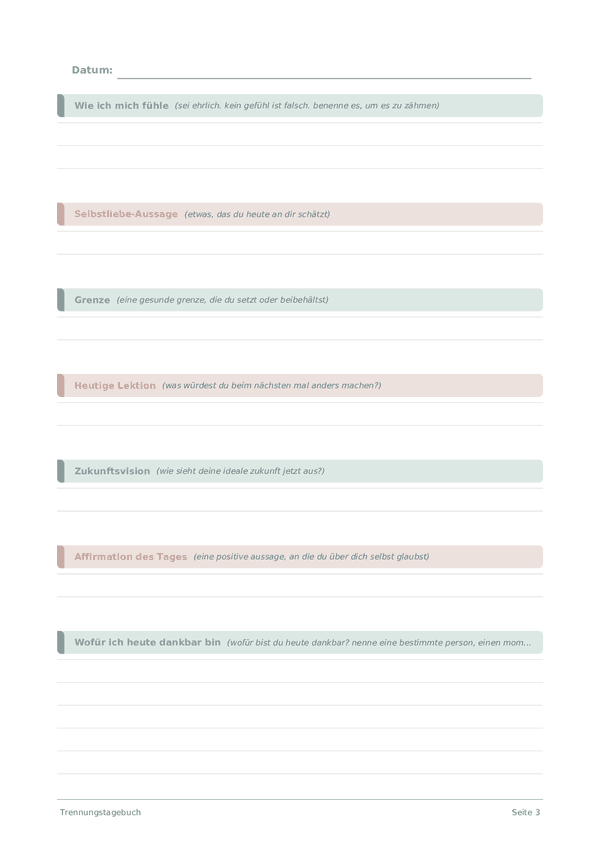
Wie ich mich fühle
Beschreiben Sie in Ihren eigenen Worten, wie Sie sich gerade fühlen. Es gibt keine falschen Antworten. Allein das Aufschreiben von Gefühlen reduziert ihre emotionale Ladung.
Selbstliebe-Aussage
Etwas, das du heute an dir schätzt
Grenze
Eine gesunde Grenze, die du setzt oder beibehältst
Heutige Lektion
Halten Sie eine Erkenntnis aus den heutigen Erfahrungen fest. Im Laufe der Zeit werden diese Lektionen zu einer persönlichen Weisheitsbibliothek.
Zukunftsvision
Wie sieht deine ideale Zukunft jetzt aus?
Affirmation des Tages
Schreiben Sie eine positive Aussage über sich selbst in der Gegenwartsform, als wäre sie bereits wahr. Zum Beispiel: 'Ich bin fähig und belastbar.' Das Wiederholen von Affirmationen formt mit der Zeit Ihre Denkmuster um.
Wofür ich heute dankbar bin
Listen Sie 1–3 Dinge auf, für die Sie heute dankbar sind. Es kann Großes oder Kleines sein — eine gute Mahlzeit, ein freundliches Wort, Sonnenschein. Dankbarkeitsjournaling gehört zu den wissenschaftlich am besten belegten Praktiken für das Wohlbefinden.
Tipps für den Erfolg
Wann und wie oft schreiben
Write daily during the acute phase (first 2–4 weeks), even if entries are short and raw. As the intensity fades, shift to 3–4 times per week, focusing on progress rather than pain. After 2–3 months, weekly entries help you consolidate growth and recognize how far you have come. Stop journaling about the breakup specifically when you notice entries becoming repetitive — that is a sign you have processed the core emotions and are ready to redirect your energy.
Häufig gestellte Fragen
Warum führt das Trennungstagebuch in fester Reihenfolge durch sieben Abschnitte?
Die Sequenz — Gefühle, selbstliebe-Aussage, Grenze, gelernte Lektion, Zukunftsbild, Affirmation, Dankbarkeit — bewegt sich vom Anerkennen über Integration zur Ausrichtung nach vorn. Das passt zur Trauerarbeit, die entgegen den fehlpopularisierten 'Phasen' nach Kübler-Ross nichtlinear ist, aber von strukturiertem Wiedereinstieg profitiert. Russ Harris' ACT With Love (Harris, 2009) verbindet ebenso ehrlichen Kontakt mit schmerzhaften Emotionen und werteorientiertes Handeln.
Was sollte der Gefühlsabschnitt enthalten — nur das Benennen von Emotionen?
Benennen Sie sie konkret und lassen Sie sie nebeneinander stehen. 'Erleichtert, einsam, wütend, beschämt, hoffnungsvoll' in einem Eintrag ist ehrlich, nicht widersprüchlich. Brene Browns Forschung zu emotionaler Granularität (Brown, 2012, Daring Greatly) zeigt: präzises Benennen reduziert die Intensität schwieriger Gefühle. Drei Zeilen reichen — das ist Aufnahme, keine Analyse. Die nächsten Abschnitte arbeiten weiter mit dem, was Sie benannt haben.
Wie schreibe ich ein selbstliebe-Aussage, das sich nicht falsch anfühlt?
Lassen Sie vage Affirmationen weg ('ich bin genug'). Schreiben Sie evidenzbasierte Aussagen: 'Ich war eine verlässliche Partnerin und habe nach Streit repariert' oder 'Ich bin jemand, der Ehrlichkeit gewählt hat, auch wenn sie etwas gekostet hat.' Brene Browns Unterscheidung von Schuld und Scham (Brown, 2012, Daring Greatly) ist relevant — genaue Selbsterkenntnis gelebter Werte baut Wert wieder auf, nicht generisches positives Denken.
Welche Art Grenze gehört in den Grenzen-Abschnitt?
Konkrete, verhaltensbezogene Limits, zu denen Sie sich heute verpflichten: 'Ich schaue diese Woche nicht auf ihren Instagram-Account', 'Ich antworte nicht auf eine-kurze-Frage-Nachrichten', 'Ich bespreche die Beziehung nicht mit gemeinsamen Freunden.' Grenzen sind, was Sie tun, nicht was Sie von anderen verlangen. Behandeln Sie jeden Eintrag als 24-Stunden-Vertrag; längere Verpflichtungen scheitern an Trauerspitzen.
Reicht tägliches Schreiben oder brauche ich nach einer Trennung Therapie?
Das Tagebuch unterstützt bei typischer Trennungstrauer, ist aber keine Traumabehandlung. Bei anhaltenden aufdringlichen Gedanken, wochenlanger Funktionsunfähigkeit im Alltag, Suizidgedanken oder dem Verlassen einer gewalttätigen Beziehung suchen Sie eine lizenzierte Therapeutin auf. Krisenkontakte in Deutschland: Hilfetelefon Gewalt gegen Frauen 08000 116 016 (kostenlos, anonym, 24/7); Telefonseelsorge 0800 111 0 111. Seiten helfen beim Verarbeiten; Therapie behandelt das, was sich nicht von selbst löst.
Wie lange werde ich dieses Tagebuch voraussichtlich brauchen?
Planen Sie 6-12 Wochen nahezu täglicher Einträge als Basis ein; die Häufigkeit sinkt natürlich, sobald Stabilität zurückkehrt. Forschung zur Anpassung nach romantischen Trennungen (Sbarra & Emery, 2005, Personal Relationships, 12(2)) fand: akute emotionale Belastung lässt bei nichtehelichen Trennungen meist innerhalb der ersten acht bis zehn Wochen deutlich nach, bei Ehen länger. Ihre zukunftsvision- und wofür ich heute dankbar bin-Einträge fühlen sich meist zuerst wieder aufrichtig an.
Was, wenn Schreiben mich schlechter statt besser fühlen lässt?
Wenn Sitzungen konsequent dysreguliert enden — über mehr als zwei Wochen — pausieren Sie das Solo-Schreiben und bringen das Material zu einer lizenzierten Therapeutin. Pennebakers Forschung zu expressivem Schreiben (Pennebaker & Beall, 1986, Journal of Abnormal Psychology, 95(3)) zeigt: der Nutzen entsteht über Zeit, aber das Modell setzt Basisregulation voraus. Akutes Traumaschreiben ohne Unterstützung kann Symptome verschärfen. In Krisen Telefonseelsorge 0800 111 0 111.
Wie passt der Dankbarkeits-Abschnitt nach einer schmerzhaften Trennung?
Dankbarkeit hier ist keine Dankbarkeit für die Trennung. Es sind zwei Zeilen über alles, was Sie heute trägt — eine Freundin, die anrief, Ihre Arbeit, Ihren Hund, den Himmel. Forschung zur Dankbarkeitspraxis (Emmons & McCullough, 2003, Journal of Personality and Social Psychology, 84(2)) fand: kurze tägliche Einträge verbessern Wohlbefinden binnen Wochen. Ziel ist, die Aufmerksamkeit auf das Verbliebene zu halten, nicht Frieden vorzutäuschen.
Das könnte Ihnen auch gefallen
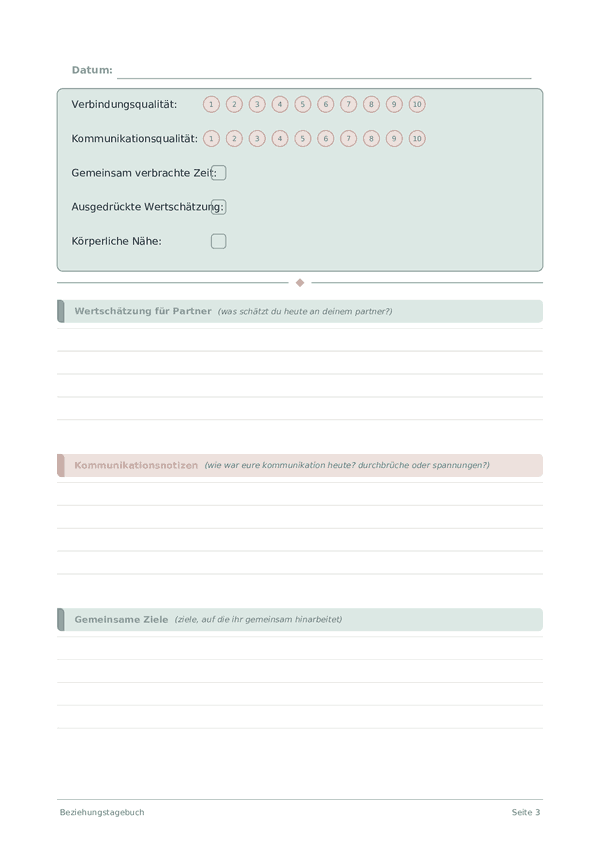
Beziehungstagebuch
Pflegen Sie Ihre Bindung durch tägliche Reflexion und bewusste Verbindung
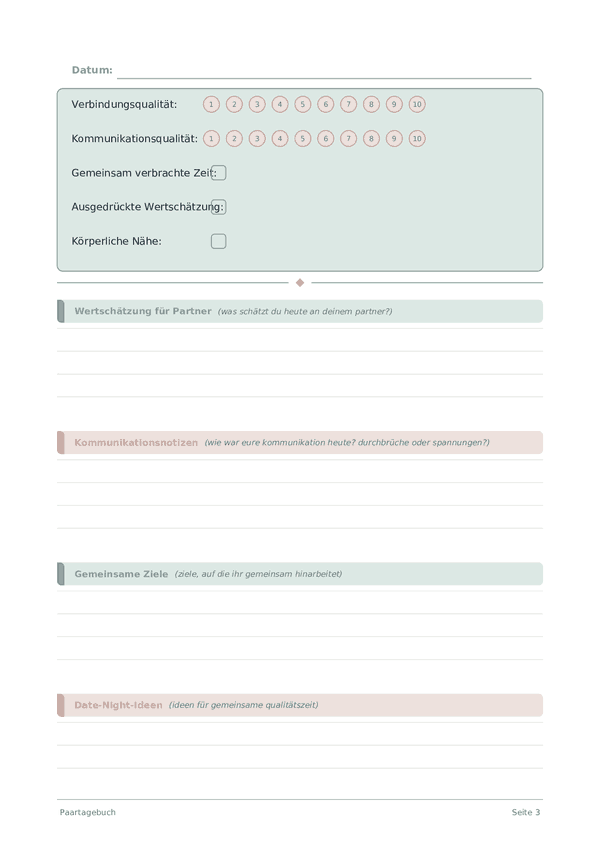
Paartagebuch
Stärken Sie Ihre Bindung mit täglichem Verbindungstracking
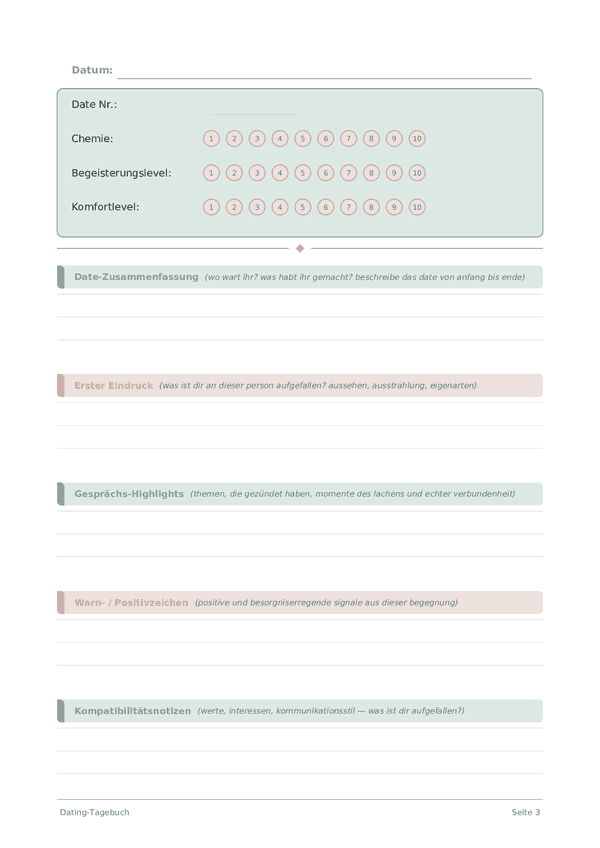
Dating-Tagebuch
Dates verfolgen, Chemie bewerten und herausfinden, was Sie wirklich wollen
Familientagebuch
Halten Sie die täglichen Momente und Erinnerungen Ihrer Familie fest
Scrollen zum Zoomen, ziehen zum Bewegen