Printable Elterntagebuch
Genießen Sie jeden Moment Ihrer Elternreise
A daily journal designed for parents to reflect on their emotional state, track quality time with their child, celebrate milestones, and grow through the beautiful challenges of parenthood. Five minutes a day can transform your relationship with your child and yourself.
Felder anpassen
Schalten Sie Felder ein oder aus. Klicken Sie auf den Stift zum Umbenennen oder fügen Sie eigene Felder hinzu.
Vorteile
Anleitung
Was ist dieses Journal?
A parenting journal is a daily practice for tracking your own well-being as a parent while documenting your child's growth, milestones, and the moments that matter. By monitoring your mood, energy, and patience alongside reflective writing about highlights and proud moments, you create a more conscious parenting practice.
This journal is for parents at any stage — from the sleep-deprived newborn phase to the complex teenage years. It serves both as a self-care tool that helps you notice when you are running on empty and as a memory book that captures the fleeting details of your child's development that you think you will remember but often forget.
Parenting research shows that self-aware parents — those who regularly reflect on their emotions and reactions — are more likely to respond thoughtfully rather than react impulsively. This journal builds that reflective capacity while simultaneously creating a treasure trove of memories you will be grateful to have when your children are grown.
Ausgefülltes Beispiel
So sieht ein typischer Eintrag aus, wenn er ausgefüllt ist:
Wie Sie jedes Feld ausfüllen
Oben auf jeder Seite befinden sich schnell ausfüllbare Felder (Bewertungen, Kontrollkästchen, Zahlen). Darunter ist ein linierter Bereich zum Schreiben. Hier erfahren Sie, was jedes Feld bedeutet:
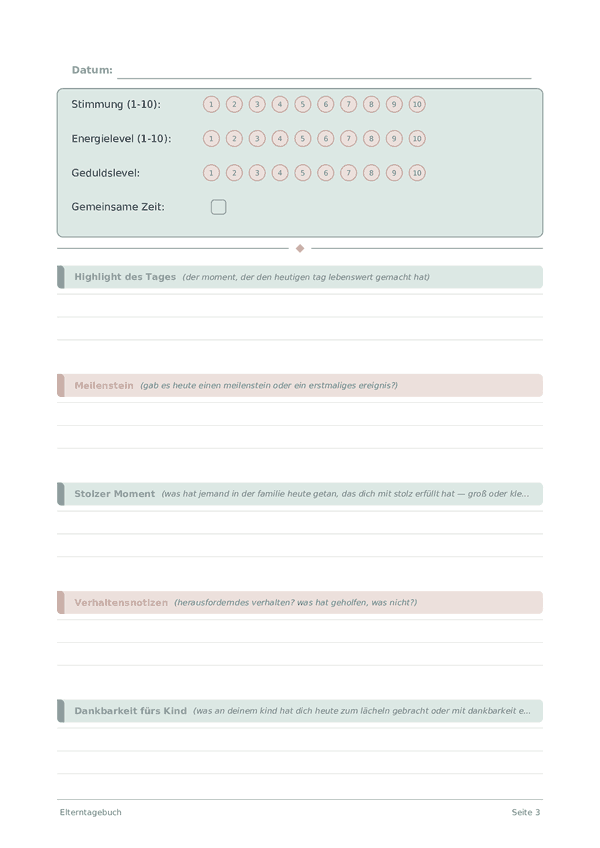
Stimmung (1-10)
Bewerten Sie Ihren allgemeinen emotionalen Zustand für den Tag. 1 bedeutet sehr niedergeschlagen oder deprimiert, 10 bedeutet außergewöhnlich glücklich und positiv. Denken Sie nicht zu lange nach — vertrauen Sie Ihrem Bauchgefühl.
Energielevel (1-10)
Bewerten Sie Ihr körperliches und geistiges Energieniveau. 1 bedeutet erschöpft und ausgelaugt, 10 bedeutet voller Energie und wach. Dies hilft Ihnen zu erkennen, welche Aktivitäten Ihre Energie steigern oder verbrauchen.
Geduldslevel
Wie geduldig warst du heute mit deinem Kind? Bewerte von 1 (schwierig) bis 10 (gelassen)
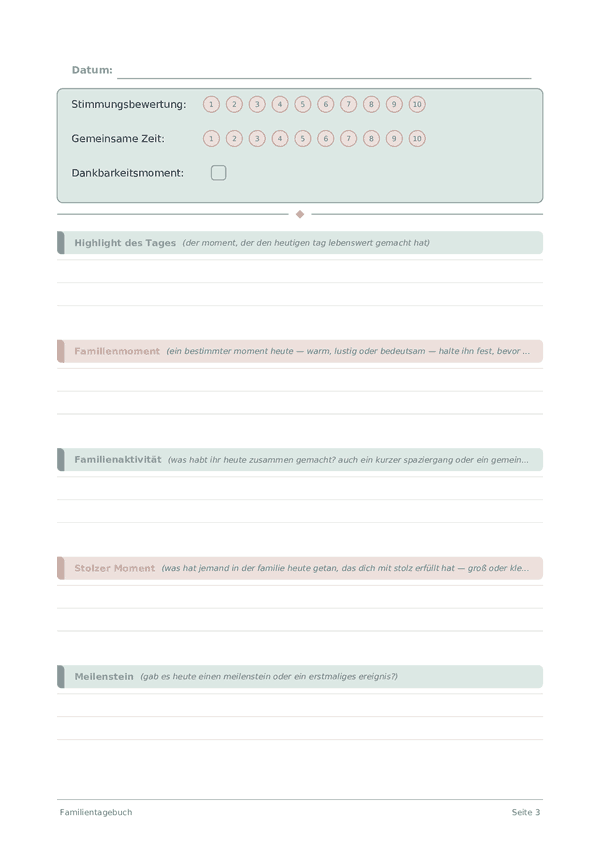
Gemeinsame Zeit
Hattest du heute bewusste, aufmerksame Zeit mit deinem Kind? Beschreibe sie kurz
Highlight des Tages
Was war das Beste an Ihrem Tag? Halten Sie den Moment fest, der den heutigen Tag lebenswert gemacht hat. Diese Highlights werden zu einer Sammlung Ihrer schönsten Erinnerungen.
Meilenstein
Gab es heute einen Meilenstein oder ein erstmaliges Ereignis?
Stolzer Moment
Was hat jemand in der Familie heute getan, das dich mit Stolz erfüllt hat — groß oder klein
Verhaltensnotizen
Herausforderndes Verhalten? Was hat geholfen, was nicht?
Dankbarkeit fürs Kind
Was an deinem Kind hat dich heute zum Lächeln gebracht oder mit Dankbarkeit erfüllt?
Notizen
Fügen Sie zusätzlichen Kontext oder Gedanken hinzu. Diese Auffangspalte ist für alles, was nirgendwo anders hinpasst, aber später nützlich sein könnte.
Tipps für den Erfolg
Wann und wie oft schreiben
Write at least 3 times per week, ideally after the children are in bed when you can reflect calmly. Brief entries work fine on hectic days — even two sentences about what went well. Weekly, do a longer entry assessing the overall emotional climate at home. During particularly challenging phases (sleep regressions, school transitions, behavioral shifts), daily entries help you stay grounded and notice when things start improving.
Häufig gestellte Fragen
Warum erfasst das Erziehungstagebuch Geduld und Energie neben der Stimmung?
Geduld und Energie sind die Ressourcenhebel des Elternteils, nicht das Verhalten des Kindes. Daniel Siegels Konzept der interpersonalen Neurobiologie (Siegel, 2011, The Whole-Brain Child) betont: elterliche Regulation steuert die Ko-Regulation des Kindes — ein erschöpfter Elternteil kann Ruhe nicht modellieren. Tägliche Bewertungen von Geduld und Energie legen Burnout-Trajektorien offen, bevor sie 'ich habe geschrien und weiß nicht warum' erreichen — vage Erschöpfung wird messbares Signal.
Was zählt für das gemeinsame Zeit-Häkchen?
Fokussierte, ungeteilte Zeit mit Ihrem Kind — kein Handy, kein halbes Zuhören. Die AAP-Empfehlungen zu Mediennutzung und Familienzeit (vergleichbar: deutsche Empfehlungen der BZgA) betonen elterliche Präsenz über Dauer; zehn handyfreie Minuten in einer vom Kind gewählten Aktivität schlagen eine Stunde abgelenktes Parallelspiel. Das binäre Häkchen verhindert, kurze Mitanwesenheit zu 'qualitativer Zeit' aufzublasen, die es nicht war.
Soll ich auch an Tagen schreiben, an denen ich mich als schlechter Elternteil fühlte?
Besonders dann. Tage mit Geduld 3/10 sind diagnostische Daten, kein Versagen. Brene Browns Forschung zu Scham versus Schuld (Brown, 2012, Daring Greatly) trennt 'ich habe etwas Schweres getan' von 'ich bin schlecht' — das Festhalten des konkreten Moments in verhaltensnotizen verhindert, dass Scham einen rauen Nachmittag zur Identität verallgemeinert. Muster über harte Tage zeigen oft einen behebbaren Auslöser: Schlaf, Hunger, Übergänge, Bildschirmüberlastung.
Wie unterscheidet sich milestone von stolzer Moment in dieser Vorlage?
Milestones sind entwicklungsrelevante Premieren und Übergänge (erste Worte, Radfahren, selbständiges Lesen, Schulbeginn) — Marker, die Kinderärzte nutzen (AAP-Leitlinie zur Entwicklungsüberwachung; vergleichbar BVKJ und deutsche U-Untersuchungen). Proud moments sind charakterliche Einblicke: Ihr Kind entschuldigte sich unaufgefordert, verteidigte ein kleineres Kind, blieb dran in der Frustration. Milestones erfassen 'was' Kinder können; proud moments erfassen 'wer' sie werden.
Reicht das Tagebuchführen oder muss ich auch Erziehungsbücher lesen?
Das Tagebuch ist Reflexion über die Praxis, nicht die Praxis selbst. Kombinieren Sie es mit evidenzbasierten Rahmen: Faber und Mazlishs Kommunikationswerkzeugen (Faber & Mazlish, 1980, How to Talk So Kids Will Listen), Baumrinds Forschung zu autoritativer Erziehung (Baumrind, 1967, Genetic Psychology Monographs, 75) und Siegels Whole-Brain-Ansatz (Siegel, 2011, The Whole-Brain Child). Das Tagebuch hilft zu sehen, ob Gelesenes im Alltag tatsächlich ankommt.
Was, wenn meine Geduldswerte dauerhaft bei 4 oder darunter liegen?
Anhaltend niedrige Geduld signalisiert ein Systemproblem, kein Willensproblem. Prüfen Sie energy und gemeinsame Zeit: chronisch niedrige Energie deutet auf Schlaf, Partnerlast oder unbearbeiteten Elternstress. Geduldsabfälle postpartal oder perimenopausal sollten ärztlich abgeklärt werden. Bei Reizbarkeit mit Hoffnungslosigkeit oder aufdringlichen Gedanken über Schaden wenden Sie sich umgehend an eine Fachperson; Notruf 112 oder Telefonseelsorge 0800 111 0 111 — Tagebuchwerte ersetzen keine klinische Einschätzung.
Wie nutze ich verhaltensnotizen konstruktiv, ohne mein Kind zu etikettieren?
Schreiben Sie Verhalten plus Kontext: 'Zusammenbruch um 17 Uhr, Snack ausgefallen, Übergang vom Bildschirm.' Faber und Mazlish (Faber & Mazlish, 1980, How to Talk So Kids Will Listen) und AAP-Leitlinien betonen beide: Verhalten beschreiben, nicht das Kind ('er hat geschlagen', nicht 'er ist aggressiv'). Notizen über Wochen offenbaren Vorbedingungen — Hunger, Schlafdefizit, sensorische Überlast — die sich planerisch umgehen lassen.
Wann sollte die Wochenauswertung Anlass zur fachlichen Abklärung sein?
Bringen Sie Daten zur Kinderärztin oder Kinderpsychologin, wenn Sie sehen: anhaltende Regression bei Meilensteinen, deutliche Verhaltensänderungen über Wochen, Ihre eigene Geduld oder Stimmung an den meisten Tagen bei 3/10, oder Gedanken an Schaden gegen sich selbst oder das Kind. Bei pädiatrischen Notfällen Notruf 112; für Kinder und Jugendliche Nummer gegen Kummer 116 111, für Eltern 0800 111 0 550. Ihre Einträge machen den Termin konkret — lassen Sie Dokumentation den Anruf nicht verzögern.
Das könnte Ihnen auch gefallen
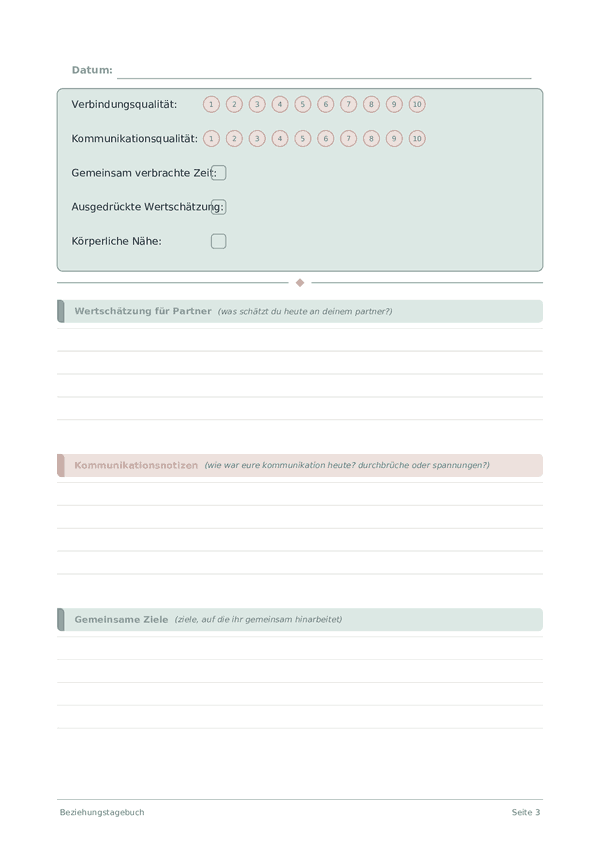
Beziehungstagebuch
Pflegen Sie Ihre Bindung durch tägliche Reflexion und bewusste Verbindung
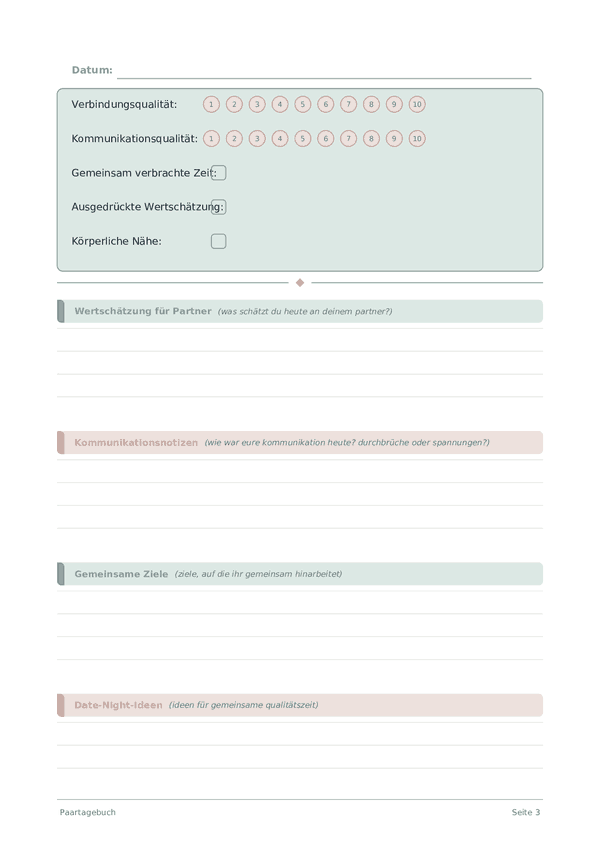
Paartagebuch
Stärken Sie Ihre Bindung mit täglichem Verbindungstracking
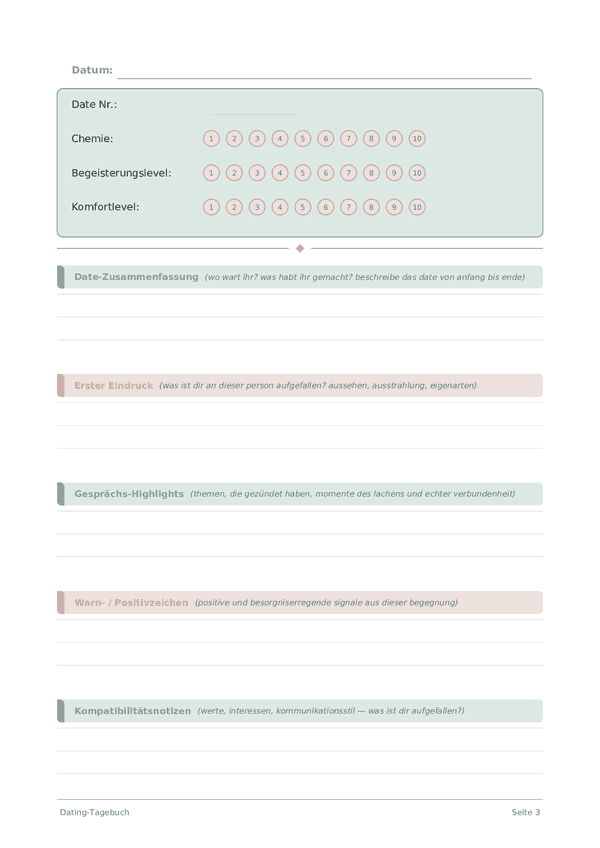
Dating-Tagebuch
Dates verfolgen, Chemie bewerten und herausfinden, was Sie wirklich wollen
Familientagebuch
Halten Sie die täglichen Momente und Erinnerungen Ihrer Familie fest
Scrollen zum Zoomen, ziehen zum Bewegen