Printable Breakup Journal
Heal, grow, and rebuild yourself after heartbreak
Navigate the emotional journey of heartbreak with a structured daily journal rooted in self-compassion and healing psychology. Each entry guides you through naming your feelings, affirming your worth, setting protective boundaries, extracting wisdom from the experience, and building a vision of your thriving future.
Personalizar campos
Activa o desactiva campos. Haz clic en el lápiz para renombrar, o añade tus propios campos.
Beneficios
Cómo Usar
¿Qué es este diario?
A breakup journal is a guided daily practice for navigating the emotional aftermath of ending a relationship. Each entry creates space for processing difficult feelings while deliberately building self-love, setting boundaries, and envisioning your future — transforming grief into growth.
This journal is for anyone going through a breakup, divorce, or the end of a significant relationship. Whether it was your decision or not, the loss of a partnership reshapes your identity and daily life. This journal provides structure during a time when everything feels unstructured.
Research on post-breakup recovery shows that expressive writing significantly reduces emotional distress and speeds healing. The key is not just venting — it is the structured reflection that combines emotional processing with forward-looking elements like self-affirmation and future visioning. People who journal through breakups report feeling "themselves again" 40% sooner than those who do not.
Ejemplo completado
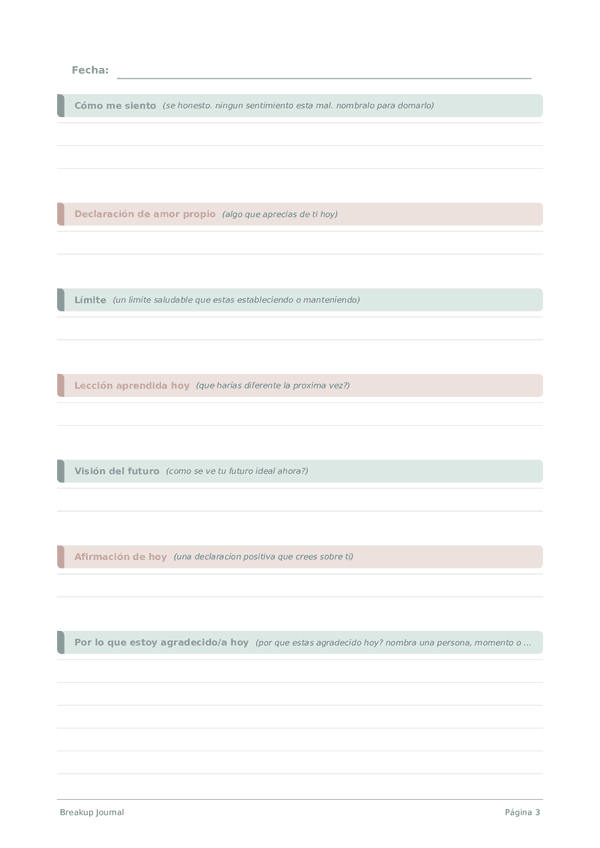
Así es como se ve una entrada típica cuando se rellena:
Cómo rellenar cada campo
Cada dia encontraras varias secciones etiquetadas con lineas para escribir. Esto es lo que significa cada seccion:
Cómo me siento
Describe como te sientes ahora mismo con tus propias palabras. No hay respuestas incorrectas. Simplemente poner los sentimientos en papel reduce su carga emocional.
Declaración de amor propio
Algo que aprecias de ti hoy
Límite
Un limite saludable que estas estableciendo o manteniendo
Lección aprendida hoy
Captura una leccion de la experiencia de hoy. Con el tiempo, estas lecciones se convierten en una biblioteca de sabiduria personal.
Visión del futuro
Como se ve tu futuro ideal ahora?
Afirmación de hoy
Escribe una declaracion positiva sobre ti en tiempo presente, como si ya fuera verdad. Por ejemplo: 'Soy capaz y resiliente.' Repetir afirmaciones reprograma tus patrones de pensamiento con el tiempo.
Por lo que estoy agradecido/a hoy
Enumera de 1 a 3 cosas por las que estas agradecido hoy. Pueden ser grandes o pequenas: una buena comida, una palabra amable, el sol. El diario de gratitud es una de las practicas de bienestar con mayor respaldo cientifico.
Consejos para el exito
Cuando y con que frecuencia escribir
Write daily during the acute phase (first 2–4 weeks), even if entries are short and raw. As the intensity fades, shift to 3–4 times per week, focusing on progress rather than pain. After 2–3 months, weekly entries help you consolidate growth and recognize how far you have come. Stop journaling about the breakup specifically when you notice entries becoming repetitive — that is a sign you have processed the core emotions and are ready to redirect your energy.
Preguntas frecuentes
¿Por qué el Diario de Ruptura guía a través de siete secciones en un orden fijo?
La secuencia —sentimientos, declaración de amor propio, límite, lección aprendida, visión de futuro, afirmación, gratitud— va del reconocimiento a la integración y luego a la orientación hacia adelante. Esto coincide con el trabajo de duelo que, al contrario de las «etapas» mal popularizadas de Kübler-Ross, es no lineal pero se beneficia de una reentrada estructurada. Russ Harris en ACT With Love (Harris, 2009) combina también el contacto honesto con emociones dolorosas y la acción comprometida hacia los valores.
¿Qué debe incluir la sección de sentimientos, solo nombrar emociones?
Nómbralos con precisión y permíteles coexistir. «Alivio, soledad, furia, vergüenza, esperanza» en una misma entrada es honestidad, no contradicción. La investigación de Brené Brown sobre la granularidad emocional (Brown, 2012, Daring Greatly) muestra que nombrar con precisión reduce la intensidad de las emociones difíciles. Tres líneas son suficientes —esto es captación inicial, no análisis—. Las secciones siguientes hacen el trabajo de avanzar con lo que nombraste.
¿Cómo escribir un declaración de amor propio que no suene falso?
Evita las afirmaciones vagas («soy suficiente»). Escribe afirmaciones basadas en evidencias: «fui una pareja estable que reparaba después de las peleas» o «soy alguien que eligió la honestidad aunque me costara». La distinción de Brené Brown entre culpa y vergüenza (Brown, 2012, Daring Greatly) es relevante: lo que reconstruye el valor es el reconocimiento preciso de los valores vividos en momentos difíciles, no el pensamiento positivo genérico.
¿Qué tipo de límite pertenece a la sección de límites?
Límites concretos a nivel de comportamiento que te comprometes a mantener hoy: «No voy a mirar su Instagram esta semana», «No voy a responder a mensajes de 'solo una pregunta'», «No voy a hablar de la relación con amigos en común». Los límites son lo que tú haces, no lo que les pides a ellos que hagan. Trata cada entrada como un contrato de 24 horas; los compromisos más largos fracasan cuando el duelo se intensifica.
¿Es suficiente el diario o necesito terapia después de una ruptura?
El diario apoya la recuperación de un duelo de ruptura habitual, pero no es tratamiento para el trauma. Si experimentas pensamientos intrusivos persistentes, incapacidad para funcionar durante semanas, ideación suicida, o estás saliendo de una relación abusiva, consulta a un terapeuta con licencia. En España: **016** (gratuito, 24 h); en México: **800 911 2000**; en Argentina: **144**. Las páginas ayudan a metabolizar; la terapia trata lo que no se metaboliza solo.
¿Cuánto tiempo necesitaré este diario?
Planifica entre 6 y 12 semanas de entradas casi diarias como punto de partida, con una frecuencia que disminuye naturalmente a medida que vuelve la estabilidad. La investigación sobre la adaptación tras una ruptura romántica (Sbarra & Emery, 2005, Personal Relationships, 12(2)) encontró que la mayor parte del malestar emocional agudo se reduce de forma considerable en las primeras ocho a diez semanas para rupturas no matrimoniales; más tiempo en caso de matrimonios. Las entradas de visión del futuro y por lo que estoy agradecido/a hoy suelen ser las primeras en volver a sentirse sinceras.
¿Qué pasa si escribir me hace sentir peor en lugar de mejor?
Si las sesiones terminan consistentemente con mayor desregulación que al empezar —durante más de dos semanas— esa es la señal para pausar el diario en solitario y llevar el material a un terapeuta con licencia. La investigación de escritura expresiva de Pennebaker (Pennebaker & Beall, 1986, Journal of Abnormal Psychology, 95(3)) muestra que los beneficios emergen con el tiempo, pero el modelo asume una regulación de base. Escribir sobre trauma agudo sin apoyo puede empeorar los síntomas.
¿Es apropiada la sección de gratitud después de una ruptura dolorosa?
La gratitud aquí no es gratitud por la ruptura. Son dos líneas sobre cualquier cosa que te sostenga hoy: un amigo que llamó, tu trabajo, tu perro, el cielo. La investigación sobre la práctica de gratitud (Emmons & McCullough, 2003, Journal of Personality and Social Psychology, 84(2)) encontró que las breves entradas diarias mejoraron el bienestar en pocas semanas. El objetivo es mantener la atención en lo que permanece, no fingir una paz a la que todavía no has llegado.
También Te Puede Gustar
Rueda para ampliar, arrastra para mover