Printable Dream Journal
Record and analyze your dreams
Write down dreams immediately upon waking to capture details. Over time, patterns emerge that offer insight into your subconscious mind.
Personalizar campos
Activa o desactiva campos. Haz clic en el lápiz para renombrar, o añade tus propios campos.
Beneficios
Cómo Usar
¿Qué es este diario?
A dream journal is a daily practice of recording and interpreting your dreams immediately upon waking. By capturing the narrative, emotions, symbols, and personal connections of each dream, you access a rich layer of your psyche that is usually lost within minutes of opening your eyes.
This journal is for anyone curious about their inner life — whether you approach dreams from a psychological, spiritual, or purely creative perspective. Writers, artists, and therapists have long used dream journals as a source of insight. If you rarely remember dreams, the simple act of placing this journal by your bed and intending to record signals your brain to retain more dream content.
Neuroscience research confirms that dreaming plays a crucial role in emotional processing, memory consolidation, and creative problem-solving. Carl Jung called dreams "the royal road to the unconscious." Consistent dream journaling has been shown to increase dream recall by up to 300% and provides patterns that reveal ongoing emotional themes your waking mind may be avoiding.
Ejemplo completado
Así es como se ve una entrada típica cuando se rellena:
Cómo rellenar cada campo
Cada dia encontraras varias secciones etiquetadas con lineas para escribir. Esto es lo que significa cada seccion:
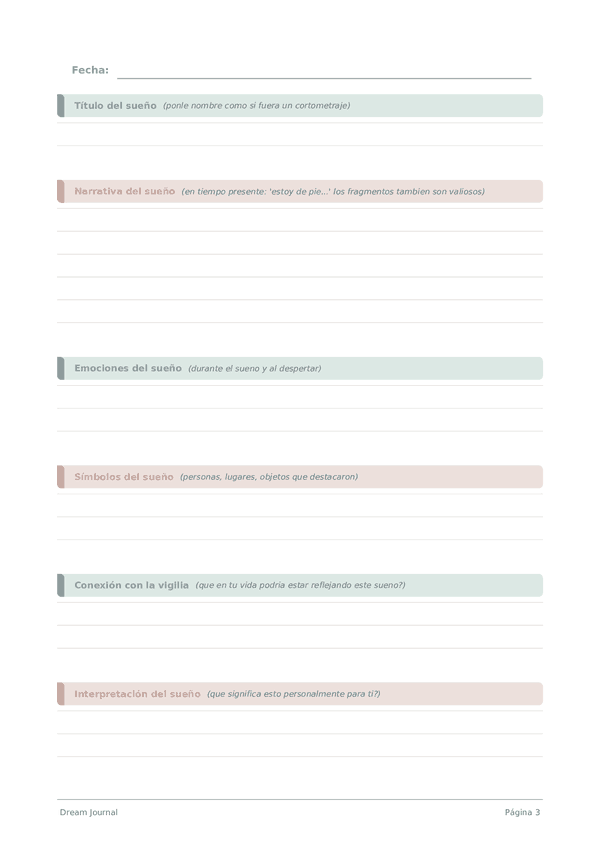
Título del sueño
Ponle nombre como si fuera un cortometraje
Narrativa del sueño
En tiempo presente: 'Estoy de pie...' Los fragmentos tambien son valiosos
Emociones del sueño
Durante el sueno y al despertar
Símbolos del sueño
Personas, lugares, objetos que destacaron
Conexión con la vigilia
Que en tu vida podria estar reflejando este sueno?
Interpretación del sueño
Que significa esto personalmente para ti?
Consejos para el exito
Cuando y con que frecuencia escribir
Write every morning without exception, even if you only remember a fragment or a feeling. Keep your journal and pen within arm’s reach of your bed. The act of consistent recording trains your brain to retain dreams — most people notice significantly improved dream recall within 2 weeks of daily journaling. If you remember nothing, write that fact and any mood you woke with. Weekend mornings with natural waking (no alarm) often yield the richest dream material.
Preguntas frecuentes
¿Qué captura el Diario de Sueños?
Seis secciones estructuradas —título del sueño, narrativa del sueño (seis líneas), emociones del sueño, símbolos del sueño, conexión con la vigilia y interpretación del sueño— capturan tanto el contenido del sueño como tu reflexión sobre él. Escribir inmediatamente al despertar es esencial porque el recuerdo de los sueños se desvanece en minutos desde el despertar completo, un hallazgo observado de forma consistente en la investigación sobre el sueño y la memoria durante varias décadas.
¿Llevar un diario de sueños mejora realmente el recuerdo?
Sí. La mejora del recuerdo de los sueños mediante el diario deliberado está bien documentada en la investigación del sueño; escribir por la mañana de forma constante entrena la atención a los sueños y fortalece su consolidación en la memoria. El campo narrativa del sueño proporciona seis líneas para capturar incluso los recuerdos fragmentarios. Mantén el diario al alcance de la cama y escribe antes de mirar el teléfono, que desplaza las huellas de los sueños con nueva información.
¿Cómo uso el campo símbolos del sueño?
Anota las imágenes recurrentes —personas, objetos, lugares, animales— sin forzar un significado. Los diccionarios de sueños dan interpretaciones genéricas que a menudo ignoran tus asociaciones personales. El enfoque de Carl Jung (y de los investigadores modernos que lo siguen) subraya la amplificación personal: pregúntate qué significa el símbolo en tu vida, no lo que dice un libro. Registra los símbolos en bruto aquí; reserva la interpretación para el campo interpretación del sueño.
¿Es científicamente fiable la interpretación de los sueños?
Las interpretaciones específicas no están validadas científicamente: no existe evidencia revisada por pares de que los sueños codifiquen mensajes universales ocultos descifrables por ningún diccionario. Sin embargo, los sueños reflejan de forma fiable las preocupaciones emocionales actuales y el procesamiento de la memoria (la hipótesis de continuidad, bien establecida en la literatura de investigación del sueño). Trata interpretación del sueño como reflexión personal, útil para el autoconocimiento y para observar patrones a lo largo del tiempo.
¿En qué se diferencia conexión con la vigilia de interpretación del sueño?
Conexión con la vigilia anota los vínculos literales: una persona que apareció, un lugar que visitaste ayer, una conversación reciente o un evento del día. Interpretación del sueño es tu significado especulativo del sueño. La distinción importa: las conexiones son hechos observables que a menudo explican el sueño a través del residuo diurno; las interpretaciones son subjetivas y especulativas. Tres líneas cada uno es suficiente; separarlos evita sobreleer el sueño.
¿Puede este diario ayudar con las pesadillas o los sueños angustiantes recurrentes?
El diario puede apoyar la autoconciencia, pero las pesadillas persistentes —especialmente tras un trauma— requieren atención clínica. La Terapia de Ensayo de Imágenes es un tratamiento basado en evidencias para las pesadillas crónicas (recomendada por la American Academy of Sleep Medicine para las pesadillas relacionadas con el TEPT). Usa este diario junto a, no en lugar de, la atención profesional si las pesadillas perturban el sueño regularmente.
¿Cuál es el error más habitual entre los nuevos usuarios?
Intentar recordar el sueño antes de escribir. El recuerdo se desvanece en segundos tras el despertar completo. Escribe el narrativa del sueño de inmediato, incluso fragmentos inconexos, luego rellena emociones, símbolos y conexiones. El título del sueño puede añadirse al final. Evita también mirar el teléfono primero: los nuevos estímulos sobreescriben las frágiles huellas del sueño y el resto de la entrada quedará vacío.
¿Cuánto tiempo tarda en aparecer patrones en mis sueños?
Dos a cuatro semanas de entradas diarias suelen revelar símbolos, escenarios o tonos emocionales recurrentes. El campo símbolos del sueño es el principal lugar donde emergen los patrones: anota cuándo regresa la misma imagen. La revisión semanal a través de las seis secciones revela conexiones entre las preocupaciones diurnas y el contenido de los sueños. Esto es práctica reflexiva; los trastornos clínicos del sueño deben ser evaluados por un profesional de salud.
También Te Puede Gustar
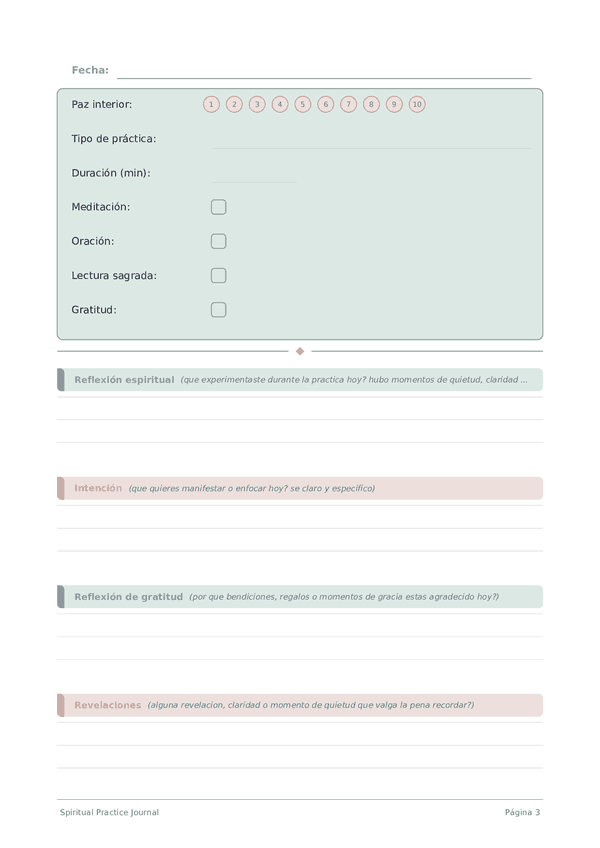
Spiritual Practice Journal
Nurture your inner life with daily practice and reflection
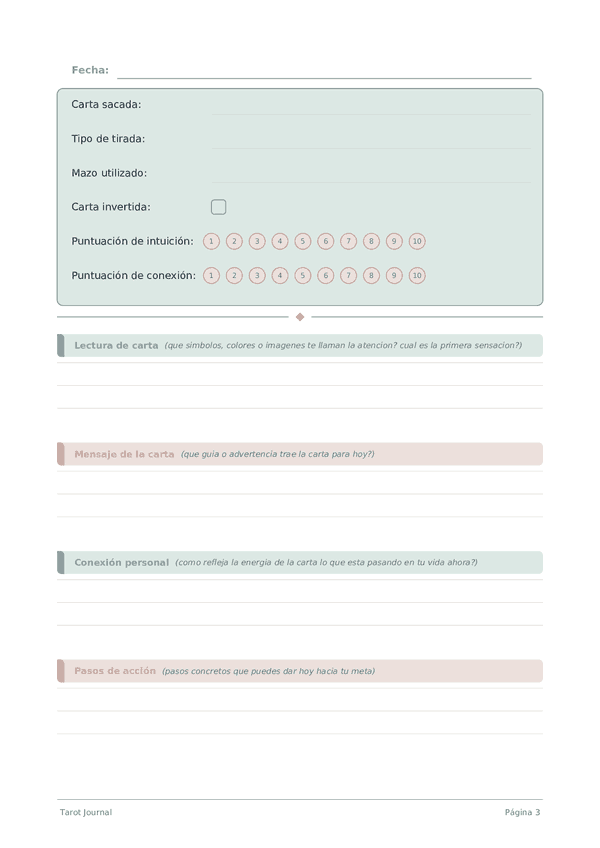
Tarot Journal
Track daily card draws, spreads, and intuitive insights
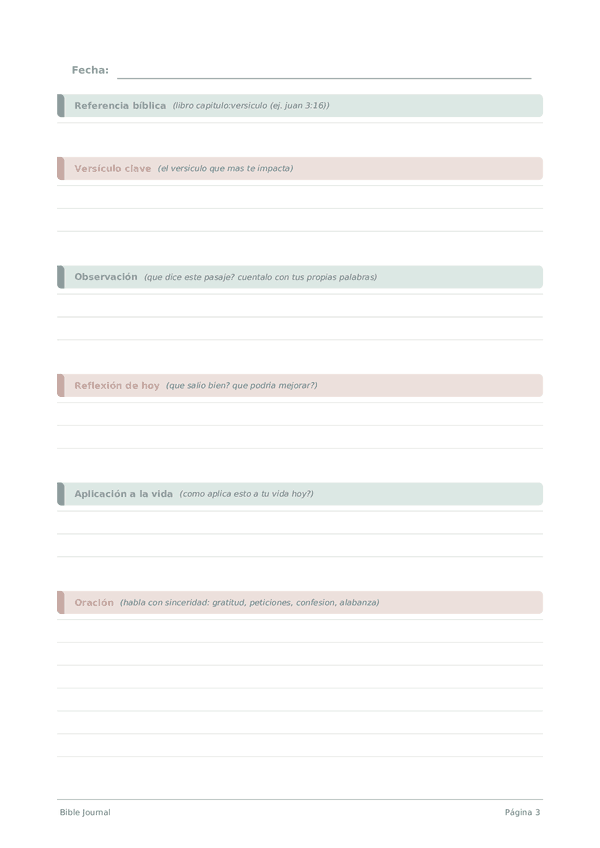
Bible Journal
Scripture, Observation, Application, Prayer — the SOAP method
Moon Journal
Align with the lunar cycle — track, reflect, and release
Rueda para ampliar, arrastra para mover