Printable Parenting Journal
Cherish every moment of your parenting journey
A daily journal designed for parents to reflect on their emotional state, track quality time with their child, celebrate milestones, and grow through the beautiful challenges of parenthood. Five minutes a day can transform your relationship with your child and yourself.
Personalizar campos
Activa o desactiva campos. Haz clic en el lápiz para renombrar, o añade tus propios campos.
Beneficios
Cómo Usar
¿Qué es este diario?
A parenting journal is a daily practice for tracking your own well-being as a parent while documenting your child's growth, milestones, and the moments that matter. By monitoring your mood, energy, and patience alongside reflective writing about highlights and proud moments, you create a more conscious parenting practice.
This journal is for parents at any stage — from the sleep-deprived newborn phase to the complex teenage years. It serves both as a self-care tool that helps you notice when you are running on empty and as a memory book that captures the fleeting details of your child's development that you think you will remember but often forget.
Parenting research shows that self-aware parents — those who regularly reflect on their emotions and reactions — are more likely to respond thoughtfully rather than react impulsively. This journal builds that reflective capacity while simultaneously creating a treasure trove of memories you will be grateful to have when your children are grown.
Ejemplo completado
Así es como se ve una entrada típica cuando se rellena:
Cómo rellenar cada campo
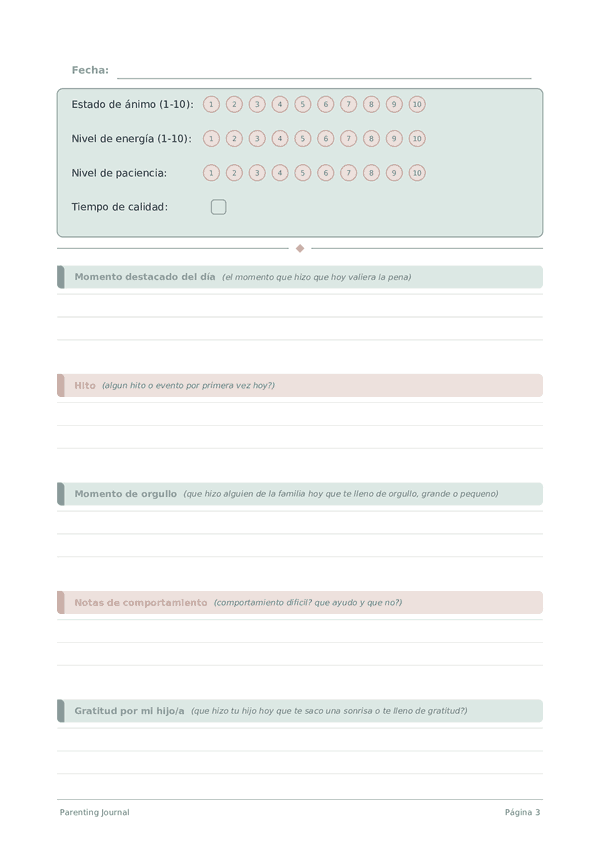
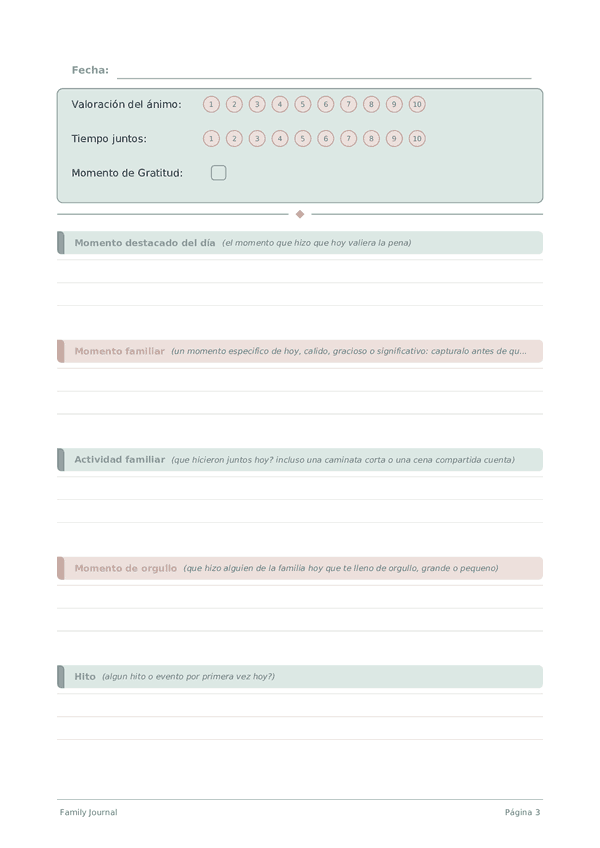
La parte superior de cada pagina tiene campos de llenado rapido (calificaciones, casillas, numeros). Debajo hay una seccion con lineas para escribir. Esto es lo que significa cada campo:
Estado de ánimo (1-10)
Califica tu estado emocional general del dia. 1 significa muy bajo o deprimido, 10 significa excepcionalmente feliz y positivo. No lo pienses demasiado: ve con tu instinto.
Nivel de energía (1-10)
Califica tu nivel de energia fisica y mental. 1 significa agotado y sin fuerzas, 10 significa totalmente energizado y alerta. Esto te ayuda a identificar que actividades aumentan o agotan tu energia.
Nivel de paciencia
Que tan paciente fuiste con tu hijo hoy? Califica del 1 (con dificultad) al 10 (en calma)
Tiempo de calidad
Tuviste tiempo enfocado y presente con tu hijo hoy? Describelo brevemente
Momento destacado del día
Cual fue lo mejor de tu dia? Captura el momento que hizo que hoy valiera la pena. Estos momentos destacados se convierten en una coleccion de tus recuerdos mas felices.
Hito
Algun hito o evento por primera vez hoy?
Momento de orgullo
Que hizo alguien de la familia hoy que te lleno de orgullo, grande o pequeno
Notas de comportamiento
Comportamiento dificil? Que ayudo y que no?
Gratitud por mi hijo/a
Que hizo tu hijo hoy que te saco una sonrisa o te lleno de gratitud?
Notas
Agrega cualquier contexto o pensamiento adicional. Esta columna general es para cualquier cosa que no encaje en otro lugar pero pueda ser util despues.
Consejos para el exito
Cuando y con que frecuencia escribir
Write at least 3 times per week, ideally after the children are in bed when you can reflect calmly. Brief entries work fine on hectic days — even two sentences about what went well. Weekly, do a longer entry assessing the overall emotional climate at home. During particularly challenging phases (sleep regressions, school transitions, behavioral shifts), daily entries help you stay grounded and notice when things start improving.
Preguntas frecuentes
¿Por qué el Diario de Crianza registra la paciencia y la energía junto con el estado de ánimo?
La paciencia y la energía son los recursos del progenitor, no el comportamiento del hijo. El marco de neurobiología interpersonal de Daniel Siegel (Siegel, 2011, The Whole-Brain Child) subraya que la regulación parental impulsa la corregulación del niño: un progenitor agotado no puede modelar la calma. Valorar diariamente la paciencia y la energía permite detectar trayectorias de agotamiento antes de llegar al «grité y no sé por qué».
¿Qué cuenta como tiempo de calidad para la casilla?
Tiempo de atención plena con su hijo, sin teléfono ni escucha a medias. Las recomendaciones de la AAP sobre uso de medios y tiempo en familia enfatizan sistemáticamente la presencia parental por encima de la duración; diez minutos sin teléfono en una actividad elegida por el niño supera a una hora de juego paralelo con distracciones. La casilla binaria impide inflar una breve coexistencia a «tiempo de calidad» que no lo fue.
¿Debo escribir entradas incluso en los días en que me sentí mal como padre/madre?
Especialmente entonces. Los días con paciencia de 3/10 son datos diagnósticos, no fracasos. La investigación de Brené Brown sobre vergüenza frente a culpa (Brown, 2012, Daring Greatly) distingue «hice algo difícil» de «soy malo»: anotar el momento concreto en notas de comportamiento impide que la vergüenza generalice una tarde dura como identidad. Los patrones en los días difíciles suelen señalar un desencadenante corregible: sueño, hambre, transiciones, exceso de pantallas.
¿En qué se diferencia milestone de momento de orgullo en esta plantilla?
Los milestones son primeras veces y transiciones significativas para el desarrollo (primeras palabras, montar en bici, leer de forma independiente, empezar la escuela), hitos que los pediatras usan como marcadores (guía de vigilancia del desarrollo de la AAP). Los proud moments son destellos de carácter: su hijo se disculpó sin que se lo pidieran, defendió a un niño menor, persistió ante la frustración. Los milestones registran el «qué» puede hacer el niño; los proud moments, el «quién» está siendo.
¿Es suficiente el diario o también hay que leer libros de crianza?
El diario es reflexión sobre la práctica, no la práctica en sí. Combínelo con marcos basados en evidencia: las herramientas de comunicación de Faber y Mazlish (Faber & Mazlish, 1980, How to Talk So Kids Will Listen), la investigación sobre crianza autoritativa de Baumrind (Baumrind, 1967, Genetic Psychology Monographs, 75) y el enfoque de cerebro completo de Siegel (Siegel, 2011, The Whole-Brain Child). El diario le permite ver si lo leído aparece realmente en su día a día.
¿Qué hacer si la puntuación de paciencia es consistentemente 4 o inferior?
La paciencia persistentemente baja indica un problema sistémico, no de voluntad. Revise las entradas de energía y tiempo de calidad: la energía crónicamente baja apunta al sueño, la carga de la pareja o el estrés parental no atendido. Las caídas de paciencia en el posparto o la perimenopausia requieren seguimiento médico. Si la irritabilidad viene acompañada de desesperanza o pensamientos intrusivos sobre daño, contacte a un profesional de salud con prontitud: las puntuaciones del diario no sustituyen la evaluación clínica.
¿Cómo usar notas de comportamiento de forma constructiva sin etiquetar al niño?
Escriba el comportamiento más el contexto: «colapso a las 17 h, sin merienda, transición desde las pantallas». El enfoque de Faber y Mazlish (Faber & Mazlish, 1980, How to Talk So Kids Will Listen) y las guías de la AAP subrayan describir el comportamiento, no al niño («pegó» en lugar de «es agresivo»). Las notas a lo largo de semanas revelan antecedentes —hambre, déficit de sueño, sobrecarga sensorial— que pueden prevenirse.
¿Cuándo debe la revisión semanal llevar a consultar a un profesional?
Lleve datos al pediatra o psicólogo infantil si observa: regresión persistente en los hitos, cambios de comportamiento marcados durante semanas, su propia paciencia o estado de ánimo en 3/10 la mayoría de los días, o cualquier pensamiento de daño a usted mismo o al niño. La AAP recomienda la toma de decisiones compartida con preocupaciones del desarrollo. Sus anotaciones hacen la visita concreta; no permita que la documentación retrase una llamada que siente necesaria.
También Te Puede Gustar
Rueda para ampliar, arrastra para mover