Printable Traumtagebuch
Träume aufzeichnen und analysieren
Write down dreams immediately upon waking to capture details. Over time, patterns emerge that offer insight into your subconscious mind.
Felder anpassen
Schalten Sie Felder ein oder aus. Klicken Sie auf den Stift zum Umbenennen oder fügen Sie eigene Felder hinzu.
Vorteile
Anleitung
Was ist dieses Journal?
A dream journal is a daily practice of recording and interpreting your dreams immediately upon waking. By capturing the narrative, emotions, symbols, and personal connections of each dream, you access a rich layer of your psyche that is usually lost within minutes of opening your eyes.
This journal is for anyone curious about their inner life — whether you approach dreams from a psychological, spiritual, or purely creative perspective. Writers, artists, and therapists have long used dream journals as a source of insight. If you rarely remember dreams, the simple act of placing this journal by your bed and intending to record signals your brain to retain more dream content.
Neuroscience research confirms that dreaming plays a crucial role in emotional processing, memory consolidation, and creative problem-solving. Carl Jung called dreams "the royal road to the unconscious." Consistent dream journaling has been shown to increase dream recall by up to 300% and provides patterns that reveal ongoing emotional themes your waking mind may be avoiding.
Ausgefülltes Beispiel
So sieht ein typischer Eintrag aus, wenn er ausgefüllt ist:
Wie Sie jedes Feld ausfüllen
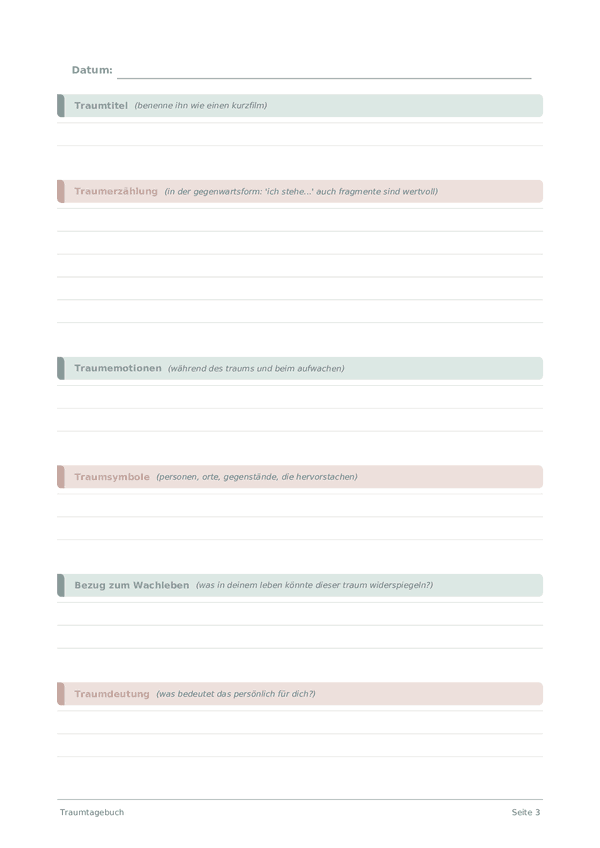
Jeden Tag finden Sie mehrere beschriftete Abschnitte mit Zeilen zum Schreiben. Hier erfahren Sie, wofür jeder Abschnitt gedacht ist:
Traumtitel
Benenne ihn wie einen Kurzfilm
Traumerzählung
In der Gegenwartsform: 'Ich stehe...' Auch Fragmente sind wertvoll
Traumemotionen
Während des Traums und beim Aufwachen
Traumsymbole
Personen, Orte, Gegenstände, die hervorstachen
Bezug zum Wachleben
Was in deinem Leben könnte dieser Traum widerspiegeln?
Traumdeutung
Was bedeutet das persönlich für dich?
Tipps für den Erfolg
Wann und wie oft schreiben
Write every morning without exception, even if you only remember a fragment or a feeling. Keep your journal and pen within arm’s reach of your bed. The act of consistent recording trains your brain to retain dreams — most people notice significantly improved dream recall within 2 weeks of daily journaling. If you remember nothing, write that fact and any mood you woke with. Weekend mornings with natural waking (no alarm) often yield the richest dream material.
Häufig gestellte Fragen
Was erfasst dieses Traumtagebuch?
Sechs strukturierte Abschnitte — traumtitel, traumerzählung (sechs Zeilen), traumemotionen, traumsymbole, bezug zum Wachleben und traumdeutung — erfassen sowohl den Inhalt des Traums als auch Ihre Reflexion darüber. Das sofortige Schreiben beim Aufwachen ist wesentlich, weil die Traumerinnerung innerhalb von Minuten nach dem vollständigen Erwachen verblasst — ein Befund, der in der Schlaf- und Gedächtnisforschung über mehrere Jahrzehnte konsistent beobachtet wurde.
Verbessert ein Traumtagebuch wirklich die Erinnerung?
Ja. Verbesserte Traumerinnerung durch gezieltes Journaling ist in der Schlafforschung gut dokumentiert; konsequentes morgendliches Schreiben trainiert die Aufmerksamkeit auf Träume und stärkt ihre Konsolidierung im Gedächtnis. Das Feld traumerzählung bietet sechs Zeilen, sodass selbst fragmentarische Erinnerung festgehalten werden kann. Halten Sie das Tagebuch in Bettnähe und schreiben Sie, bevor Sie das Handy prüfen, das Traumspuren mit neuen Reizen verdrängt.
Wie nutze ich das Feld traumsymbole?
Notieren Sie wiederkehrende Bilder — Personen, Objekte, Orte, Tiere — ohne eine Bedeutung zu erzwingen. Traumsymbol-Lexika geben generische Deutungen, die Ihre persönlichen Assoziationen oft verfehlen. Carl Jungs Ansatz (und moderne Traumforscher in seiner Nachfolge) betont die persönliche Amplifikation: Fragen Sie, was das Symbol in Ihrem Leben bedeutet, nicht was ein Buch sagt. Halten Sie hier rohe Symbole fest; die Deutung gehört ins Feld traumdeutung.
Ist Trauminterpretation wissenschaftlich verlässlich?
Spezifische Deutungen sind wissenschaftlich nicht validiert — es gibt keine peer-reviewten Belege, dass Träume universelle verborgene Botschaften kodieren, die mit irgendeinem Wörterbuch entschlüsselbar wären. Träume spiegeln aber zuverlässig aktuelle emotionale Anliegen und Gedächtnisverarbeitung (Kontinuitätshypothese, in der Traumforschung gut etabliert). Behandeln Sie traumdeutung als persönliche Reflexion — nützlich für Selbstkenntnis und das Erkennen von Mustern, nicht als objektive Dekodierung fester Botschaften.
Wie unterscheidet sich bezug zum Wachleben von traumdeutung?
Bezug zum Wachleben notiert wörtliche Verbindungen — eine erschienene Person, einen gestern besuchten Ort, ein aktuelles Gespräch oder ein Tagesereignis. Traumdeutung ist Ihre spekulative Bedeutung des Traums. Die Unterscheidung zählt: Verbindungen sind beobachtbare Fakten, die einen Traum oft durch Tagesreste erklären; Deutungen sind subjektiv und spekulativ. Je drei Zeilen reichen; die Trennung beugt Überdeutung vor.
Kann das Tagebuch bei Albträumen oder belastenden Wiederholungsträumen helfen?
Journaling kann das Selbstgewahrsein unterstützen, aber anhaltende Albträume — besonders nach Trauma — bedürfen klinischer Aufmerksamkeit. Imagery Rehearsal Therapy ist eine evidenzbasierte Behandlung chronischer Albträume (von der American Academy of Sleep Medicine bei PTBS-assoziierten Albträumen empfohlen). Bei anhaltenden Albträumen, Angstzuständen oder Depressionen wenden Sie sich an eine/n lizenzierte/n Psychotherapeuten/in — nutzen Sie dieses Tagebuch ergänzend, nicht als Ersatz.
Was ist der häufigste Fehler von Anfängern im Traumjournaling?
Den Traum vor dem Schreiben erinnern zu wollen. Die Erinnerung verblasst Sekunden nach dem vollen Aufwachen. Schreiben Sie das traumerzählung sofort — auch zusammenhanglose Fragmente — und füllen Sie dann Emotionen, Symbole und Verbindungen. Den traumtitel können Sie zuletzt ergänzen. Schauen Sie auch nicht zuerst aufs Handy; neue Reize überschreiben fragile Traumspuren und der Rest des Eintrags fühlt sich leer an.
Wie lange dauert es, bis Muster über meine Träume hinweg sichtbar werden?
Zwei bis vier Wochen täglicher Einträge bringen meist wiederkehrende Symbole, Schauplätze oder emotionale Tönungen an die Oberfläche. Das Feld traumsymbole ist der primäre Ort, an dem Muster auftauchen — vermerken Sie, wenn dasselbe Bild wiederkehrt. Wöchentliche Durchsicht aller sechs Abschnitte enthüllt Verbindungen zwischen Wachsorgen und Trauminhalt. Dies ist reflexive Praxis; klinische Schlafstörungen sollten von einer medizinischen Fachperson bewertet werden.
Das könnte Ihnen auch gefallen
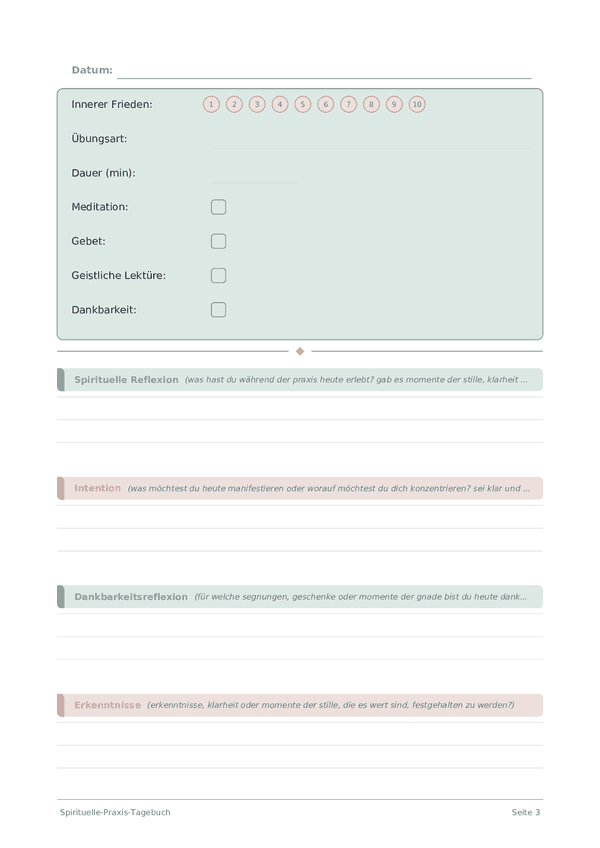
Spirituelle-Praxis-Tagebuch
Pflegen Sie Ihr inneres Leben mit täglicher Praxis und Reflexion
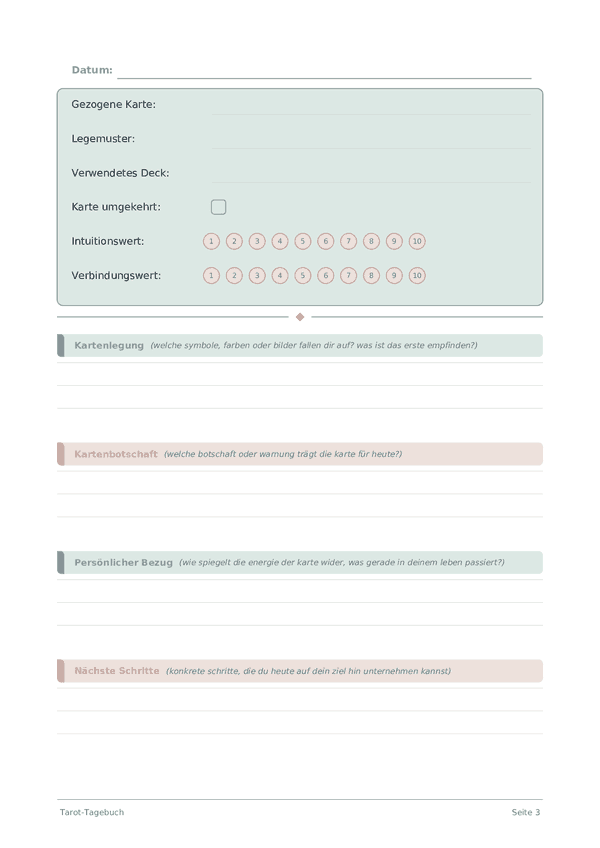
Tarot-Tagebuch
Tägliche Kartenziehungen, Legemuster und intuitive Einsichten verfolgen
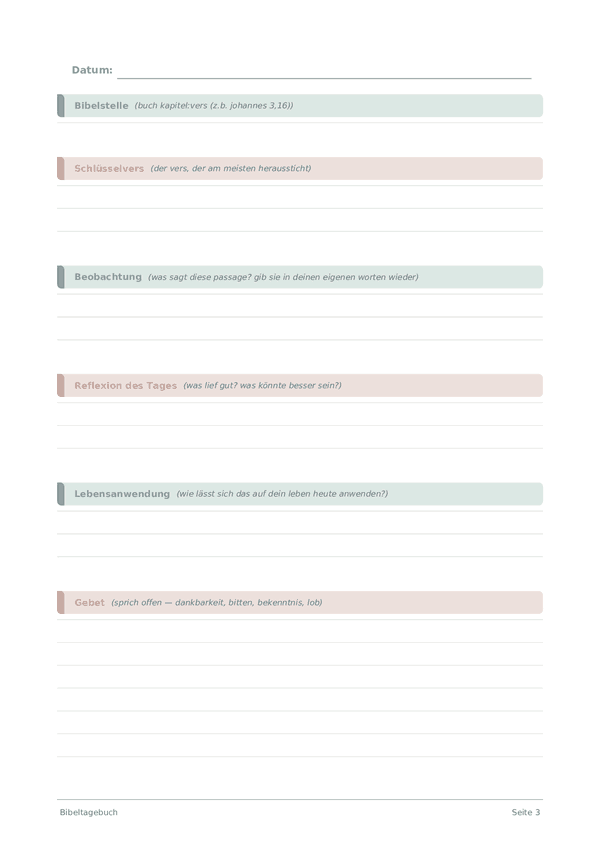
Bibeltagebuch
Bibelvers, Beobachtung, Anwendung, Gebet — die SOAP-Methode
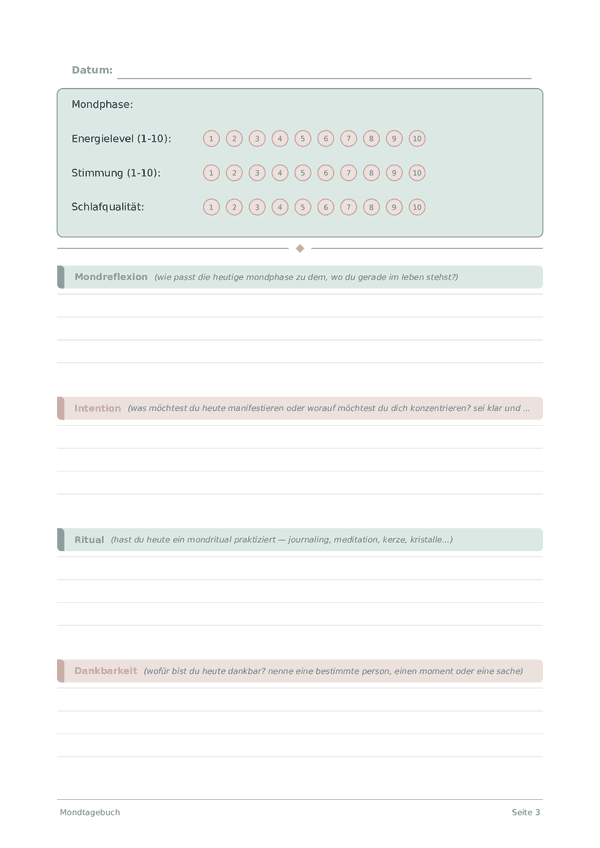
Mondtagebuch
Mit dem Mondzyklus in Einklang kommen — verfolgen, reflektieren und loslassen
Scrollen zum Zoomen, ziehen zum Bewegen