Printable Tarot-Tagebuch
Tägliche Kartenziehungen, Legemuster und intuitive Einsichten verfolgen
A structured daily practice for tarot readers of all levels. Each entry guides you to record your card draw and spread details, capture your first impressions and symbolic observations, explore the card's personal message, and reflect on how the reading connects to your life. Over time, you build a rich record of recurring cards, evolving interpretations, and patterns that deepen your intuitive reading practice.
Felder anpassen
Schalten Sie Felder ein oder aus. Klicken Sie auf den Stift zum Umbenennen oder fügen Sie eigene Felder hinzu.
Vorteile
Anleitung
Was ist dieses Journal?
A tarot journal is a daily practice for recording and reflecting on your card readings, deepening your relationship with the tarot and your own intuition. By logging the cards drawn, spread type, and deck used alongside reflective writing about messages and personal connections, you build a rich archive of symbolic dialogue with your inner wisdom.
This journal is for tarot enthusiasts at any level — from beginners learning card meanings to experienced readers refining their interpretive skills. It serves as both a study tool and a spiritual diary, tracking how your understanding of each card evolves through personal experience rather than just memorized definitions.
Whether you view tarot as a spiritual tool, a psychological mirror, or a creative thinking framework, consistent journaling dramatically accelerates learning. Tracking patterns in which cards appear frequently, which spreads resonate most, and how readings connect to actual life events builds intuitive pattern recognition that cannot be gained from studying books alone.
Ausgefülltes Beispiel
So sieht ein typischer Eintrag aus, wenn er ausgefüllt ist:
Wie Sie jedes Feld ausfüllen
Oben auf jeder Seite befinden sich schnell ausfüllbare Felder (Bewertungen, Kontrollkästchen, Zahlen). Darunter ist ein linierter Bereich zum Schreiben. Hier erfahren Sie, was jedes Feld bedeutet:
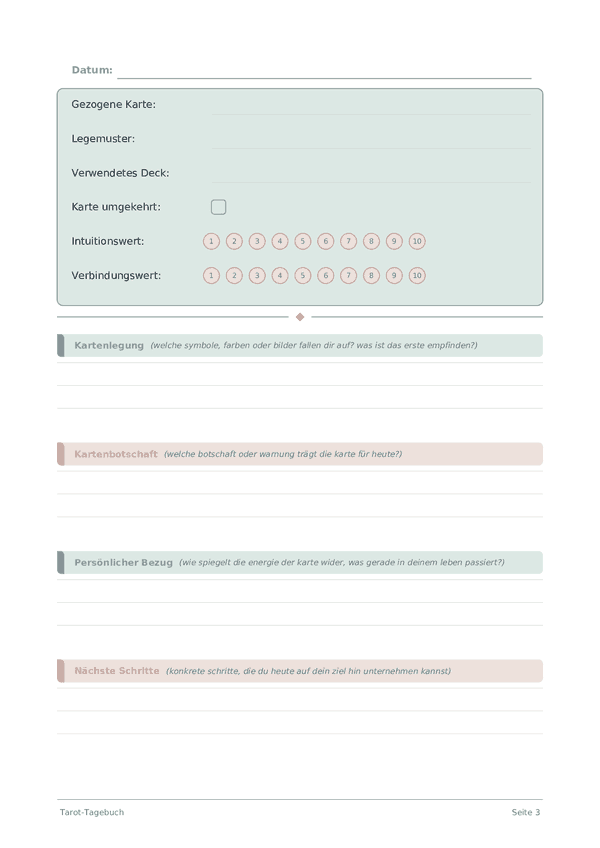
Gezogene Karte
Welche Karte hast du heute gezogen? Schreibe den Namen und die Nummer der Karte
Legemuster
Drei-Karten, Keltisches Kreuz, Einzelziehung...
Verwendetes Deck
Welches Tarot-Deck hast du verwendet?
Karte umgekehrt
War die Karte aufrecht oder umgekehrt? Notiere die Ausrichtung und wie es sich angefühlt hat
Intuitionswert
Wie stark war deine intuitive Verbindung während der Legung? Bewerte von 1 bis 10
Verbindungswert
Wie tief hat die Botschaft der Karte bei dir resoniert? Bewerte von 1 bis 10
Kartenlegung
Welche Symbole, Farben oder Bilder fallen dir auf? Was ist das erste Empfinden?
Kartenbotschaft
Welche Botschaft oder Warnung trägt die Karte für heute?
Persönlicher Bezug
Wie spiegelt die Energie der Karte wider, was gerade in deinem Leben passiert?
Nächste Schritte
Unterteilen Sie Ihr Ziel in konkrete nächste Schritte. Was genau werden Sie tun, wann und wie? Je konkreter, desto besser.
Heutige Lektion
Halten Sie eine Erkenntnis aus den heutigen Erfahrungen fest. Im Laufe der Zeit werden diese Lektionen zu einer persönlichen Weisheitsbibliothek.
Tipps für den Erfolg
Wann und wie oft schreiben
Pull and journal about a daily single-card draw each morning to build interpretive fluency and track evolving themes. Do fuller spreads (3-card or Celtic Cross) weekly or when facing a specific decision or transition. After major life events, a detailed reading and entry can provide valuable perspective. Monthly, review your card frequency log and past readings to assess accuracy and growth. Avoid pulling repeatedly on the same question — if you feel the urge, journal about why the first answer was unsatisfying instead.
Häufig gestellte Fragen
Was ist der Zweck des Tarot-Tagebuchs?
Es ist ein strukturierter täglicher Tracker für gezogene Karten, Legesysteme, verwendete Decks, umgekehrte Position und zwei Bewertungen — Intuitions- und Verbindungsscore — verbunden mit acht Reflexionszeilen über die Botschaft der Karte, persönliche Verbindung, Handlungsschritte und Lektionen. Das Tagebuch erhebt keinen Anspruch auf wahrsagerische Genauigkeit; es ist ein Werkzeug zur Selbstreflexion, ähnlich den expressiven Schreibpraktiken, die James Pennebaker zur emotionalen Verarbeitung erforscht hat.
Wie nutze ich die Felder Intuitions- und Verbindungsscore?
Bewerten Sie den Intuitionsscore morgens auf einer Skala von 1–10, wie klar die Karte zu Ihnen sprach. Den Verbindungsscore vergeben Sie abends, je nachdem wie die Karte Ihren Tag widerspiegelte. Der Vergleich beider Werte über Wochen zeigt, wann erste Eindrücke mit gelebter Erfahrung übereinstimmen. Behandeln Sie es als reflektive Praxis, nicht als Vorhersagebestätigung — es gibt keine peer-reviewten Belege für Tarot als Prognosewerkzeug.
Warum fragt das Tagebuch, ob die Karte umgekehrt ist?
Die umgekehrte Ausrichtung ist eine lang etablierte Lesekonvention der modernen westlichen Tarot-Tradition (Rider-Waite-System, 1909). Das Kontrollkästchen erlaubt es, die Orientierung präzise zu notieren, damit Ihre Notizen zu kartenbotschaft und persönlicher Bezug bei wiederholten Lesungen derselben Karte konsistent bleiben. Ohne diese Markierung wird das Vergleichen alter Einträge unzuverlässig, da umgekehrte und aufrechte Karten in den meisten Systemen unterschiedliche symbolische Gewichtung tragen.
Wie unterscheidet sich Tarot-Journaling von einer Tarot-App?
Apps liefern auf Knopfdruck vorgefertigte Deutungen; diese Vorlage hält Ihre eigenen ersten Eindrücke, das verwendete Deck, das Legesystem und die gelebten Ergebnisse fest. Über Monate bauen Sie eine persönliche Bibliothek von Bedeutungen auf, gegründet in realer Erfahrung statt im Leitfaden anderer Autoren. James Pennebakers Forschung zum expressiven Schreiben zeigt, dass Handschrift über persönlich bedeutsames Material messbare Wohlbefindenseffekte hat, unabhängig vom wahrsagerischen Rahmen.
Gibt es wissenschaftliche Belege, dass Tarot Wahrheit offenbart?
Es gibt keine peer-reviewten Belege dafür, dass Tarot Zugang zu verborgenen Informationen verschafft. Die in der Psychologie dokumentierten Vorteile sind projektiver Natur — die Karte wird zum Anstoß für Selbstreflexion, ähnlich klinischen projektiven Verfahren. Nutzen Sie das Tagebuch entsprechend: behandeln Sie kartenbotschaft und persönlicher Bezug als Ihre Deutungen, nicht als objektive Vorhersagen. Bei psychischen Beschwerden konsultieren Sie eine/n lizenzierte/n Psychotherapeuten/in, statt sich auf Kartenlegungen zu verlassen.
Kann ein Anfänger ohne Tarot-Ausbildung dieses Tagebuch nutzen?
Ja. Beginnen Sie mit Einzelkartenziehungen und tragen Sie unter verwendetes Deck das Deck ein und unter legemuster Daily Draw. Überspringen Sie das Umgekehrt-Kästchen, bis Sie diese Konvention übernehmen. Die unteren Felder (kartenbotschaft, persönlicher Bezug, nächste Schritte, heutige Lektion) funktionieren ohne auswendig gelernte Bedeutungen — Sie reagieren auf die Bildsprache selbst. Mit zunehmendem Lesen werden Ihre Deutungen reicher; dieses Wachstum verfolgt der Verbindungsscore.
Was ist der häufigste Anfängerfehler beim Tarot-Journaling?
Generische Bedeutungen aus dem Leitfaden in kartenbotschaft zu kopieren, statt aufzuschreiben, was die Bildsprache hervorgerufen hat. Vorgefertigte Deutungen blockieren das Feld persönlicher Bezug darin, seine Arbeit zu tun — die Karte mit Ihrer konkreten Situation zu verbinden. Schreiben Sie zuerst Ihren rohen Eindruck, schlagen Sie das Buch wenn gewünscht danach nach und notieren Sie den Unterschied. Mit der Zeit spiegelt der Intuitionsscore Ihre eigenen Lesungen wider.
Wie oft sollte ich Karten ziehen und journalen, um Muster zu sehen?
Tägliche Einzelkartenziehungen über einen Monat ergeben genug Daten, um wiederkehrende Karten und Themen zu erkennen. Die fünf Trackerfelder plus acht Reflexionszeilen sammeln sich schnell an. Bei wöchentlicher Durchsicht werden Muster sichtbar — dieselbe Karte an stressigen Tagen, bestimmte Farben in bestimmten Wochen. Behandeln Sie dies als persönliche symbolische Praxis; sie ergänzt, ersetzt aber keine Therapie oder medizinische Versorgung.
Das könnte Ihnen auch gefallen
Spirituelle-Praxis-Tagebuch
Pflegen Sie Ihr inneres Leben mit täglicher Praxis und Reflexion
Bibeltagebuch
Bibelvers, Beobachtung, Anwendung, Gebet — die SOAP-Methode
Mondtagebuch
Mit dem Mondzyklus in Einklang kommen — verfolgen, reflektieren und loslassen
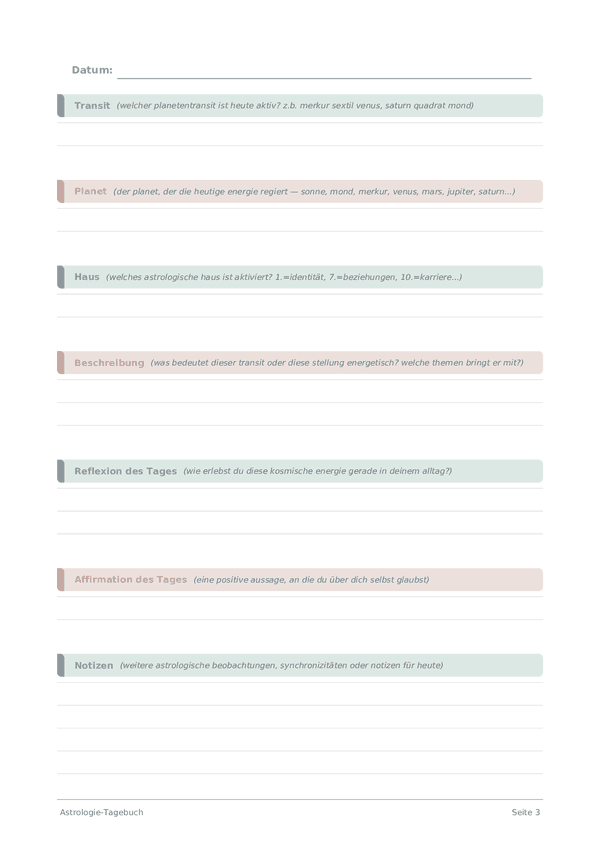
Astrologie-Tagebuch
Die Sterne entschlüsseln, Transite verfolgen und Ihren Alltag mit kosmischen Rhythmen abstimmen
Scrollen zum Zoomen, ziehen zum Bewegen