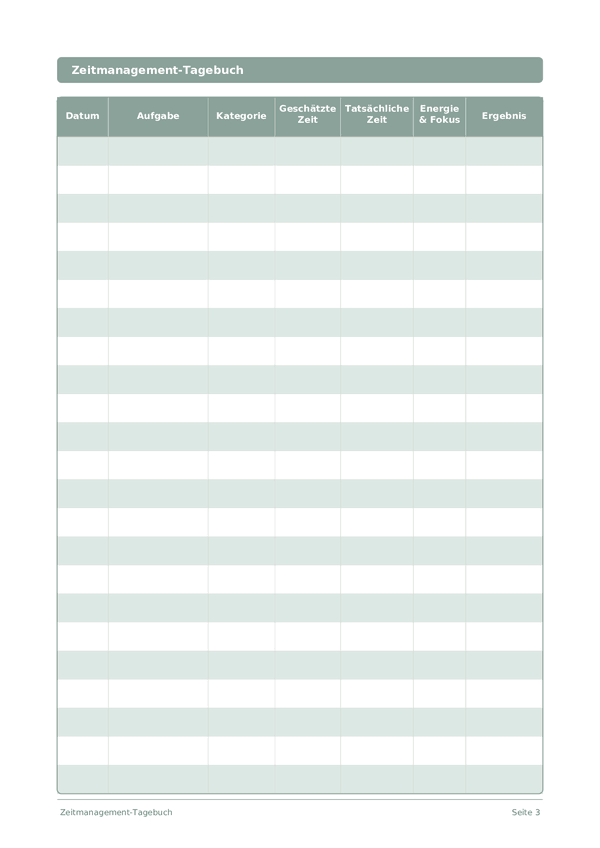
Printable Zeitmanagement-Tagebuch
Aufgaben, Zeit und Energie verfolgen, um Ihren Tag zurückzugewinnen
A structured time log for recording what you work on, how long it takes, and how focused you feel. By tracking estimated vs. actual duration and energy levels, you reveal where your time really goes — and when you do your best work.
Felder anpassen
Schalten Sie Felder ein oder aus. Klicken Sie auf den Stift zum Umbenennen oder fügen Sie eigene Felder hinzu.
Vorteile
Anleitung
Was ist dieses Journal?
A time management journal is a structured log for tracking how you actually spend your time versus how you plan to. By recording tasks alongside their estimated and actual durations, energy required, and outcomes, you develop an increasingly accurate understanding of where your time really goes.
This journal is for anyone who feels like the day disappears without enough to show for it. It is especially powerful for freelancers, remote workers, students, and anyone whose time is self-directed. The gap between how we think we spend time and how we actually spend it is typically 30-50% — this journal closes that gap.
Time perception research reveals that humans are notoriously poor at estimating how long tasks take — a phenomenon called the "planning fallacy." By consistently recording actual durations alongside estimates, you calibrate your internal clock, improve your ability to plan realistic schedules, and identify the time sinks that silently consume your most productive hours.
Ausgefülltes Beispiel
So sieht ein typischer Eintrag aus, wenn er ausgefüllt ist:
| Datum | Aufgabe | Kategorie | Geschätzte Zeit | Tatsächliche Zeit | Energie & Fokus | Ergebnis |
|---|---|---|---|---|---|---|
| 2025-03-04 | Write Q1 strategy document | Deep work | 2 hours | 2h 45m | High energy, peak focus | Completed first draft. Quality exceeded expectations. Best to schedule deep work before 11am. |
| 2025-03-04 | Email triage and responses | Admin | 30 min | 55 min | Low energy needed | Cleared inbox but took longer than expected. 3 emails required research. Batch email at set times. |
| 2025-03-04 | Design mockup review | Collaboration | 1 hour | 1h 20m | Medium energy, attention to detail | Approved 4 of 6 mockups. Remaining 2 need color revisions. Faster in person than async. |
| 2025-03-04 | Team 1-on-1 meeting | Management | 30 min | 45 min | Medium energy, empathetic listening | Productive conversation about career goals. Went over time but worth it. |
| 2025-03-04 | Social media scrolling | Distraction | 0 | 35 min | Zero — mindless | Unplanned. Noticed I reach for phone when transitioning between tasks. Set up app timer. |
Wie Sie jedes Feld ausfüllen
Jede Seite ist eine Tabelle mit Spalten. Füllen Sie pro Eintrag eine Zeile aus. Hier erfahren Sie, wofür jede Spalte gedacht ist:
Datum
Schreiben Sie das heutige Datum. Dies verankert Ihren Eintrag in der Zeit und hilft beim späteren Durchsehen der Einträge.
Aufgabe
Kategorie
Weisen Sie diesem Eintrag eine Kategorie zu (z. B. Essen, Transport, Unterhaltung). Einheitliche Kategorien machen Ihre Daten leicht analysierbar.
Geschätzte Zeit
Tatsächliche Zeit
Energie & Fokus
Ergebnis
Was ist tatsächlich als Ergebnis passiert?
Tipps für den Erfolg
Wann und wie oft schreiben
Log each task as you start and finish it throughout the day \u2014 real-time tracking is far more accurate than end-of-day reconstruction. At the end of the day, review your log and note the gap between estimated and actual time for each task. Weekly, calculate total time spent per category to see where your hours actually go. Monthly, use this data to restructure your schedule, placing high-focus work during your proven peak hours.
Häufig gestellte Fragen
Was erfasst die siebenspaltige Struktur dieses Zeitprotokolls?
Jede Zeile enthält Datum, Aufgabe, Kategorie, geschätzte Dauer, tatsächliche Dauer, Energie/Fokus und Ergebnis — 14 Zeilen pro Seite. Das spiegelt die Aufzeichnungsdisziplin hinter Peter Druckers The Effective Executive (HarperBusiness, 1967), wo Drucker darauf bestand, dass Führungskräfte zuerst wissen müssen, wohin ihre Zeit tatsächlich fließt, bevor sie sie managen können. Die Spalten Schätzung gegen Ist legen den Planungsfehlschluss in deiner eigenen Arbeit offen.
Wie ist das Protokollieren von geschätzter gegen tatsächliche Dauer praktisch nützlich?
Die meisten Menschen unterschätzen Aufgabendauer systematisch — das ist der bekannte Planungsfehlschluss, dokumentiert in Kahnemans umfassenderem Werk zu Urteilen. Zwei bis vier Wochen beide Spalten tracken bringt Kalibrierung: Du entdeckst etwa, dass einstündige Meetings inklusive Vorbereitung 90 Minuten dauern. Zukünftige Schätzungen werden realistisch, Pläne weniger zerbrochen, und Tim-Ferriss-artiges Batching (The 4-Hour Workweek, Crown, 2007) wird möglich, weil du echte Dauern kennst.
Wie unterscheidet sich das von Zeiterfassungs-Apps wie Toggl oder Clockify?
Apps automatisieren das Messen; das Tagebuch erzwingt bewusste Reflexion. Die Energie/Fokus-Spalte und das Ergebnis von Hand zu schreiben lässt dich bemerken, wann du auf niedriger Kapazität gearbeitet hast, was blockiert wurde und was du mitnimmst — Kontext, den Apps nicht erfassen. Cal Newports Deep Work (Grand Central, 2016) argumentiert, dass diese metakognitive Schicht, nicht reine Zeitdaten, Tracking in bessere zukünftige Pläne übersetzt.
Welche Kategoriegranularität ist richtig — breit oder schmal?
Verwende fünf bis acht Kategorien: zu wenige verstecken Muster, zu viele zersplittern die Daten. Beispiele: Deep Work, Admin, Meetings, Kommunikation, Lernen, tiefe Erholung. Stephen Coveys The 7 Habits of Highly Effective People (Free Press, 1989) und die von ihm popularisierte Eisenhower-Matrix legen nahe, zusätzlich nach Wichtigkeit und Dringlichkeit zu sortieren. Nach zwei Wochen zeigen die wöchentlichen Kategorie-Summen, wohin Stunden wirklich fließen.
Wie lange dauert es, bis Muster aus dem Zeitprotokoll nützlich werden?
Zwei bis vier Wochen konsequente Protokollierung bringen Spitzenenergiefenster und überschätzte Aufgabentypen zutage. Mark, Gudith und Klocke (2008, CHI conference) fanden, dass Aufgabenwechsel rund 23 Minuten Erholungszeit kostet — die Energie/Fokus-Spalte zeigt, wie fragmentierte Tage mit niedrigen Bewertungen korrelieren. In der dritten Woche hast du genug Daten, um deinen Kalender um echte Fokusfenster neu zu gestalten.
Sollte ich jede Aufgabe protokollieren oder nur die großen?
Protokolliere bedeutsame Arbeitsblöcke — alles ab 15 Minuten — und gruppiere wirklich Kleines als Admin oder Kommunikation. Jede Zwei-Minuten-Mail einzutragen zerstört das System; 90-Minuten-Blöcke zu übergehen entwertet den Sinn. David Allens Getting Things Done (Penguin, 2001; überarbeitet 2015) verwendet eine ähnliche Zwei-Minuten-Regel: Winzige Aufgaben werden erledigt, nicht protokolliert. Tracke, was Analyse wert ist.
Welchen Fehler machen Nutzer mit diesem Tagebuch am häufigsten?
Aufgaben erst nach Abschluss aus dem Gedächtnis zu protokollieren statt Schätzungen vor dem Start zu notieren. Ohne echte Vorhersage kannst du den Planungsfehlschluss nicht messen oder Kalibrierung verbessern. Die Spalte geschätzte Dauer muss vor Arbeitsbeginn ausgefüllt werden. Sophie Leroy (2009, Organizational Behavior and Human Decision Processes, 109(2)) zu Attention Residue legt zudem nahe, Kontext vor dem Wechsel zu notieren — wozu das Tagebuch natürlich anregt.
Kann das Tagebuch meine besten Stunden für Deep Work zeigen?
Ja — das ist seine stärkste Anwendung. Kreuze hohe Energie/Fokus-Bewertungen mit Tageszeit und Aufgabentyp ab. Innerhalb von zwei bis drei Wochen wird dein hochwertigstes Fokusfenster offensichtlich. Cal Newports Deep Work (Grand Central, 2016) empfiehlt, kognitiv anspruchsvolle Arbeit in dieses Fenster zu legen und es vor Meetings zu schützen. Die Daten, nicht allgemeine Ratschläge, sagen dir, ob du ein Morgen- oder Nachmittags-Deep-Worker bist.
Das könnte Ihnen auch gefallen
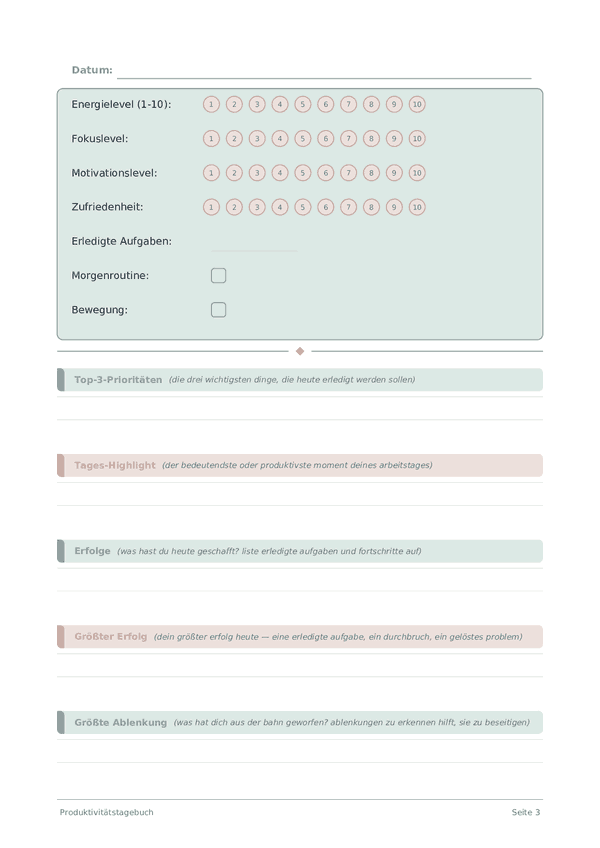
Produktivitätstagebuch
Energie, Fokus und tägliche Leistung verfolgen, um Spitzenleistung aufzubauen
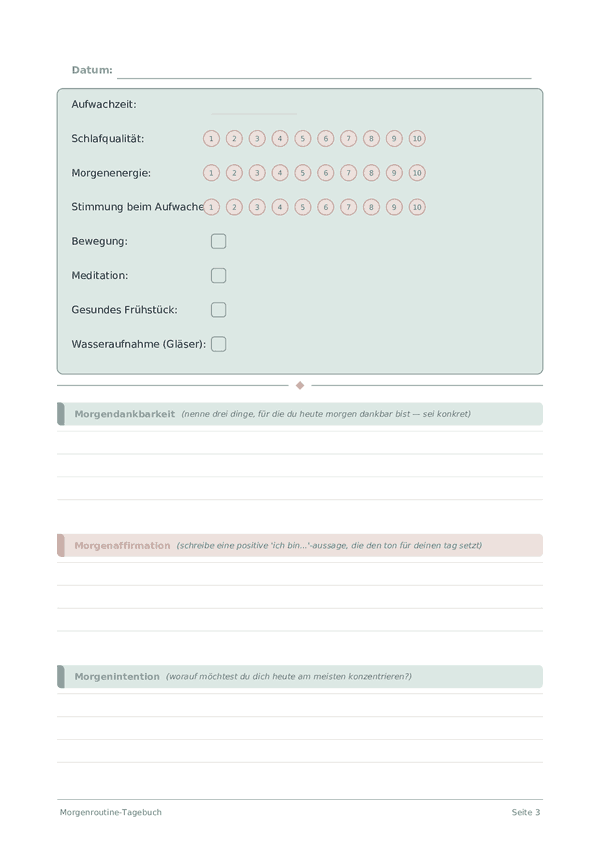
Morgenroutine-Tagebuch
Starten Sie jeden Tag mit Klarheit, Dankbarkeit und Intention
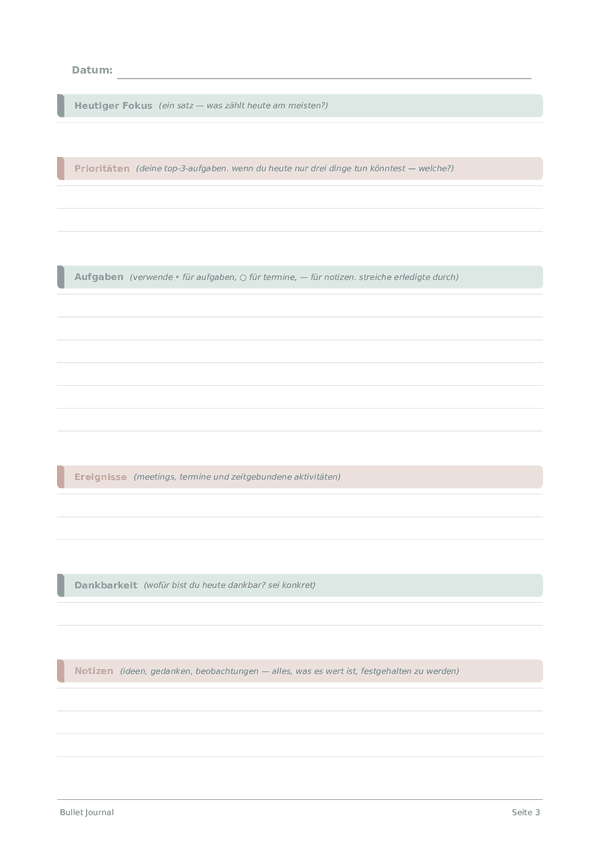
Bullet Journal
Strukturiertes Tagesprotokoll für Rapid Logging
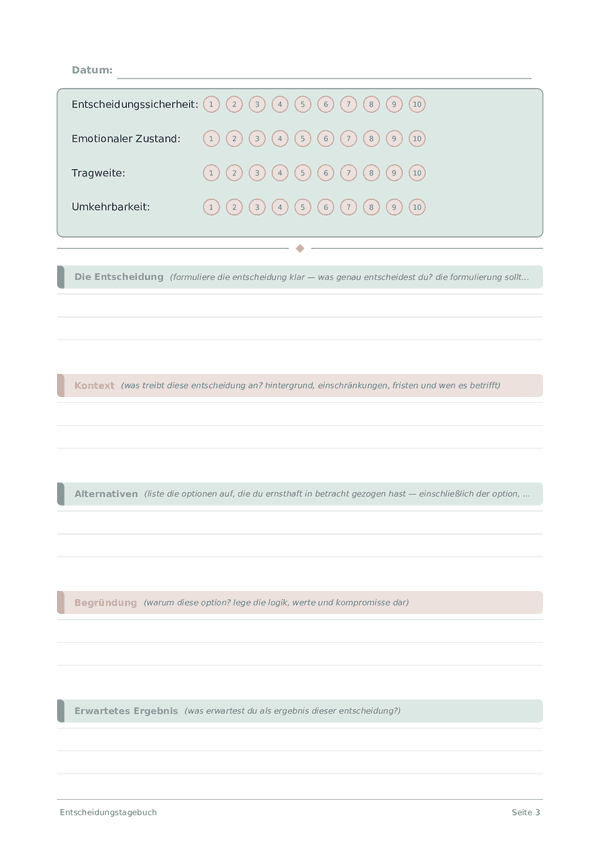
Entscheidungstagebuch
Klar denken, sicher entscheiden, aus jeder Wahl lernen
Scrollen zum Zoomen, ziehen zum Bewegen