Printable ADHD Journal
Your structured daily companion for focus, calm, and momentum
A daily journal designed specifically for people with ADHD. Each page helps you cut through the mental noise — track your focus and energy, capture the brain dump, set a clear intention, and prioritise what actually matters. Built around neurodivergent needs: minimal structure, maximum clarity.
Personalizar campos
Activa o desactiva campos. Haz clic en el lápiz para renombrar, o añade tus propios campos.
Beneficios
Cómo Usar
¿Qué es este diario?
An ADHD journal is a daily support tool designed specifically for the ADHD brain. By tracking focus, mood, energy, and medication alongside writing about intentions, priorities, and brain dumps, you externalize the mental clutter and create a system that works with your neurology rather than against it.
This journal is for adults and teens with ADHD — diagnosed or suspected — who struggle with executive function, focus, time blindness, and emotional regulation. It is built to be quick and low-friction, because an elaborate journaling system that requires too much executive function defeats its own purpose.
ADHD coaching research shows that external accountability systems dramatically improve follow-through for ADHD brains. The brain dump section is particularly powerful — getting racing thoughts onto paper frees up working memory that ADHD brains need for task execution. Tracking patterns in focus and energy helps identify optimal windows for different types of work, turning self-knowledge into a productivity advantage.
Ejemplo completado
Así es como se ve una entrada típica cuando se rellena:
Cómo rellenar cada campo
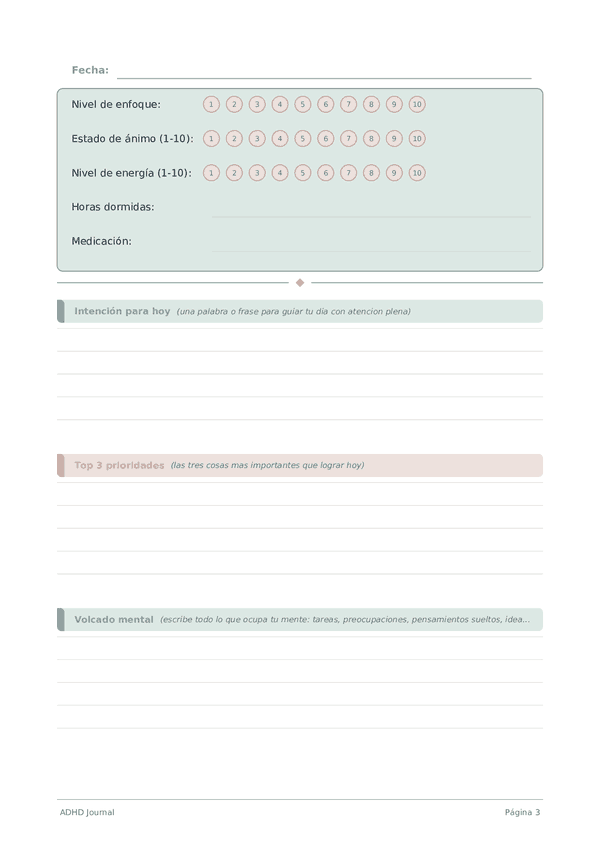
La parte superior de cada pagina tiene campos de llenado rapido (calificaciones, casillas, numeros). Debajo hay una seccion con lineas para escribir. Esto es lo que significa cada campo:
Nivel de enfoque
Que tan bien puedes concentrarte ahora? Califica del 1 (disperso) al 10 (enfoque total)
Estado de ánimo (1-10)
Califica tu estado emocional general del dia. 1 significa muy bajo o deprimido, 10 significa excepcionalmente feliz y positivo. No lo pienses demasiado: ve con tu instinto.
Nivel de energía (1-10)
Califica tu nivel de energia fisica y mental. 1 significa agotado y sin fuerzas, 10 significa totalmente energizado y alerta. Esto te ayuda a identificar que actividades aumentan o agotan tu energia.
Horas dormidas
Escribe cuantas horas dormiste realmente (no solo el tiempo en cama). Rastrear esto junto con el animo y la energia a menudo revela conexiones poderosas.
Medicación
Registra los medicamentos tomados, incluyendo nombre y dosis. El seguimiento consistente te ayuda a ti y a tu medico a evaluar la efectividad del tratamiento.
Intención para hoy
Una palabra o frase para guiar tu dia con atencion plena
Top 3 prioridades
Las tres cosas mas importantes que lograr hoy
Volcado mental
Escribe todo lo que ocupa tu mente: tareas, preocupaciones, pensamientos sueltos, ideas sin terminar. Libera espacio
Reflexión de hoy
Mira atras a tu dia con honestidad. Que salio bien? Que podria mejorar? No se trata de juzgar, sino de aprender y crecer.
Consejos para el exito
Cuando y con que frecuencia escribir
Write twice daily: a 2-minute evening entry (what worked today, what didn\u2019t, tomorrow\u2019s top 3) and a 1-minute morning check-in (energy level, medication, today\u2019s anchor task). Keep the journal next to where you actually sit — if it requires getting up to find it, ADHD friction will win. Weekly, spend 10 minutes reviewing patterns: which days were productive and why, which strategies helped, which times of day were your cognitive peaks. This journal works best when it is short, consistent, and immediately accessible.
Preguntas frecuentes
¿Por qué este diario está diseñado específicamente para el TDAH en lugar de productividad general?
El cerebro con TDAH lucha con la sobrecarga de la memoria de trabajo, la percepción del tiempo y la fricción de inicio. Esta plantilla responde con una estructura deliberadamente mínima: cinco elementos del rastreador (foco, estado de ánimo, energía, horas de sueño, medicación) y cuatro preguntas (intención de hoy, prioridades principales, volcado mental, reflexión). Menos campos, jerarquía más clara y una sección explícita de volcado mental abordan directamente los desafíos de función ejecutiva que descarrilan los sistemas de productividad estándar para usuarios neurodivergentes.
¿Qué es un brain dump y por qué es central en este diario?
Un brain dump es la descarga desestructurada de cada pensamiento, tarea y preocupación en papel. Para el cerebro con TDAH, mantener múltiples bucles abiertos en la memoria de trabajo crea sobrecarga cognitiva y parálisis de decisiones. Organízate con Eficacia de David Allen (Penguin, 2001; revisado 2015) construyó toda su metodología alrededor de la captura por esta razón. El campo volcado mental proporciona una válvula de escape diaria antes de que se puedan establecer claramente las prioridades.
¿Por qué solo tres prioridades principales y una intención?
El TDAH a menudo produce listas de 20 elementos que paralizan en lugar de guiar. Limitar a tres prioridades y una intención diaria obliga a una selección implacable, ajustándose a los límites de la memoria de trabajo. El Esencialismo de McKeown (Crown Business, 2014) y Los 7 Hábitos de Covey (Free Press, 1989) abogan por el estrecho radical: especialmente valioso cuando el cerebro genera naturalmente más elementos 'urgentes' de los que puede acomodar cualquier día.
¿Es este diario un sustituto de la medicación o la terapia para el TDAH?
No. El TDAH es una condición del neurodesarrollo; este diario es una herramienta de autogestión de apoyo, no un tratamiento. El campo de rastreador de medicación existe para ayudarte a ti y a tu médico a ver cómo los medicamentos se correlacionan con el foco y el estado de ánimo, no para reemplazar la atención clínica. Consulta a un psiquiatra calificado o especialista en TDAH para el diagnóstico y el tratamiento; usa el diario junto con, no en lugar de, el apoyo profesional.
¿En qué se diferencia de un planificador regular o un bullet journal?
Los planificadores estándar asumen una función ejecutiva neurotípica: que recordarás revisarlos, priorizarás de forma consistente y resistirás la deriva del hiperfoco. El rastreador de esta plantilla toma menos de dos minutos, el brain dump elimina el estado de 'demasiado abrumado para planificar' y la única intención elude la parálisis de elección. La estructura es deliberadamente escasa porque las páginas llenas de información en sí mismas desencadenan la evitación del TDAH.
¿Por qué rastrear la medicación y las horas de sueño junto con el foco y el estado de ánimo?
El foco del TDAH varía marcadamente con el sueño y el momento de la medicación: patrones invisibles sin datos registrados. La revisión semanal de la adherencia a la medicación, las horas de sueño y las tres valoraciones de 1-10 revela qué combinaciones producen los mejores días de foco. Comparte los patrones con tu médico para ajustes de medicación. Esto es observación, no autodiagnóstico: solo un clínico calificado interpreta los datos para las decisiones de tratamiento.
¿Cuánto tiempo hasta que el diario me ayude a ver mis mejores ventanas de trabajo?
La mayoría de los usuarios con TDAH ven patrones claros de foco y estado de ánimo después de dos a tres semanas de entradas consistentes en el rastreador. Cruza las valoraciones de nivel de enfoque con la hora del día, las horas de sueño y el momento de la medicación. Cal Newport en Trabajo Profundo (Grand Central, 2016) recomienda programar las tareas exigentes en tu ventana de mayor foco: para el TDAH, esta ventana puede ser estrecha pero es identificable a través de los datos en lugar de conjeturas.
¿Cuál es el error más común que cometen los usuarios con TDAH con este diario?
Intentar rellenarlo perfectamente todos los días y luego abandonarlo después de una semana perdida. El diario está diseñado para un uso imperfecto: omite un día, rellena solo el rastreador, escribe un brain dump de una línea. Las Cuatro Tendencias de Gretchen Rubin (Harmony, 2017) y Hábitos Atómicos de James Clear (Avery, 2018) advierten que el perfeccionismo mata los hábitos más rápido que los fallos. Apunta a aparecer, no a completar.
También Te Puede Gustar
Rueda para ampliar, arrastra para mover