Printable Time Management Journal
Track tasks, time, and energy to reclaim your day
A structured time log for recording what you work on, how long it takes, and how focused you feel. By tracking estimated vs. actual duration and energy levels, you reveal where your time really goes — and when you do your best work.
Personalizar campos
Activa o desactiva campos. Haz clic en el lápiz para renombrar, o añade tus propios campos.
Beneficios
Cómo Usar
¿Qué es este diario?
A time management journal is a structured log for tracking how you actually spend your time versus how you plan to. By recording tasks alongside their estimated and actual durations, energy required, and outcomes, you develop an increasingly accurate understanding of where your time really goes.
This journal is for anyone who feels like the day disappears without enough to show for it. It is especially powerful for freelancers, remote workers, students, and anyone whose time is self-directed. The gap between how we think we spend time and how we actually spend it is typically 30-50% — this journal closes that gap.
Time perception research reveals that humans are notoriously poor at estimating how long tasks take — a phenomenon called the "planning fallacy." By consistently recording actual durations alongside estimates, you calibrate your internal clock, improve your ability to plan realistic schedules, and identify the time sinks that silently consume your most productive hours.
Ejemplo completado
Así es como se ve una entrada típica cuando se rellena:
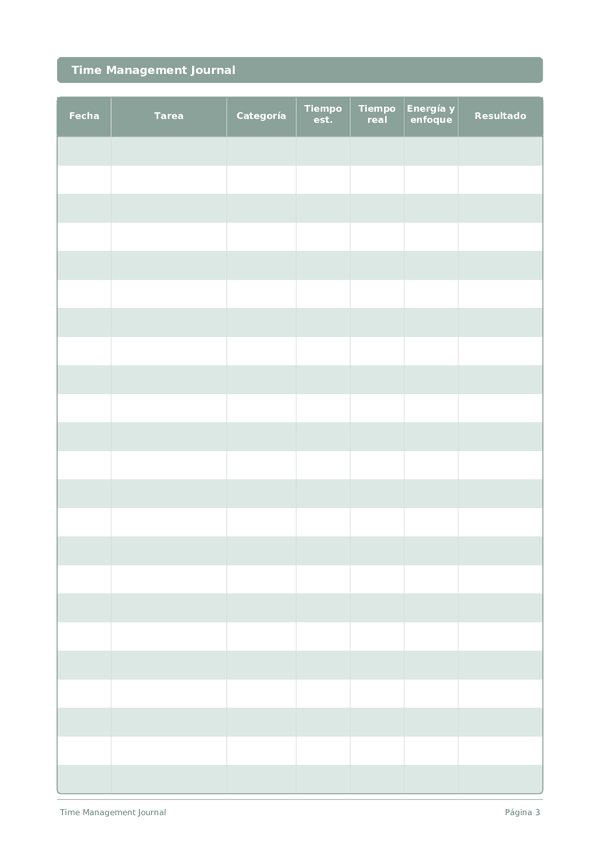
| Fecha | Tarea | Categoría | Tiempo est. | Tiempo real | Energía y enfoque | Resultado |
|---|---|---|---|---|---|---|
| 2025-03-04 | Write Q1 strategy document | Deep work | 2 hours | 2h 45m | High energy, peak focus | Completed first draft. Quality exceeded expectations. Best to schedule deep work before 11am. |
| 2025-03-04 | Email triage and responses | Admin | 30 min | 55 min | Low energy needed | Cleared inbox but took longer than expected. 3 emails required research. Batch email at set times. |
| 2025-03-04 | Design mockup review | Collaboration | 1 hour | 1h 20m | Medium energy, attention to detail | Approved 4 of 6 mockups. Remaining 2 need color revisions. Faster in person than async. |
| 2025-03-04 | Team 1-on-1 meeting | Management | 30 min | 45 min | Medium energy, empathetic listening | Productive conversation about career goals. Went over time but worth it. |
| 2025-03-04 | Social media scrolling | Distraction | 0 | 35 min | Zero — mindless | Unplanned. Noticed I reach for phone when transitioning between tasks. Set up app timer. |
Cómo rellenar cada campo
Cada pagina es una tabla con columnas. Completa una fila por entrada. Esto es lo que significa cada columna:
Fecha
Escribe la fecha de hoy. Esto ancla tu entrada en el tiempo y ayuda cuando revisas entradas despues.
Tarea
Categoría
Asigna una categoria a esta entrada (ej. comida, transporte, entretenimiento). Las categorias consistentes hacen que tus datos sean faciles de analizar.
Tiempo est.
Tiempo real
Energía y enfoque
Resultado
Que ocurrio realmente como resultado?
Consejos para el exito
Cuando y con que frecuencia escribir
Log each task as you start and finish it throughout the day \u2014 real-time tracking is far more accurate than end-of-day reconstruction. At the end of the day, review your log and note the gap between estimated and actual time for each task. Weekly, calculate total time spent per category to see where your hours actually go. Monthly, use this data to restructure your schedule, placing high-focus work during your proven peak hours.
Preguntas frecuentes
¿Qué captura la estructura de siete columnas de este registro de tiempo?
Cada fila registra fecha, tarea, categoría, duración estimada, duración real, energía/foco y resultado —14 filas por página—. Esto refleja la disciplina de registro detrás de El Ejecutivo Eficaz de Peter Drucker (HarperBusiness, 1967): los ejecutivos deben primero saber dónde va realmente su tiempo antes de gestionarlo. Las columnas estimado-versus-real exponen la falacia de planificación en tu propio trabajo.
¿Por qué es útil en la práctica registrar la duración estimada frente a la real?
La mayoría de personas subestiman sistemáticamente la duración de las tareas: esta es la bien conocida falacia de planificación documentada en la investigación sobre el juicio. Registrar ambas columnas durante dos a cuatro semanas construye calibración: descubres, por ejemplo, que las reuniones 'de una hora' realmente duran 90 minutos incluida la preparación. Las estimaciones futuras se vuelven realistas y los horarios se rompen menos.
¿En qué se diferencia de las apps de seguimiento de tiempo como Toggl o Clockify?
Las apps automatizan la medición; el diario fuerza la reflexión deliberada. Escribir la columna de energía/foco y el resultado a mano te hace notar cuándo trabajaste con baja capacidad, qué se bloqueó y qué hay que llevar adelante: contexto que las apps no pueden capturar. Cal Newport en Trabajo Profundo (Grand Central, 2016) argumenta que esta capa metacognitiva, no los datos brutos de tiempo, es lo que convierte el seguimiento en mejores horarios futuros.
¿Cuál es la granularidad correcta de las categorías: amplia o estrecha?
Usa de cinco a ocho categorías: pocas ocultan patrones, demasiadas fragmentan los datos. Ejemplos: trabajo profundo, administración, reuniones, comunicación, aprendizaje, descanso profundo. Los 7 Hábitos de Covey (Free Press, 1989) y la Matriz de Eisenhower que popularizó sugieren ordenar también por importancia y urgencia. Después de dos semanas, los totales semanales por categoría revelan dónde van realmente las horas frente a dónde asumías.
¿Cuánto tarda en volverse útiles los patrones del registro de tiempo?
Dos a cuatro semanas de registro consistente revelan ventanas de máxima energía y tipos de tareas sobreestimados. Mark, Gudith y Klocke (2008, CHI conference) encontraron que el cambio de tarea costaba unos 23 minutos de tiempo de recuperación: la columna energía/foco muestra cómo los días fragmentados se correlacionan con puntuaciones bajas. En la tercera semana tienes suficientes datos para rediseñar tu calendario en torno a ventanas de foco reales.
¿Debo registrar cada tarea individual o solo las principales?
Registra bloques de trabajo significativos —de 15 minutos o más— y agrupa los elementos verdaderamente pequeños como 'administración' o 'comunicación'. Registrar cada email de dos minutos destruye el sistema; omitir bloques de 90 minutos elimina el objetivo. Organízate con Eficacia de David Allen (Penguin, 2001; revisado 2015) usa una regla de dos minutos similar: las tareas diminutas se hacen, no se registran. Rastrea lo que merece ser analizado.
¿Cuál es el error más común de los usuarios con este diario?
Registrar las tareas solo después de terminarlas, de memoria, en lugar de escribir estimaciones antes de empezar. Sin una predicción real, no puedes medir la falacia de planificación ni mejorar la calibración. La columna 'tiempo est.' debe rellenarse antes de comenzar el trabajo. Sophie Leroy (2009, Organizational Behavior and Human Decision Processes, 109(2)) sobre el residuo de atención también sugiere anotar el contexto antes de cambiar de tarea.
¿Puede el diario mostrarme mis mejores horas para el trabajo profundo?
Sí: ese es su uso más potente. Cruza las valoraciones altas de energía/foco con la hora del día y el tipo de tarea. En dos a tres semanas, tu ventana de foco de mayor calidad se vuelve obvia. Cal Newport en Trabajo Profundo (Grand Central, 2016) recomienda programar el trabajo cognitivamente exigente en esa ventana y protegerla de reuniones. Los datos, no los consejos genéricos, te dicen si eres un trabajador profundo de mañana o de tarde.
También Te Puede Gustar
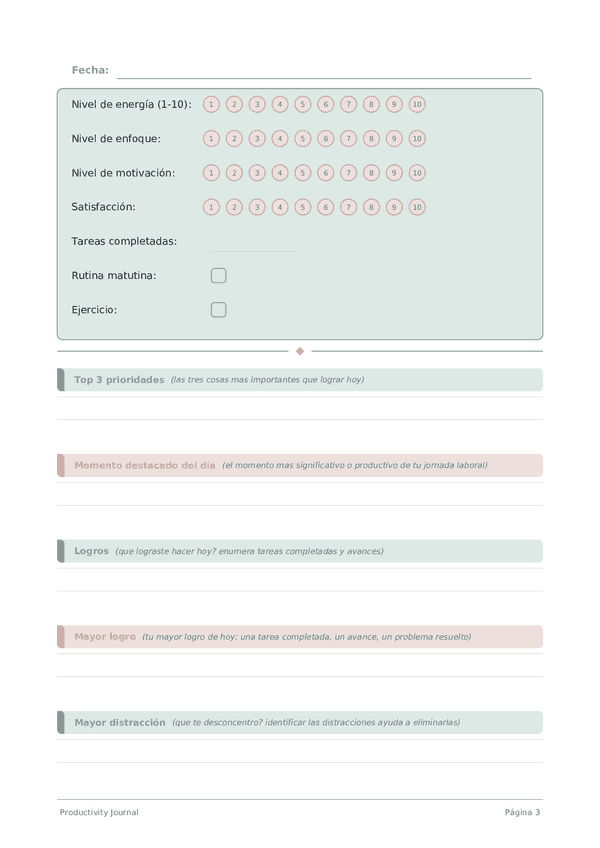
Productivity Journal
Track energy, focus, and daily output to build peak performance habits
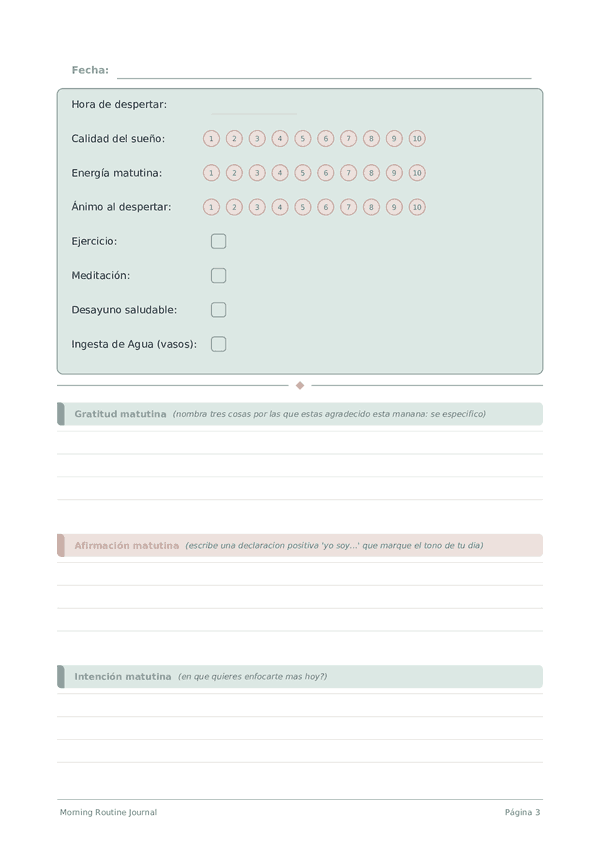
Morning Routine Journal
Start every day with clarity, gratitude, and intention
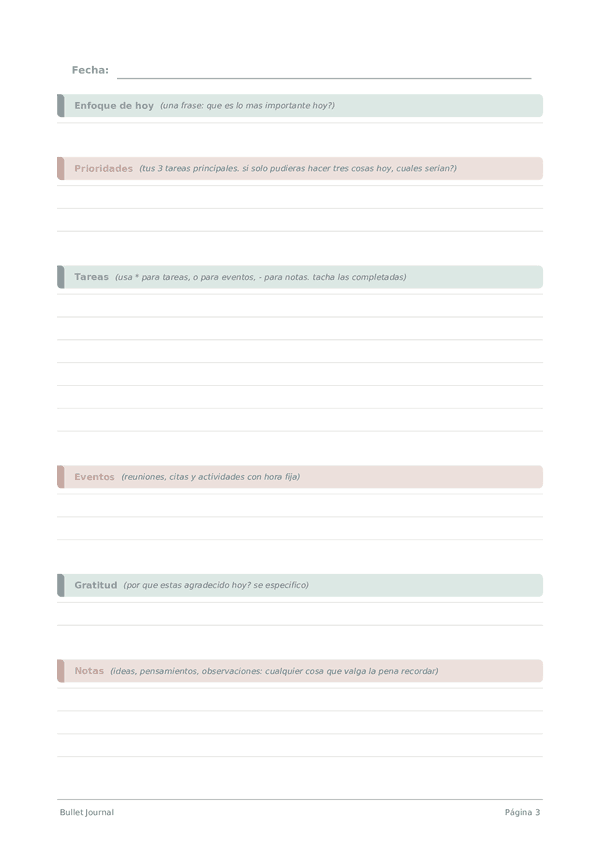
Bullet Journal
Structured daily log for rapid logging
Decision Journal
Think clearly, decide confidently, learn from every choice
Rueda para ampliar, arrastra para mover