Printable Decision Journal
Think clearly, decide confidently, learn from every choice
A structured decision log that captures your reasoning, confidence, emotional state, and outcome for every important choice. Revisiting past entries reveals patterns, reduces hindsight bias, and sharpens your judgment over time.
Personalizar campos
Activa o desactiva campos. Haz clic en el lápiz para renombrar, o añade tus propios campos.
Beneficios
Cómo Usar
¿Qué es este diario?
A decision journal is a structured practice for recording important decisions at the moment you make them — before you know how they turn out. By capturing your reasoning, alternatives considered, emotional state, and expected outcomes, you create an honest record that lets you evaluate your decision-making process over time, separate from results.
This journal is for leaders, entrepreneurs, investors, and anyone who makes consequential decisions and wants to improve their judgment. It is based on the principle that good decisions can have bad outcomes and bad decisions can have good outcomes — the only way to improve is to evaluate the process, not just the result.
Decision science research, popularized by Annie Duke and Daniel Kahneman, shows that "resulting" — judging decisions solely by their outcomes — is one of the biggest obstacles to better judgment. This journal creates a time-stamped record of your reasoning that you can revisit months later, helping you distinguish between genuine skill and luck in your decision-making.
Ejemplo completado
Así es como se ve una entrada típica cuando se rellena:
Cómo rellenar cada campo
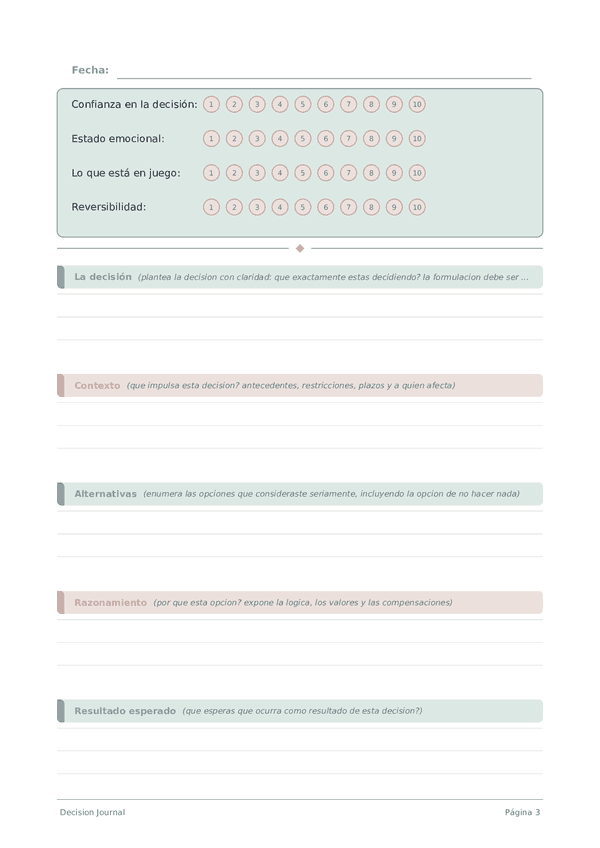
La parte superior de cada pagina tiene campos de llenado rapido (calificaciones, casillas, numeros). Debajo hay una seccion con lineas para escribir. Esto es lo que significa cada campo:
Confianza en la decisión
Que tan seguro estas de que es la decision correcta? Califica del 1 (muy inseguro) al 10 (seguro)
Estado emocional
Que tan lucido estas ahora? Califica del 1 (disperso) al 10 (muy claro)
Lo que está en juego
Que tan significativas son las consecuencias si sale mal? Califica del 1 (menor) al 10 (trascendental)
Reversibilidad
Que tan facil seria cambiar de rumbo si es necesario? Califica del 1 (sin retorno) al 10 (facilmente reversible)
La decisión
Plantea la decision con claridad: que exactamente estas decidiendo? La formulacion debe ser comprensible incluso para un nino
Contexto
Que impulsa esta decision? Antecedentes, restricciones, plazos y a quien afecta
Alternativas
Enumera las opciones que consideraste seriamente, incluyendo la opcion de no hacer nada
Razonamiento
Por que esta opcion? Expone la logica, los valores y las compensaciones
Resultado esperado
Que esperas que ocurra como resultado de esta decision?
Resultado
Que ocurrio realmente como resultado?
Lecciones aprendidas
Mirando atras: fue solido tu razonamiento? Que harias diferente la proxima vez?
Consejos para el exito
Cuando y con que frecuencia escribir
Write an entry for every significant decision: career moves, large purchases, relationship choices, health changes, and strategic pivots. Minor daily decisions do not need logging, but any choice you might second-guess later deserves an entry. At the decision point, spend 10\u201315 minutes writing your reasoning and confidence. Set calendar reminders to revisit at 30, 90, and 365 days. Quarterly, review your decision history to identify recurring biases.
Preguntas frecuentes
¿Qué captura el Diario de Decisiones más allá de la decisión en sí?
El rastreador valora la confianza en la decisión, el estado emocional, las apuestas y la reversibilidad (cada uno de 1-10). La sección escrita captura la decisión, el contexto, las alternativas consideradas, el razonamiento, el resultado esperado, el resultado real y las lecciones aprendidas. Esta estructura te obliga a escribir el razonamiento antes de conocer el resultado, atacando directamente el sesgo de retrospección, donde la memoria reescribe la lógica previa a la decisión para que coincida con lo que realmente ocurrió.
¿Por qué valorar la reversibilidad y las apuestas por separado?
Jeff Bezos popularizó el marco de puerta de un solo sentido frente a de doble sentido por razones similares: las decisiones irreversibles de alto riesgo merecen mucha más deliberación que las reversibles de bajo riesgo. Valorar la reversibilidad (1-10) y las apuestas (1-10) evita pensar demasiado en elecciones triviales y pensar demasiado poco en las importantes. El Ejecutivo Eficaz de Peter Drucker (HarperBusiness, 1967) enfatizó que las decisiones efectivas ajustan la profundidad de deliberación a las consecuencias.
¿En qué se diferencia de simplemente tomar notas sobre decisiones?
Las notas casuales derivan hacia la justificación; esta plantilla obliga a incluir alternativas, resultados esperados y valoraciones de confianza: los elementos que más querrás comparar con la realidad más tarde. Los campos resultado esperado y outcome crean un bucle de retroalimentación que tu mente no puede falsificar retrospectivamente. Sin esta estructura, recuerdas haber tenido más razón de lo que tuviste, un sesgo documentado en la investigación sobre el juicio.
¿Con qué frecuencia debo escribir entradas: para cada decisión o solo para las grandes?
Úsalo para cualquier decisión valorada en 5 o más en apuestas o reversibilidad. Registrar cada elección de café destruye la señal; registrar solo las obvias pierde las medianas, donde la calibración mejora más. El Esencialismo de Greg McKeown (Crown Business, 2014) sugiere tratar la capacidad de toma de decisiones como finita: reserva el diario para decisiones que merezcan un rastro de razonamiento documentado.
¿Cuál es el punto de valorar el estado emocional antes de decidir?
El estado emocional moldea la tolerancia al riesgo y la claridad. Un estado emocional de 3/10 combinado con altas apuestas es una señal fuerte para aplazar la decisión si es posible. Esta comprobación anti-sesgo aparece en toda la literatura sobre el juicio. El diario la hace explícita: si te valoras en 1-3, la propia entrada se convierte en una señal de advertencia: dormir con ello, recopilar más datos o buscar opinión antes de comprometerte.
¿Cuánto tiempo tarda en verse una mejor toma de decisiones?
La calibración mejora de forma medible después de unas 20-30 decisiones registradas con resultados completados, típicamente de tres a seis meses para decisiones de riesgo medio. El bucle de retroalimentación —comparar resultado esperado con outcome— es lo que entrena el juicio. Locke y Latham (2002, American Psychologist, 57(9)) mostraron que la retroalimentación impulsa el rendimiento de las metas; lo mismo se aplica a la calidad de las decisiones.
¿Cuál es el error más común que comete la gente con un diario de decisiones?
No volver a completar los campos de resultado y lecciones aprendidas. Sin la entrada posterior al resultado, el diario se convierte en un registro unilateral de optimismo, no en una herramienta de calibración. Establece un recordatorio en el calendario para dos semanas después de las entradas importantes. La sección lecciones aprendidas es donde realmente mejora el juicio personal: omitirla elimina todo el bucle de crecimiento para el que el diario fue diseñado.
¿Puede este diario ayudar con decisiones de equipo o empresariales, no solo personales?
Sí. La misma estructura sustenta las prácticas de revisión de decisiones en artículos de MIT Sloan Management Review y Harvard Business Review sobre la calidad de las decisiones de gestión. Para uso en equipo, rellena alternativas y razonamiento de forma colaborativa antes de comprometerte, luego revisa los resultados en retrospectivas. Las cuatro valoraciones dan al grupo un vocabulario compartido para la confianza y las apuestas.
También Te Puede Gustar
Rueda para ampliar, arrastra para mover