Printable Anxiety Journal
Daily anxiety tracking and CBT-based reflection journal
Manage anxiety with evidence-based daily tracking and reflection. Identify triggers, notice body sensations, challenge anxious thoughts, and document what coping strategies actually work for you.
Personalizar campos
Activa o desactiva campos. Haz clic en el lápiz para renombrar, o añade tus propios campos.
¿Qué es este diario?
An anxiety journal is a therapeutic self-monitoring tool specifically designed to help you understand, manage, and gradually reduce anxiety. By combining daily anxiety ratings with structured writing about triggers, body sensations, thought patterns, and coping strategies, you create a personal anxiety management system backed by cognitive behavioral therapy principles.
Anxiety often feels overwhelming because it operates in the background of your mind — vague, persistent, and hard to pin down. This journal brings anxiety into the light where it becomes manageable. Research shows that the simple act of writing about anxious thoughts reduces their intensity by up to 47%. Tracking your anxiety numerically also helps you see that it fluctuates — it is not permanent, even when it feels that way.
The hybrid format combines quick daily ratings (anxiety level, stress, sleep quality, exercise, breathing practice) with guided writing prompts that help you identify triggers, notice physical sensations, examine your thoughts, document what coping strategies you used, and reflect on what actually helped. Over time, this builds a personalized toolkit for managing anxiety.
Ejemplo completado
Así es como se ve una entrada típica cuando se rellena:
Cómo rellenar cada campo
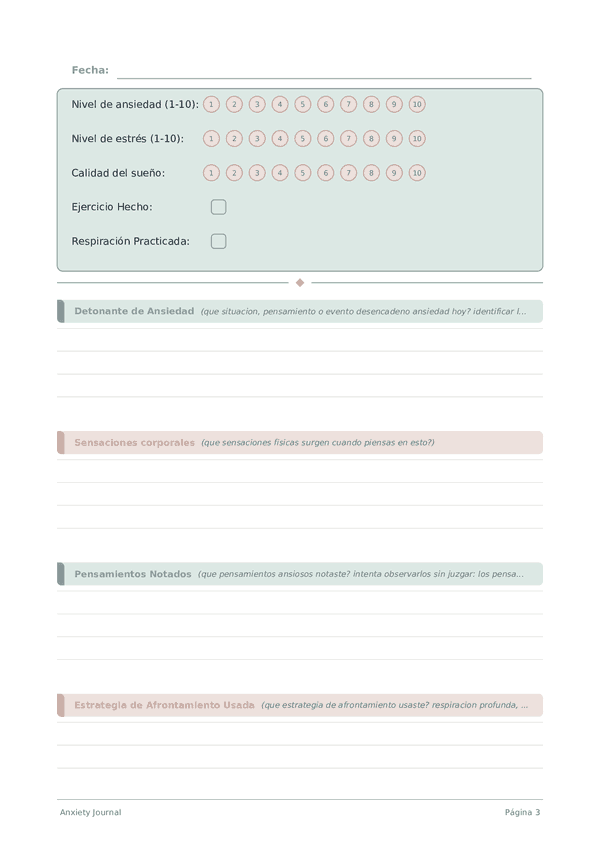
La parte superior de cada pagina tiene campos de llenado rapido (calificaciones, casillas, numeros). Debajo hay una seccion con lineas para escribir. Esto es lo que significa cada campo:
Nivel de ansiedad (1-10)
Califica tu nivel de ansiedad hoy. Ponerle un numero hace que el sentimiento sea mas manejable y rastreable.
Nivel de estrés (1-10)
Califica tu estres en una escala del 1 al 10. Con el tiempo, identificaras tus patrones de estres y que estrategias de afrontamiento funcionan mejor.
Calidad del sueño
Califica que tan reparador fue tu sueno. 1 significa terrible y agitado, 5 significa profundo y refrescante. La calidad importa tanto como la cantidad.
Ejercicio Hecho
Hiciste ejercicio hoy? Incluso una caminata corta cuenta. El movimiento es uno de los reductores naturales de ansiedad mas efectivos.
Respiración Practicada
Practicaste respiracion consciente hoy? La respiracion diafragmatica activa el sistema nervioso parasimpatico y calma la ansiedad.
Detonante de Ansiedad
Que situacion, pensamiento o evento desencadeno ansiedad hoy? Identificar los desencadenantes es el primer paso en el manejo de ansiedad basado en TCC.
Sensaciones corporales
Que sensaciones fisicas surgen cuando piensas en esto?
Pensamientos Notados
Que pensamientos ansiosos notaste? Intenta observarlos sin juzgar: los pensamientos no son hechos.
Estrategia de Afrontamiento Usada
Que estrategia de afrontamiento usaste? Respiracion profunda, anclaje, reformulacion, caminar, hablar con alguien: que ayudo?
Qué ayudó
Que te trajo alivio? Anota lo que funciono para poder usarlo de nuevo cuando la ansiedad aumente.
Consejos para el exito
Cuando y con que frecuencia escribir
Fill in the tracker daily, even on calm days — data from low-anxiety days is just as valuable for understanding your patterns. When anxiety spikes during the day, do a quick 'thought dump' in the writing section as soon as possible. Full evening reflection should take 5–10 minutes. Over time, this journal becomes your personal CBT workbook.
Preguntas frecuentes
¿Por qué este diario valora la ansiedad, el estrés y el sueño por separado?
Estos constructos se superponen pero son distintos. La APA define la ansiedad como preocupación anticipatoria, el estrés como respuesta a la demanda y la calidad del sueño como factor fisiológico que modera ambos. Las directrices del NIMH sobre trastornos de ansiedad los trata como relacionados pero mediblemente separados. Tres valoraciones de 0-10 te permiten ver qué dimensión impulsa un mal día en lugar de colapsar todo en un número.
¿Cómo relleno 'pensamientos Notados' usando principios de TCC?
Escribe el pensamiento automático palabra por palabra: exactamente la frase que tienes en la cabeza. Luego etiqueta la distorsión cognitiva presente. Aaron Beck ('Cognitive Therapy and the Emotional Disorders', 1976) catalogó patrones como la catastrofización, la lectura de la mente y el pensamiento todo-o-nada. Nombrar la distorsión es el primer paso de la reestructuración cognitiva antes de escribir 'qué ayudó'.
¿Para qué sirve registrar 'sensaciones corporales' en la ansiedad?
La ansiedad produce señales somáticas —corazón acelerado, pecho apretado, respiración superficial— que la exposición interoceptiva (Protocolo Unificado de Barlow; Barlow et al., 2017, Behaviour Research and Therapy, 88) trabaja directamente. Registrar las sensaciones desarrolla la conciencia necesaria para distinguir un pico de pánico de una línea base elevada estable y para aplicar respiración o anclaje antes de escalar.
¿Por qué hay una casilla 'respiración Practicada'?
La respiración lenta activa el tono vagal y reduce la activación fisiológica. Laborde et al. (2022, Neuroscience and Biobehavioral Reviews, 138) revisaron protocolos de respiración lenta y encontraron efectos agudos consistentes sobre la VFC y la ansiedad autoinformada. La casilla establece el hábito de práctica; con el tiempo puedes correlacionar los días con respiración Practicada=true frente a las puntuaciones de nivel de ansiedad (1-10).
¿Es este diario un sustituto de la terapia si tengo un trastorno de ansiedad?
No. El diario apoya el tratamiento basado en evidencia pero no lo reemplaza. El NIMH y la APA recomiendan TCC, terapia de exposición o farmacoterapia para los trastornos de ansiedad diagnosticados. Si tienes un trastorno clínico de ansiedad, consulta a un profesional de salud mental con licencia. Este diario funciona bien como tarea entre sesiones junto a la terapia.
¿Cómo interpreto semanas de puntuaciones?
Busca correlaciones, no días aislados. Después de dos semanas, observa si nivel de ansiedad (1-10) sube cuando calidad del sueño baja, o si cae en los días con ejercicio Hecho marcado. Hofmann et al. (2012, Cognitive Therapy and Research, 36(5)) analizaron la TCC para la ansiedad y hallaron que el seguimiento de síntomas mejoró la respuesta al tratamiento al clarificar los desencadenantes. Lleva los patrones a terapia si corresponde.
¿Qué hago si no puedo identificar un 'detonante de Ansiedad' claro?
Es habitual en la ansiedad generalizada, donde la preocupación es difusa. El modelo de evitación de Borkovec (1994) y Behar et al. (2009, Journal of Anxiety Disorders, 23(8)) describen la preocupación como supresora de imágenes temidas concretas. Escribe qué hacías, con quién estabas y cuánta tensión sentías en el cuerpo: el desencadenante puede surgir como contexto somático, no como un evento claro.
¿En qué se diferencia de un diario de estado de ánimo genérico?
Está estructurado en torno al formato del registro de pensamientos de la TCC: situación, pensamientos automáticos, sensaciones corporales, afrontamiento utilizado y qué ayudó. Esa secuencia —más cercana al registro diario de pensamientos de Beck— apunta específicamente a la reestructuración cognitiva. Un diario de estado de ánimo registra sentimientos; este trabaja las valoraciones que los generan.
También Te Puede Gustar
Rueda para ampliar, arrastra para mover