Printable Emotion Journal
Understand, process, and grow through your emotions
Explore the full spectrum of your emotional life with this science-backed daily journal. Name what you feel, locate it in your body, uncover what triggered it, discover how you coped, extract the lesson it carries, and find gratitude even in difficulty. Built on evidence-based emotional intelligence practices used by therapists and mindfulness coaches.
Personalizar campos
Activa o desactiva campos. Haz clic en el lápiz para renombrar, o añade tus propios campos.
Beneficios
Cómo Usar
¿Qué es este diario?
An emotion journal is a therapeutic writing practice focused specifically on understanding and processing your emotional experiences. Unlike a mood tracker that captures a snapshot, this journal invites you to explore the full texture of your feelings — what you felt, where you felt it in your body, what triggered it, and what it can teach you.
Emotional awareness is the foundation of emotional intelligence. Research by psychologist James Pennebaker has shown that expressive writing about emotions significantly reduces anxiety, improves immune function, and enhances overall wellbeing. The key is not just naming emotions but exploring them with curiosity rather than judgment.
This journal guides you through six focused sections: identifying emotions, noticing body sensations, exploring triggers, documenting coping strategies, extracting lessons, and finding gratitude within emotional experiences. This structured approach transforms overwhelming feelings into manageable insights.
Ejemplo completado
Así es como se ve una entrada típica cuando se rellena:
Cómo rellenar cada campo
Cada dia encontraras varias secciones etiquetadas con lineas para escribir. Esto es lo que significa cada seccion:
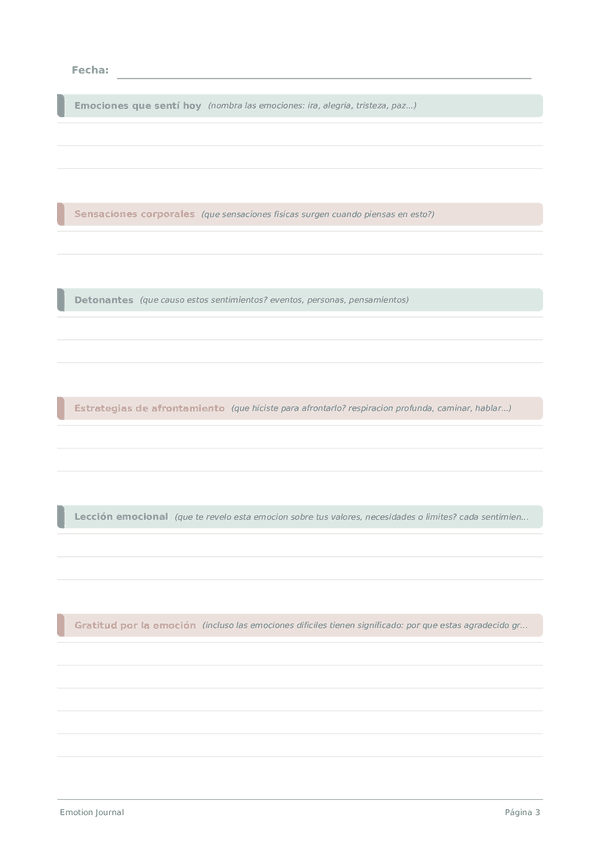
Emociones que sentí hoy
Nombra las emociones especificas que experimentaste. Las investigaciones muestran que etiquetar las emociones reduce su intensidad y aumenta la autoconciencia.
Sensaciones corporales
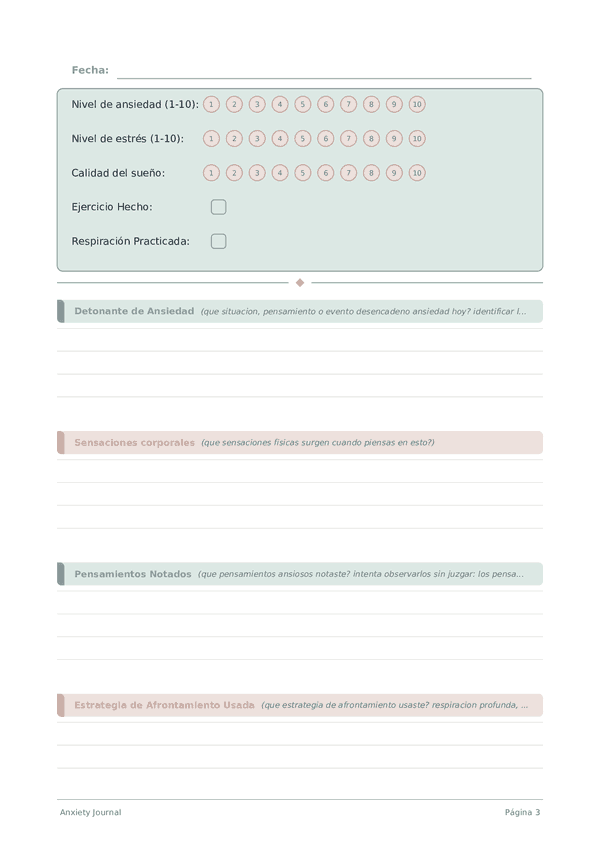
Que sensaciones fisicas surgen cuando piensas en esto?
Detonantes
Identifica que causo tus reacciones emocionales: eventos, personas, pensamientos, entornos. Reconocer los desencadenantes te da el poder de prepararte o evitarlos.
Estrategias de afrontamiento
Que hiciste para afrontarlo? Respiracion profunda, caminar, hablar...
Lección emocional
Que te revelo esta emocion sobre tus valores, necesidades o limites? Cada sentimiento lleva un mensaje que vale la pena escuchar
Gratitud por la emoción
Incluso las emociones dificiles tienen significado: por que estas agradecido gracias a lo que sentiste hoy?
Consejos para el exito
Cuando y con que frecuencia escribir
Write at the end of your day, when emotions from the day are still fresh but you have some distance from them. If a strong emotion hits during the day, jot a quick note to expand on later. Daily practice is ideal for building emotional awareness, but even 3–4 times per week will sharpen your ability to name and navigate feelings.
Preguntas frecuentes
¿Cuánto debo detallar la sección 'emociones que sentí hoy'?
Mucho. La investigación sobre granularidad emocional (Kashdan, Barrett, McKnight, 2015, Current Directions in Psychological Science, 24(1)) muestra que quienes distinguen emociones finas —'frustrado', 'resentido', 'humillado' en lugar de solo 'mal'— regulan mejor las emociones y recurren menos al alcohol o la agresión bajo estrés. Usa las tres líneas para nombrar sentimientos distintos, no una sola palabra genérica.
¿Para qué sirve registrar 'sensaciones corporales'?
Las emociones emergen como señales físicas antes de las etiquetas conscientes. El vínculo interoceptivo-emocional está documentado en Critchley y Garfinkel (2017, Current Opinion in Psychology, 17). Nombrar dónde sientes tensión, calor o pesadez mejora lo que Hayes (Terapia de Aceptación y Compromiso) llama defusión cognitiva: observar el sentimiento en lugar de fusionarte con él. Dos líneas bastan para un escaneo corporal rápido.
¿Cómo identificar con precisión un 'trigger'?
Usa las tres líneas para mapear la situación, el pensamiento y la emoción en secuencia: el modelo A-B-C del REBT de Albert Ellis y la terapia cognitiva de Aaron Beck ('Cognitive Therapy and the Emotional Disorders', 1976). El desencadenante rara vez es el evento solo; es el significado que tu mente le asignó. Anotar los tres elementos expone la valoración que impulsó la emoción.
¿Qué cuenta como 'coping strategy' saludable para registrar?
Distingue aproximación de evitación. El modelo transaccional de Folkman y Lazarus y el inventario COPE de Carver categorizan las estrategias en centradas en el problema, centradas en la emoción o de evitación. Registra lo que realmente hiciste, incluyendo el afrontamiento poco útil como el scrolling o comer. El seguimiento honesto revela patrones. Aldao, Nolen-Hoeksema, Schweizer (2010, Clinical Psychology Review, 30(2)) hallaron que la rumiación y la supresión predicen peores resultados que la revaluación.
¿Es este diario lo mismo que un rastreador de estado de ánimo?
No. Los rastreadores usan puntuaciones numéricas; este diario desarrolla la granularidad emocional a través del relato. Las tres líneas para emociones que sentí hoy, más sensaciones corporales, triggers y lesson, siguen el formato de escritura expresiva de Pennebaker (1997, Psychological Science, 8(3)), que produjo beneficios que las puntuaciones solas no logran. Combínalo con un rastreador para obtener datos completos.
¿Qué significa 'lección emocional' y cómo encuentro uno?
Cada emoción señala una necesidad insatisfecha o un valor vulnerado. El marco RULER de Marc Brackett (Yale Center for Emotional Intelligence) y el trabajo de Susan David sobre 'agilidad emocional' tratan las emociones como información. Pregúntate: ¿qué quiere que note este sentimiento sobre mis límites, valores o necesidades? Tres líneas es espacio para una sola idea honesta, no una filosofía completa.
¿Puedo usarlo para emociones difíciles como la ira o la vergüenza?
Sí, esa es su fortaleza. Suprimir emociones empeora los resultados (Gross, 2002, Psychophysiology, 39(3)). Nombrar emociones difíciles en papel, incluido gratitud por la emoción al final, apoya lo que la DBT de Linehan llama 'aceptación radical'. Si la vergüenza, la ira o el duelo se sienten abrumadores o persistentes, consulta a un profesional de salud mental con licencia como complemento al diario.
¿Con qué frecuencia debo rellenarlo para ver resultados?
Apunta a diario durante períodos emocionalmente activos; tres o cuatro veces por semana en otros momentos. Burton y King (2004, Journal of Research in Personality, 38(2)) encontraron que la escritura expresiva de dos minutos durante tres días produjo mejoras medibles en el bienestar. La constancia importa más que la extensión. Revisa semanalmente para detectar qué desencadenantes y estrategias se repiten.
También Te Puede Gustar
Rueda para ampliar, arrastra para mover