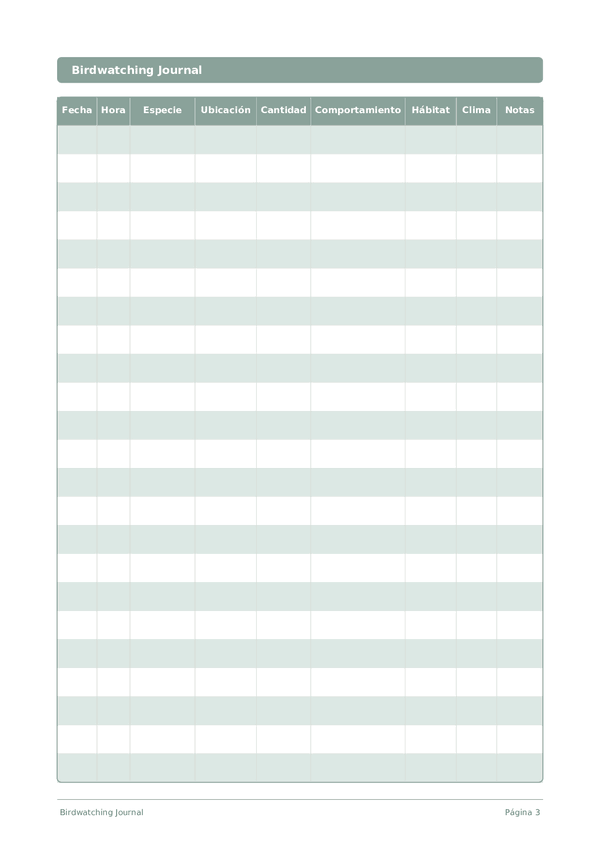
Printable Birdwatching Journal
Record every bird sighting with species, habitat, and behavior
A structured field log designed for birders of all levels. Capture species, location, count, behavior, habitat, and weather conditions for every sighting. Build a detailed life list, track seasonal migrations, and spot long-term patterns in bird activity across different habitats.
Personalizar campos
Activa o desactiva campos. Haz clic en el lápiz para renombrar, o añade tus propios campos.
Beneficios
Cómo Usar
¿Qué es este diario?
A birdwatching journal is a structured observation log for recording every bird you spot in the field. By documenting species, location, behavior, and habitat conditions, you build a personal birding database that tracks your growing knowledge and reveals patterns in bird activity across seasons and locations.
This journal is for birders at every level — from backyard bird feeders to dedicated listers pursuing life lists. It is equally valuable whether you are learning to identify your first ten species or tracking rare migrants at a known hotspot.
Citizen science research has shown that personal birding records contribute significantly to understanding bird populations and migration patterns. Beyond contributing to collective knowledge, the practice of careful observation and recording trains your eyes and ears to detect subtle differences — the skill that separates casual observers from skilled birders.
Ejemplo completado
Así es como se ve una entrada típica cuando se rellena:
| Fecha | Hora | Especie | Ubicación | Cantidad | Comportamiento | Hábitat | Clima | Notas |
|---|---|---|---|---|---|---|---|---|
| 2025-03-04 | 7:15 | Northern Cardinal | Riverside Park, feeder area | 2 | Male singing from top of oak; female foraging below feeder | Suburban park, mixed deciduous, near water | Overcast, 8C, calm | Bright red male very vocal — territorial song. Pair seems resident. |
| 2025-03-04 | 7:30 | Black-capped Chickadee | Riverside Park, willow grove | 4 | Active foraging flock moving through willows, hanging upside down on twigs | Willow grove near river bank | Overcast, 8C, calm | Mixed with Tufted Titmice. Very active and vocal — "chick-a-dee-dee-dee" calls. |
| 2025-03-04 | 8:05 | Great Blue Heron | Riverside Park, river shallows | 1 | Standing motionless in ankle-deep water, hunting. Struck once — missed. | River shallows, rocky bottom, overhanging willows | Overcast, mist clearing, 9C | Same individual as last Tuesday? Same spot. Patient hunter. Stood for 20 min without moving. |
| 2025-03-04 | 8:20 | Red-tailed Hawk | Above Riverside Park, soaring | 1 | Soaring in wide circles, gaining altitude, then heading east | Open sky above park and fields | Cloud breaking, thermals starting | Light morph adult. Beautiful contrast against grey sky. All songbirds went quiet. |
Cómo rellenar cada campo
Cada pagina es una tabla con columnas. Completa una fila por entrada. Esto es lo que significa cada columna:
Fecha
Escribe la fecha de hoy. Esto ancla tu entrada en el tiempo y ayuda cuando revisas entradas despues.
Hora
Registra la hora de la medicion o evento. La consistencia en los horarios hace que los datos sean comparables y revela patrones segun la hora del dia.
Especie
Nombre de la especie de pez capturada
Ubicación
Donde se tomo la foto?
Cantidad
Comportamiento
Hábitat
Clima
Soleado, nublado, lluvia, viento: condiciones actuales
Notas
Agrega cualquier contexto o pensamiento adicional. Esta columna general es para cualquier cosa que no encaje en otro lugar pero pueda ser util despues.
Consejos para el exito
Cuando y con que frecuencia escribir
Log every birding outing immediately, whether it is a dedicated trip or a casual backyard observation. Fill in one row per species sighted per session. Weekly birders should review their log monthly to track species diversity trends. During migration seasons (spring and fall), daily logging is especially valuable. At the end of each year, review your complete log to calculate your annual species count and compare it to previous years.
Preguntas frecuentes
¿Qué campos hacen que un avistamiento sea útil para la ciencia ciudadana?
El protocolo eBird del Cornell Lab of Ornithology requiere especie, fecha, hora, ubicación, conteo y hábitat, exactamente las columnas que ofrece este diario. Añadir comportamiento y clima eleva aún más el valor científico. Los protocolos de campo de la Audubon Society coinciden en el mismo conjunto mínimo. Tu registro impreso puede transcribirse más tarde a eBird, contribuyendo con registros utilizables a los conjuntos de datos de migración y abundancia que los investigadores analizan.
¿Debo registrar el nombre común o el científico de las especies?
Cualquiera funciona si eres constante. Cornell Lab y eBird aceptan nombres comunes en inglés emparejados con listas estandarizadas; iNaturalist y la IOC World Bird List usan binomios científicos para la identificación inequívoca. Para el avistamiento en varios idiomas o para especies raras, escribe ambos: «Mirlo común (Turdus merula)». La columna de especie es ancha precisamente para permitir esta doble notación cuando sea necesario.
¿Qué nivel de detalle debe tener la columna de hábitat?
El suficiente para que un desconocido pudiera encontrar el mismo microhábitat. Las guías de registro de la RSPB y la Audubon distinguen biomas amplios de microhábitats: «borde de bosque caducifolio, estrato medio del dosel» supera a «bosque». La resolución del hábitat impulsa el valor analítico de los registros a largo plazo: te permite correlacionar la presencia de especies con el tipo de vegetación, la proximidad al agua y el nivel de perturbación cuando revisas los patrones.
¿Qué se considera una nota de comportamiento útil?
Comportamientos que señalan el rol ecológico: alimentación (y de qué), canto, llamada, cortejo, anidación, altura de forrajeo, mobbing, migración. Las cuentas de Birds of the World de Cornell catalogan los comportamientos por especie: tus notas alimentan el mismo vocabulario. Evita entradas vagas como «activo». Los verbos concretos como «espigando insectos de la corteza del roble» hacen las entradas recuperables y revelan patrones de uso del hábitat que los simples conteos no pueden mostrar.
¿En qué se diferencia esto de la app Merlin o eBird?
Merlin identifica especies; eBird registra listas de verificación. Ambos dependen de la batería del teléfono y la atención a la pantalla, lo que puede romper el silencio que los pájaros recompensan. Este registro en papel libera tus ojos y oídos, te permite esbozar marcas de campo que Merlin no puede capturar, y produce un registro permanente independiente de cambios de cuenta. Muchos pajareros serios usan ambos: la app en el momento, el papel para la permanencia.
¿Cómo afecta el clima a lo que verás?
De forma significativa. Las guías de campo de la RSPB y Cornell Lab señalan que las mañanas nubladas pueden prolongar la actividad del coro del amanecer, los frentes desencadenan caídas durante la migración, y los vientos fuertes reducen la detección de pájaros cantores. Registrar la columna de clima junto a las especies te permite correlacionar con el tiempo: eventualmente reconocerás qué condiciones en tu zona producen las mejores horas de observación.
¿Cuánto tiempo tarda en aparecer patrones en mi registro?
Aproximadamente un año completo. Los ciclos anuales necesitan 12 meses para aflorar: las primeras llegadas, el pico de migración, la reproducción, la partida. Con 14 filas por página, los pajareros semanales llenan una página por temporada. Los datos de eBird del Cornell Lab muestran que las listas personales plurianuales mejoran significativamente la habilidad de detección año tras año. Los patrones de cronología migratoria se vuelven predictivos tras dos o tres ciclos anuales.
¿Es este diario apto para principiantes absolutos?
Sí. Los principiantes se benefician más de la estructura: forzar campos como conteo y comportamiento entrena la atención disciplinada que distingue a los pajareros de los observadores ocasionales. Los materiales de Bird Academy del Cornell Lab recomiendan llevar registros desde el primer día aunque solo identifiques tres especies comunes por salida. La columna de notas admite identificaciones inciertas: escribe «gorrión, pecho estriado, pinar» hasta que puedas confirmarlo.
También Te Puede Gustar
Rueda para ampliar, arrastra para mover