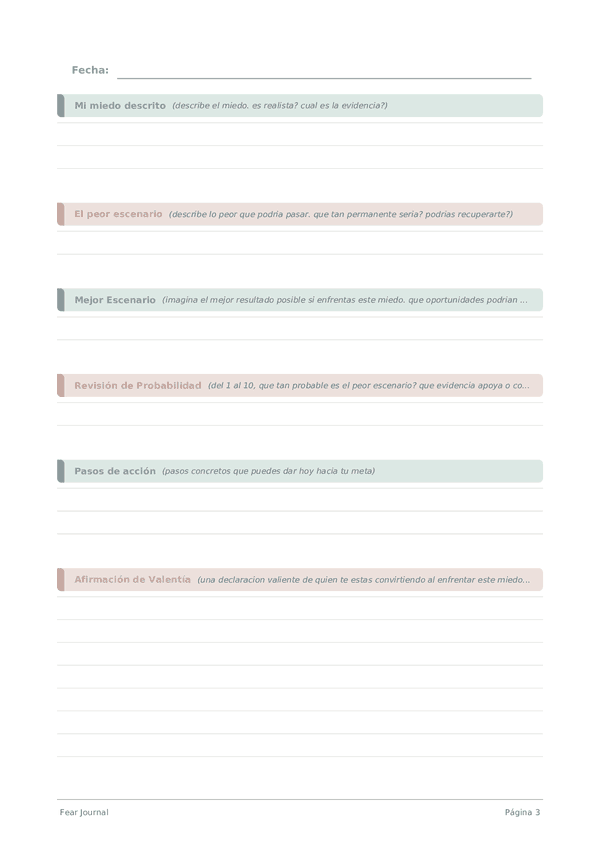
Printable Fear Journal
Fear exploration and courage-building journal
Face your fears with structured analysis and courageous action. Based on fear-setting methodology, this journal helps you examine fears rationally, envision outcomes, and take the steps that transform fear into freedom.
Personalizar campos
Activa o desactiva campos. Haz clic en el lápiz para renombrar, o añade tus propios campos.
¿Qué es este diario?
A fear journal is a structured practice for confronting and dismantling the fears that hold you back. Each entry walks you through describing a fear, examining worst and best case scenarios, reality-testing the probability, and identifying concrete steps to move forward despite the fear.
This journal is for anyone who feels stuck, anxious, or held back by fears — whether rational or irrational. It works for major life fears (career changes, public speaking, relationship vulnerability) as well as the quiet, daily anxieties that accumulate and constrict your life over time.
Research from exposure therapy and cognitive behavioral therapy shows that naming fears precisely and examining them objectively reduces their emotional charge. The structured format of this journal mirrors the therapeutic technique of "cognitive defusion" — creating distance between you and your fearful thoughts so you can see them clearly rather than be controlled by them.
Ejemplo completado
Así es como se ve una entrada típica cuando se rellena:
Cómo rellenar cada campo
Cada dia encontraras varias secciones etiquetadas con lineas para escribir. Esto es lo que significa cada seccion:
Mi miedo descrito
Describe aquello a lo que le temes en detalle. A menudo los miedos se encogen cuando los pones en papel. Se honesto: este diario es solo para tus ojos.
El peor escenario
Escribe el peor escenario posible. Luego preguntate: que tan probable es realmente? Y si ocurriera, podria sobrevivir? Generalmente, la respuesta es si.
Mejor Escenario
Imagina el mejor resultado posible si enfrentas este miedo. Que oportunidades podrian abrirse?
Revisión de Probabilidad
Del 1 al 10, que tan probable es el peor escenario? Que evidencia apoya o contradice tu miedo?
Pasos de acción
Divide tu meta en acciones concretas. Que exactamente haras, cuando y como? Cuanto mas especifico, mejor.
Afirmación de Valentía
Una declaracion valiente de quien te estas convirtiendo al enfrentar este miedo. Escribela en tiempo presente.
Consejos para el exito
Cuando y con que frecuencia escribir
Write whenever a fear feels strong enough to influence your decisions — this could be daily or several times a week. The key is capturing the fear while it is active, not after it has passed. Spend 10 minutes examining one fear per entry rather than listing many superficially. Weekly, review your fear entries and notice patterns: are they clustered around certain themes (rejection, failure, loss)? Monthly, celebrate the fears you confronted. This journal is most effective as an as-needed tool with a weekly review ritual.
Preguntas frecuentes
¿Qué es la metodología 'fear-setting' que usa este diario?
El fear-setting es un análisis estructurado del miedo popularizado por Tim Ferriss pero arraigado en la premeditación estoica (Séneca, Epicteto) y el análisis de decisiones. La secuencia el peor escenario, mejor Escenario, revisión de Probabilidad y pasos de acción del diario refleja el análisis de decisiones de Edwards (1954, Psychological Bulletin, 51(4)) e investigaciones contemporáneas de toma de decisiones estructurada: examinar resultados explícitamente debilita la anticipación catastrófica vaga que impulsa la evitación.
¿Cómo ayuda escribir el 'el peor escenario'?
Usa la exposición imaginal combinada con la reestructuración cognitiva. Beck ('Cognitive Therapy and the Emotional Disorders', 1976) y la TCC basada en exposición (Foa y Kozak, 1986, Psychological Bulletin, 99(1)) muestran que especificar los resultados temidos reduce su poder. El miedo vago sigue siendo catastrófico; los peores casos nombrados suelen verse como superables. Dos líneas obligan a la especificidad: ¿qué ocurre concretamente si se produce el resultado temido?
¿Por qué incluir 'mejor Escenario' si el foco es el miedo?
Para restaurar el pensamiento equilibrado. Las distorsiones cognitivas como la catastrofización se centran exclusivamente en lo negativo. La TCC de Beck usa explícitamente el equilibrio de evidencia —incluyendo posibilidades positivas y negativas— para debilitar el dominio de las distorsiones. Dos líneas bastan para un mejor caso creíble, no utopía. El contraste con el peor escenario calibra las estimaciones de probabilidad que formaliza revisión de Probabilidad.
¿Cómo hago 'revisión de Probabilidad' con honestidad?
Valora la probabilidad realista de que el el peor escenario ocurra en una ventana definida. Kahneman ('Thinking, Fast and Slow', 2011) y su investigación con Tversky sobre la heurística de disponibilidad muestran que los miedos vívidos se sienten más probables de lo que son. Dos líneas: valora de 0-100 % y una frase sobre la evidencia que respalda tu estimación. La calibración mejora con la práctica repetida en varios miedos.
¿Qué va en 'pasos de acción' para el trabajo con el miedo?
Dos categorías: pasos para prevenir el el peor escenario y pasos para recuperarse si ocurre. Esta planificación dual subyace a la flexibilidad psicológica (ACT de Hayes) y a la investigación sobre toma de decisiones preparadas. Tres líneas dan espacio para ambas. El lado de la recuperación importa más: saber que podrías manejar lo peor desactiva el miedo más que los planes de prevención solos.
¿Es seguro para la ansiedad clínica o las fobias?
Con cuidado. Las fobias específicas, el trastorno de pánico y el TEPT responden mejor a la terapia de exposición con un clínico capacitado (directrices del NIMH sobre trastornos de ansiedad). La escritura desestructurada sobre miedos para la ansiedad severa puede convertirse en rumiación. Si los miedos son incapacitantes, consulta a un profesional de salud mental con licencia. Este diario complementa el trabajo de TCC/exposición como herramienta entre sesiones.
¿Qué es una buena 'afirmación de Valentía'?
Un enunciado de identidad creíble, no un eslogan. Cohen y Sherman (2014, Annual Review of Psychology, 65) sobre la autoafirmación mostraron que los enunciados basados en valores eran efectivos; el genérico 'soy valiente' menos. Mejor: 'Soy alguien que actúa a pesar del miedo cuando la acción importa', verificable a través de tus pasos de acción. La línea única es intencional: un enunciado, no una lista.
¿Con qué frecuencia debo hacer un análisis del miedo?
Según necesidad, no a diario. El fear-setting funciona como intervención dirigida cuando evitas una decisión o acción específica. Repetirlo a diario sobre el mismo miedo puede convertirse en rumiación: Watkins (2008, Psychological Bulletin, 134(2)) encontró que el pensamiento negativo repetitivo empeora el estado de ánimo y la calidad de las decisiones. Úsalo una vez por cada miedo significativo y vuelve solo cuando aparezca información nueva.
También Te Puede Gustar
Rueda para ampliar, arrastra para mover