Printable Forgiveness Journal
Guided forgiveness practice and emotional release journal
Free yourself from resentment through guided forgiveness journaling. Based on the REACH model of forgiveness, explore your feelings, develop empathy, and make the conscious choice to release what no longer serves you.
Personalizar campos
Activa o desactiva campos. Haz clic en el lápiz para renombrar, o añade tus propios campos.
¿Qué es este diario?
A forgiveness journal is a guided writing practice for processing hurt and resentment through structured reflection. Each entry invites you to explore a situation that caused pain, examine your feelings, practice empathy, and work toward releasing the emotional weight you carry.
This journal is for anyone holding onto grudges, past wounds, or self-blame that drains their energy and limits their present. Forgiveness does not mean excusing harmful behavior — it means choosing to free yourself from the ongoing burden of resentment. This journal supports both forgiving others and forgiving yourself.
Research from Stanford's Forgiveness Project shows that structured forgiveness practices reduce anger, stress, and depression while increasing optimism and self-confidence. The process of writing about pain with the explicit intention of release activates different neural pathways than rumination, turning repetitive hurt into progressive healing.
Ejemplo completado
Así es como se ve una entrada típica cuando se rellena:
Cómo rellenar cada campo
Cada dia encontraras varias secciones etiquetadas con lineas para escribir. Esto es lo que significa cada seccion:
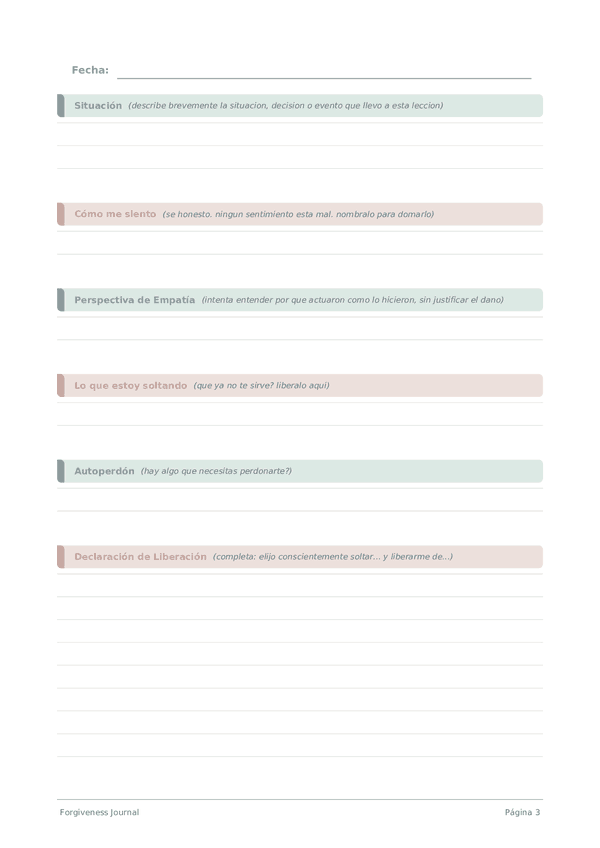
Situación
Describe la situacion o evento objetivamente, como si fueras un observador neutral. Separar los hechos de los sentimientos te ayuda a ver las cosas con mas claridad.
Cómo me siento
Describe como te sientes ahora mismo con tus propias palabras. No hay respuestas incorrectas. Simplemente poner los sentimientos en papel reduce su carga emocional.
Perspectiva de Empatía
Intenta entender por que actuaron como lo hicieron, sin justificar el dano
Lo que estoy soltando
Escribe algo que estas listo para soltar: una preocupacion, un resentimiento o una expectativa. Nombrar lo que sueltas es el primer paso hacia la libertad.
Autoperdón
Hay algo que necesitas perdonarte?
Declaración de Liberación
Completa: Elijo conscientemente soltar... y liberarme de...
Consejos para el exito
Cuando y con que frecuencia escribir
Write 2-3 times per week, dedicating each entry to one forgiveness topic. This is deep emotional work, and daily entries on the same wound can feel overwhelming. Alternate between forgiving others and forgiving yourself. Spend 15-20 minutes per entry — forgiveness journaling requires more time than typical journals because you need space to process emotions fully. Monthly, re-read your entries to see how your feelings toward specific situations have evolved. Some wounds take months to process; patience with yourself is part of the practice.
Preguntas frecuentes
¿Qué es el modelo REACH?
REACH es el modelo de perdón de Everett Worthington: Recall (recordar el daño), Empathize (empatizar), Altruistic gift (regalo altruista), Commit (comprometerse), Hold on (mantener). Worthington y Scherer (2004, Psychology and Health, 19(3)) y ensayos aleatorizados posteriores documentaron sus efectos sobre la hostilidad y el bienestar. Las secciones del diario —situation, feelings, perspectiva de Empatía, lo que estoy soltando, declaración de Liberación— se mapean directamente a la secuencia REACH.
¿El perdón significa aprobar lo que ocurrió?
No. La investigación de Worthington y los recursos de la APA sobre el perdón distinguen explícitamente entre perdonar, aprobar, olvidar o reconciliarse. El perdón es una liberación interna del resentimiento; la reconciliación requiere a la otra parte. La sección lo que estoy soltando del diario aborda tu relación con el daño, no la responsabilidad del ofensor. Puedes perdonar sin contacto ni confianza.
¿Cómo escribir 'perspectiva de Empatía' sin minimizar el daño?
El modelo de Worthington usa la empatía para suavizar el afecto sin justificar el comportamiento. Dos líneas: escribe qué factores podrían explicar las acciones de la otra persona, sin excusarlas. McCullough, Pargament, Thoresen (2000, 'Forgiveness: Theory, Research, and Practice', Guilford) describen esto como humanizar sin absolver. El daño sigue siendo daño; la empatía reduce la rumiación que sostiene tu sufrimiento.
¿Por qué incluir 'autoperdón'?
El autoperdón es un constructo distinto al de perdonar a otros. Hall y Fincham (2005, Journal of Social and Clinical Psychology, 24(5)) y Wohl, DeShea, Wahkinney (2008, Canadian Journal of Behavioural Science, 40(1)) mostraron que el autoperdón reduce la depresión y la vergüenza cuando se combina con responsabilidad. Dos líneas obligan al trabajo más difícil: nombra de qué te arrepientes, luego ofrécete la misma liberación que darías a otro.
¿Qué debe hacer 'declaración de Liberación'?
Funciona como un compromiso conductual: lo que Worthington llama 'aferrarse al perdón'. La única línea cristaliza la elección. Karremans et al. (2003, JPSP, 84(5)) encontraron que los enunciados explícitos de perdón predijeron mejores resultados que las intenciones vagas. Escríbelo en tiempo presente, asumiendo la decisión: 'Libero el peso de esto' en lugar de 'lo intentaré'.
¿Es adecuado el diario de perdón para el trauma?
Con precaución. Worthington y otros (Wade, Hoyt, Kidwell, Worthington, 2014, Journal of Counseling Psychology, 61(2), metaanálisis) encontraron intervenciones de perdón efectivas para muchos, pero el perdón presionado puede dañar a los supervivientes de trauma. Si el daño involucra abuso, agresión o trauma sostenido, consulta a un profesional de salud mental con licencia y formación en trauma antes del trabajo sostenido de perdón. El perdón prematuro puede agravar el daño.
¿Cuánto tiempo lleva este trabajo?
De días a meses según la gravedad del daño. Worthington y Scherer (2004, Psychology and Health, 19(3)) y Wade et al. (2014, Journal of Counseling Psychology, 61(2)) encontraron que los efectos de la intervención escalaron con el número de sesiones y la profundidad del daño. El diario puede revisitarse para la misma situación durante semanas; el progreso en la misma herida es un patrón normal, no una señal de que la práctica fracasó.
¿Perdonar a alguien reconciliará la relación?
No necesariamente. El perdón es interno; la reconciliación requiere el trabajo de reparación de la otra parte. Los recursos de la APA sobre el perdón y la literatura clínica los tratan como elecciones separables. El diario apoya el perdón —tu paz— sin requerir contacto ni confianza restaurada. Algunos perdonan sin reconciliarse; otros se reconcilian sin un perdón completo. El declaración de Liberación es solo tuyo.
También Te Puede Gustar
Rueda para ampliar, arrastra para mover