Printable Inner Child Journal
Inner child healing and reparenting journal
Heal childhood wounds and nurture your inner child through compassionate journaling. Explore memories, write letters to your younger self, and take reparenting actions that provide the love and safety your child self needed.
¿Qué es este diario?
An inner child journal is a freeform writing practice that helps you reconnect with the younger version of yourself — your needs, wounds, joys, and the parts of you that still seek healing. Through guided prompts about emotions, childhood memories, and letters to your younger self, you begin the gentle work of reparenting.
This journal is for anyone who senses that old patterns from childhood still influence their adult life — people-pleasing, fear of abandonment, difficulty setting boundaries, or an inner critic that sounds suspiciously like a parent or teacher from the past.
Rooted in Internal Family Systems therapy and attachment theory, inner child work has gained significant clinical support. Writing to and about your younger self activates self-compassion circuits in the brain, and studies show that this form of reflective writing can reduce symptoms of anxiety, depression, and PTSD by reprocessing formative emotional experiences with adult perspective and care.
Ejemplo completado
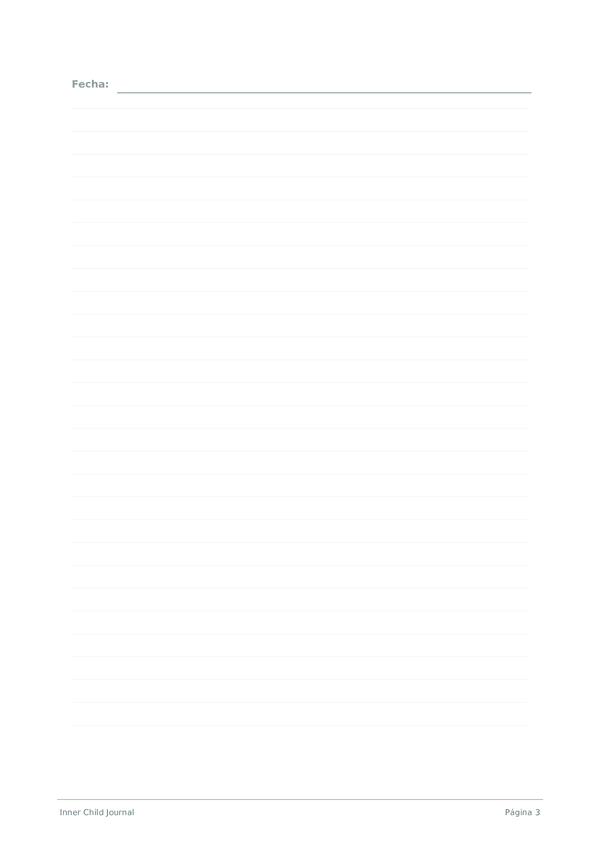
Así es como se ve una entrada típica cuando se rellena:
Consejos para el exito
Cuando y con que frecuencia escribir
This is a freeform journal — write when emotions call you to it, not on a rigid schedule. Many people find 2-3 sessions per week sustainable for deep inner child work. Each session may take 15-30 minutes because this writing accesses deeper emotional layers. If a session brings up intense feelings, write the next day to process the aftereffects. Take breaks when needed — this work is not meant to be rushed. Monthly, re-read your letters to your inner child and notice how the relationship with yourself is healing.
Preguntas frecuentes
¿Qué es psicológicamente el trabajo con el 'niño interior'?
El trabajo con el niño interior explora partes del yo formadas en la infancia: emociones, necesidades y creencias desarrolladas antes de que existieran los recursos cognitivos adultos. El concepto aparece en el análisis transaccional (Eric Berne), la terapia de esquemas (Jeffrey Young; Young, Klosko, Weishaar, 2003, 'Schema Therapy', Guilford) y los Sistemas de Familia Interior (Richard Schwartz). Carta a mi yo más joven y acción de Reparentalización se basan en estas tradiciones clínicas.
¿Qué es 'reparenting' como práctica de diario?
El reparenting consiste en darte las respuestas que tu yo más joven necesitaba pero no recibió. Los Sistemas de Familia Interior de Schwartz y la terapia de esquemas de Young (Young, Klosko, Weishaar, 2003, 'Schema Therapy', Guilford) lo tratan como central para sanar las necesidades tempranas insatisfechas. El formato libre te invita a especificar una acción concreta hoy —escuchar, consolar, defender— dirigida a la parte niña de ti mismo.
¿Por qué incluir 'recuerdo de infancia'?
Los recuerdos específicos hacen concretos los patrones abstractos. La terapia de esquemas trata los recuerdos tempranos como contenedores de los esquemas emocionales que impulsan los patrones adultos (Young, Klosko, Weishaar, 2003, 'Schema Therapy', Guilford). El espacio libre invita a describir un recuerdo en presente y con detalle sensorial, emocional y relacional. Esto activa el esquema lo suficiente para trabajar con él; el resumen intelectual no alcanza el afecto.
¿Qué es la técnica 'carta a mi yo más joven'?
Escribir a tu yo más joven usa el diálogo imaginal, una técnica con respaldo en la terapia de esquemas y las tradiciones Gestalt. Arntz y Weertman (1999, Behaviour Research and Therapy, 37(8)) hallaron que el rescripting imaginal redujo el malestar emocional de los recuerdos de la infancia. El formato de carta te permite ofrecer las palabras, la comprensión o la protección que faltaron, actuando sobre la memoria emocional.
¿Es seguro hacerlo solo?
Depende de lo que surja. La reflexión suave sobre el niño interior es generalmente segura; el trabajo relacionado con el trauma no lo es. Briere y Scott ('Principles of Trauma Therapy', SAGE, 2014) y la atención informada por el trauma actual enfatizan el apoyo profesional cuando el material infantil implica abuso, negligencia o trauma de apego. Si los recuerdos desencadenan malestar persistente, flashbacks o disociación, consulta a un profesional de salud mental con formación en trauma.
¿Para qué sirve aquí la plantilla 'freeform'?
El trabajo con el niño interior no encaja en preguntas ordenadas. El formato libre con márgenes y guías, más cuatro sugerencias opcionales (emoción de hoy, recuerdo de infancia, carta a mi yo más joven, acción de Reparentalización), acomoda lo que surja. La investigación de escritura expresiva de Pennebaker (1997, Psychological Science, 8(3)) respaldó la escritura menos estructurada para el contenido emocionalmente cargado; las preguntas rígidas pueden cerrar el material.
¿En qué se diferencia de un diario de autocompasión?
La autocompasión apunta al autotrato del momento presente (Neff, 2003, Self and Identity, 2(2)). El trabajo con el niño interior apunta a capas de desarrollo anteriores: las partes que aprendieron que el valor era condicional. Ambos pueden complementarse: la autocompasión proporciona la postura cálida; el trabajo con el niño interior identifica las heridas que esa calidez sana. Usa ambos si los patrones de autocrítica se remontan a material infantil.
¿Con qué frecuencia debo hacer el trabajo con el niño interior?
Semanalmente o cuando se desencadene, no a diario. El material del niño interior es emocionalmente exigente; el trabajo en profundidad diario arriesga la desestabilización. Los protocolos clínicos de la terapia de esquemas (Young, Klosko, Weishaar, 2003) distribuyen típicamente el trabajo imaginal en sesiones terapéuticas semanales. El formato libre del diario es adecuado para entradas menos frecuentes y más largas. Si el material se acumula sin resolución, el apoyo profesional acelera el progreso.
También Te Puede Gustar
Rueda para ampliar, arrastra para mover