Printable Mindfulness Journal
Anchor yourself in the present moment with MBSR-inspired daily writing
The Mindfulness Journal is built on evidence-based principles from Mindfulness-Based Stress Reduction (MBSR), developed by Jon Kabat-Zinn at the University of Massachusetts. Each daily entry guides you through a structured sequence: setting an intention, scanning your body, sharpening sensory awareness, cultivating gratitude, and practicing self-compassion. By writing without judgment, you train your attention to rest in the present — the foundation of every proven mindfulness program.
Personalizar campos
Activa o desactiva campos. Haz clic en el lápiz para renombrar, o añade tus propios campos.
Beneficios
Cómo Usar
¿Qué es este diario?
A mindfulness journal is a daily writing practice designed to anchor you in the present moment and cultivate non-judgmental awareness. Rooted in Buddhist meditation traditions and adapted by modern psychology, mindfulness journaling combines structured reflection with contemplative exercises to reduce mental chatter and increase inner calm.
Research from Harvard Medical School and the University of Massachusetts shows that regular mindfulness practice reduces cortisol levels, shrinks the brain's stress center (amygdala), and strengthens areas associated with attention and emotional regulation. Writing is a particularly effective mindfulness tool because it forces you to slow down and articulate your inner experience.
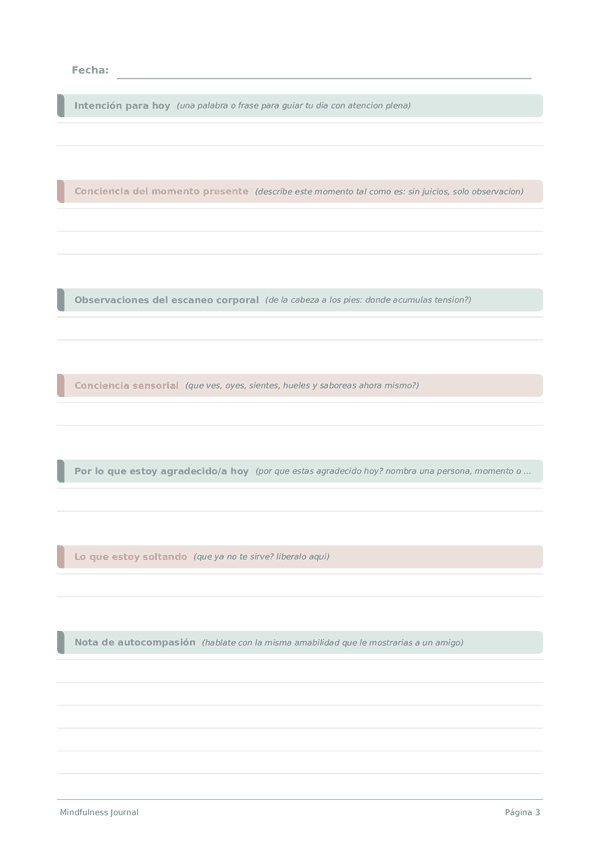
This journal guides you through seven focused sections: setting an intention, present-moment awareness, body scan observations, sensory awareness, gratitude, letting go, and self-compassion. Each section takes just 1-2 minutes, making the entire practice achievable in under 15 minutes.
Ejemplo completado
Así es como se ve una entrada típica cuando se rellena:
Cómo rellenar cada campo
Cada dia encontraras varias secciones etiquetadas con lineas para escribir. Esto es lo que significa cada seccion:
Intención para hoy
Una palabra o frase para guiar tu dia con atencion plena
Conciencia del momento presente
Describe lo que notas ahora mismo: sonidos, sensaciones, pensamientos. Esto te ancla en el presente y construye conciencia plena.
Observaciones del escaneo corporal
Escanea de la cabeza a los pies: donde hay tension, calor, entumecimiento o alivio? Simplemente observa sin intentar cambiar nada
Conciencia sensorial
Que ves, oyes, sientes, hueles y saboreas ahora mismo?
Por lo que estoy agradecido/a hoy
Enumera de 1 a 3 cosas por las que estas agradecido hoy. Pueden ser grandes o pequenas: una buena comida, una palabra amable, el sol. El diario de gratitud es una de las practicas de bienestar con mayor respaldo cientifico.
Lo que estoy soltando
Escribe algo que estas listo para soltar: una preocupacion, un resentimiento o una expectativa. Nombrar lo que sueltas es el primer paso hacia la libertad.
Nota de autocompasión
Hablate con la misma amabilidad que le mostrarias a un amigo
Consejos para el exito
Cuando y con que frecuencia escribir
Write once a day, ideally right after your meditation or mindfulness practice while awareness is heightened. Morning practice followed by immediate journaling is the most effective pattern — you capture insights while they're vivid. If you don't have a formal practice, use the journal itself as a 5-minute mindfulness exercise: sit, breathe, observe, then write.
Preguntas frecuentes
¿Qué es el MBSR y por qué está basado este diario en él?
El MBSR (Reducción del Estrés Basada en Mindfulness) fue desarrollado por Jon Kabat-Zinn en el Centro Médico de la Universidad de Massachusetts en 1979 y sigue siendo una de las intervenciones de mindfulness más estudiadas. Khoury et al. (2015, Journal of Psychosomatic Research, 78(6)) analizaron 29 estudios y hallaron efectos moderados del MBSR sobre el estrés y la ansiedad en adultos sanos. Las secciones del diario reflejan sus prácticas centrales.
¿Cómo hago correctamente 'observaciones del escaneo corporal'?
El escaneo corporal es una de las prácticas ancla del MBSR. Mueve la atención lentamente desde los pies hasta la cabeza, anotando sensación, temperatura, tensión o ausencia, sin intentar cambiar nada. Dos líneas bastan para un resumen: dónde notaste tensión, dónde había alivio. Kerr et al. (2013, Frontiers in Human Neuroscience, 7) encontraron que la práctica regular altera la regulación de la corteza somatosensorial.
¿Cuál es la diferencia entre mindfulness y relajación?
El mindfulness es la conciencia no enjuiciadora de la experiencia presente, incluido el contenido desagradable. La relajación busca reducir la activación. Kabat-Zinn los distingue explícitamente: el MBSR cultiva la ecuanimidad con lo que es, no sentimientos placenteros. Goyal et al. (2014, JAMA Internal Medicine, 174(3)) hallaron que los programas de mindfulness mejoraron la ansiedad y la depresión donde la simple relajación no igualó el tamaño del efecto.
¿Qué hace 'nota de autocompasión' en un diario de mindfulness?
La investigación de Kristin Neff sobre la autocompasión (Neff, 2003, Self and Identity, 2(2)) la identifica como una construcción hermana del mindfulness: tres pilares, mindfulness, humanidad común y autoamabilidad. Programas derivados del MBSR como el Mindful Self-Compassion (MSC) los integran. La línea final te entrena a dirigirte a ti mismo como lo harías con un amigo que atraviesa la misma dificultad.
¿Cómo se relaciona 'conciencia sensorial' con el anclaje?
Nombrar lo que ves, escuchas, tocas, hueles y saboreas es la técnica clásica de anclaje 5-4-3-2-1, usada en la atención informada por el trauma y en la tolerancia al malestar de la DBT (Linehan). Ancla la atención al presente sensorial, interrumpiendo los bucles de rumiación que Watkins (2008, Psychological Bulletin, 134(2)) identificó como transdiagnósticos. Las dos líneas obligan a seleccionar datos vívidos del momento presente.
¿Debo escribir en el diario antes o después de meditar?
Después. La intención puede establecerse antes, pero body scan, conciencia sensorial y lo que estoy soltando son más claros cuando ya te has sentado. Killingsworth y Gilbert (2010, Science, 330(6006)) mostraron que la mente errante correlaciona con menor felicidad; una breve sesión antes de escribir reduce la divagación y produce entradas más honestas. Incluso cinco minutos de conciencia de la respiración agudiza el resultado.
¿Es adecuado el diario de mindfulness durante la recuperación de un trauma?
Con precaución. Algunas personas con historial de trauma experimentan mayor angustia con el mindfulness centrado en el cuerpo: Treleaven ('Trauma-Sensitive Mindfulness', Norton, 2018) y Britton et al. (2021, Clinical Psychological Science, 9(6)) documentan efectos adversos. Si tienes historial de trauma, consulta a un profesional de salud mental con formación en trauma antes de una práctica sostenida. Modifica o acorta el body scan según necesites.
¿Cuánto tiempo tarda en producir resultados el diario de mindfulness?
El MBSR es un protocolo de 8 semanas porque es cuando emergen los cambios medibles. Tang, Holzel y Posner (2015, Nature Reviews Neuroscience, 16(4)) revisaron cambios neurales que aparecen en semanas. Las entradas diarias, incluso de diez minutos, a lo largo de 8 semanas alcanzan el umbral de dosis que usan la mayoría de estudios. La práctica inconsistente produce resultados inconsistentes; el diario apoya la adherencia.
También Te Puede Gustar
Rueda para ampliar, arrastra para mover