Printable Mood Journal
Track emotions, spot patterns, and build emotional awareness
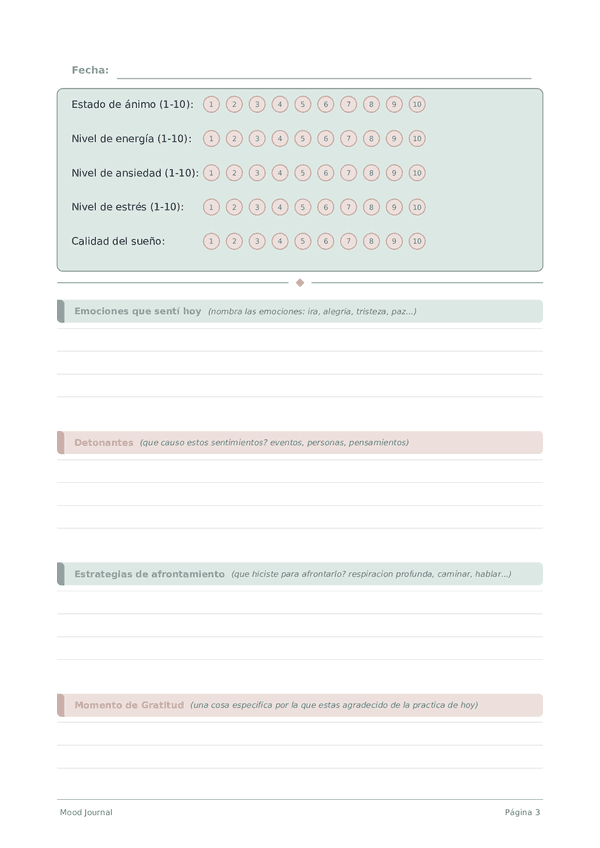
A comprehensive daily mood journal that combines quantitative tracking with reflective writing. Rate your mood, energy, anxiety, stress, and sleep quality each day, then explore what emotions you felt, what triggered them, how you coped, what you are grateful for, and what patterns you noticed. Grounded in cognitive behavioral therapy and positive psychology research, this hybrid format helps you develop emotional intelligence, recognize recurring triggers, and build a personalized toolkit for emotional resilience.
Personalizar campos
Activa o desactiva campos. Haz clic en el lápiz para renombrar, o añade tus propios campos.
Beneficios
Cómo Usar
¿Qué es este diario?
A mood journal is a daily self-monitoring tool that helps you understand the connection between your emotions, energy, sleep, and daily experiences. By tracking your mood numerically alongside written reflections, you create a personal emotional map that reveals patterns invisible in the moment.
Mood tracking is widely recommended by therapists and psychologists as a foundational practice for emotional intelligence. It helps you identify what triggers negative moods, what activities boost your wellbeing, and how factors like sleep and stress interact with your emotional state. Over weeks, the data becomes genuinely insightful.
This journal combines quick numerical ratings (mood, energy, anxiety, stress, sleep quality) with guided writing prompts for deeper exploration. The hybrid format means you can fill in the tracker in under a minute on busy days, while the writing section invites you to dig deeper when you have more time.
Ejemplo completado
Así es como se ve una entrada típica cuando se rellena:
Cómo rellenar cada campo
La parte superior de cada pagina tiene campos de llenado rapido (calificaciones, casillas, numeros). Debajo hay una seccion con lineas para escribir. Esto es lo que significa cada campo:
Estado de ánimo (1-10)
Califica tu estado emocional general del dia. 1 significa muy bajo o deprimido, 10 significa excepcionalmente feliz y positivo. No lo pienses demasiado: ve con tu instinto.
Nivel de energía (1-10)
Califica tu nivel de energia fisica y mental. 1 significa agotado y sin fuerzas, 10 significa totalmente energizado y alerta. Esto te ayuda a identificar que actividades aumentan o agotan tu energia.
Nivel de ansiedad (1-10)
Califica tu nivel de ansiedad hoy. Ponerle un numero hace que el sentimiento sea mas manejable y rastreable.
Nivel de estrés (1-10)
Califica tu estres en una escala del 1 al 10. Con el tiempo, identificaras tus patrones de estres y que estrategias de afrontamiento funcionan mejor.
Calidad del sueño
Califica que tan reparador fue tu sueno. 1 significa terrible y agitado, 5 significa profundo y refrescante. La calidad importa tanto como la cantidad.
Emociones que sentí hoy
Nombra las emociones especificas que experimentaste. Las investigaciones muestran que etiquetar las emociones reduce su intensidad y aumenta la autoconciencia.
Detonantes
Identifica que causo tus reacciones emocionales: eventos, personas, pensamientos, entornos. Reconocer los desencadenantes te da el poder de prepararte o evitarlos.
Estrategias de afrontamiento
Que hiciste para afrontarlo? Respiracion profunda, caminar, hablar...
Momento de Gratitud
Una cosa especifica por la que estas agradecido de la practica de hoy
Perspectiva del ánimo
Que patron o leccion sobre tus emociones notaste hoy?
Consejos para el exito
Cuando y con que frecuencia escribir
Fill in your mood tracker at the end of each day, ideally at the same time (before bed works well). The tracker numbers take under a minute. Add a few sentences of reflection — this is where the real insight lives. After two weeks, start reviewing your data weekly to spot which days score highest and what they have in common.
Preguntas frecuentes
¿Por qué cinco puntuaciones más narrativa superan a una sola puntuación de estado de ánimo?
Cinco escalas de 0-10 —mood, energy, nivel de ansiedad (1-10), nivel de estrés (1-10), calidad del sueño— separan constructos distintos que se mueven de forma independiente. La investigación PANAS de Watson, Clark y Tellegen (1988, JPSP, 54(6)) estableció que el afecto positivo y negativo no son extremos opuestos de un eje. Combinar números con narrativa captura tanto la forma dimensional de tu día como su significado.
¿Qué es 'perspectiva del ánimo' y cómo encuentro uno?
Perspectiva del ánimo es un patrón, lección u observación que notaste hoy sobre tu vida emocional. Es el paso de síntesis. El trabajo de Wilson y Gilbert sobre la previsión afectiva (2003, Advances in Experimental Social Psychology, 35) muestra que predecimos mal nuestras emociones sin datos. Escribir una sola observación semanal convierte sentimientos abstractos en autoconocimiento accionable.
¿Cuánto debo detallar 'emociones que sentí hoy'?
Usa palabras precisas, no 'bien' o 'mal'. Kashdan, Barrett, McKnight (2015, Current Directions in Psychological Science, 24(1)) mostraron que la granularidad emocional —distinguir 'solo' de 'rechazado' de 'aislado'— predice mejor regulación. La sección de 7 líneas da espacio para nombrar tres o cuatro sentimientos distintos. El 'perspectiva del ánimo' depende de esta resolución.
¿Cómo usa este diario la psicología positiva?
A través de momento de Gratitud y la sección de observación. El marco de psicología positiva de Seligman (Seligman et al., 2005, American Psychologist, 60(5)) integra la identificación de emociones positivas con la búsqueda de significado, ambas presentes aquí. Lyubomirsky ('The How of Happiness', Penguin, 2007) reporta que las prácticas de gratitud contribuyen a ganancias duraderas de bienestar. El formato híbrido combina esto con el seguimiento de desencadenantes al estilo TCC.
¿Qué patrones debo buscar después de un mes?
Haz tres comprobaciones: qué días de la semana correlacionan con bajo estado de ánimo, qué desencadenantes aparecen en más de tres entradas y si calidad del sueño precede el cambio de estado de ánimo del día siguiente. La investigación de Watson et al. sobre el afecto circadiano y semanal, y los patrones de rumiación de Watkins (2008, Psychological Bulletin, 134(2)) sugieren que la revisión semanal revela patrones invisibles día a día.
¿Debo hacer las puntuaciones de estado de ánimo a la misma hora cada día?
Sí, idealmente por la noche para la evaluación retrospectiva del día. La hora del día afecta fuertemente el estado de ánimo valorado (Stone et al., 2006, Emotion, 6(1), sobre patrones diurnos). Tomar muestras a horas diferentes mezcla ruido diurno en tu línea de tendencia. Elige una hora y mantenla; la consistencia en la medición revela cambios reales en lugar de artefactos de la hora del día.
¿Es suficiente para trastornos clínicos del estado de ánimo?
No. El diario apoya la conciencia de uno mismo y puede complementar el tratamiento, pero los trastornos del estado de ánimo diagnosticados —depresión mayor, trastorno bipolar, distimia— requieren atención clínica. Las directrices de la APA, el NIMH y la OMS recomiendan tratamiento basado en evidencia con un profesional de salud mental con licencia. Muchos clínicos usan gráficos de estado de ánimo junto a la terapia.
¿En qué se diferencia de las apps de seguimiento de emociones?
Las apps generan datos longitudinales pero reducen la reflexión a toques. El formato híbrido fuerza el procesamiento escrito: Lieberman et al. (2007, Psychological Science, 18(5)) mostraron que etiquetar emociones en palabras reduce la reactividad de la amígdala, un efecto producido por el lenguaje y no por la selección. El relato de siete líneas captura las valoraciones que impulsan las puntuaciones, lo que hace accionables los datos.
También Te Puede Gustar
Rueda para ampliar, arrastra para mover