Printable Self-Compassion Journal
Daily self-compassion practice and inner kindness journal
Cultivate genuine self-compassion through Kristin Neff three-pillar practice: mindfulness, common humanity, and self-kindness. Treat yourself with the same warmth and understanding you would offer a dear friend.
Personalizar campos
Activa o desactiva campos. Haz clic en el lápiz para renombrar, o añade tus propios campos.
¿Qué es este diario?
A self-compassion journal is a daily practice built on Dr. Kristin Neff's three pillars of self-compassion: mindfulness, common humanity, and self-kindness. Each entry guides you through recognizing suffering without over-identifying with it, remembering that struggle is universally human, and treating yourself with the same warmth you would offer a friend.
This journal is for anyone who tends to be their own harshest critic — perfectionists, overachievers, people-pleasers, and anyone who finds it easier to be compassionate to others than to themselves. It is particularly powerful during periods of failure, loss, or transition.
Research shows that self-compassion is a stronger predictor of mental health than self-esteem. While self-esteem depends on achievement and comparison, self-compassion provides a stable foundation of self-worth regardless of outcomes. Regular self-compassion practice has been shown to reduce cortisol, increase emotional resilience, and decrease symptoms of anxiety and depression.
Ejemplo completado
Así es como se ve una entrada típica cuando se rellena:
Cómo rellenar cada campo
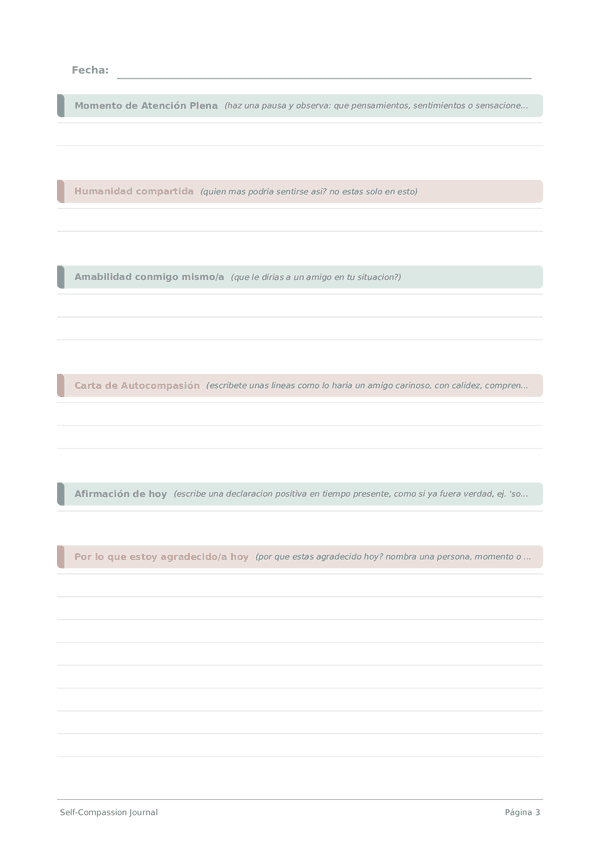
Cada dia encontraras varias secciones etiquetadas con lineas para escribir. Esto es lo que significa cada seccion:
Momento de Atención Plena
Haz una pausa y observa: que pensamientos, sentimientos o sensaciones estan presentes ahora, sin juzgar?
Humanidad compartida
Quien mas podria sentirse asi? No estas solo en esto
Amabilidad conmigo mismo/a
Escribete algo amable, como lo harias con un amigo querido pasando por la misma experiencia. La autocompasion es una habilidad que crece con la practica.
Carta de Autocompasión
Escribete unas lineas como lo haria un amigo carinoso, con calidez, comprension y aliento
Afirmación de hoy
Escribe una declaracion positiva sobre ti en tiempo presente, como si ya fuera verdad. Por ejemplo: 'Soy capaz y resiliente.' Repetir afirmaciones reprograma tus patrones de pensamiento con el tiempo.
Por lo que estoy agradecido/a hoy
Enumera de 1 a 3 cosas por las que estas agradecido hoy. Pueden ser grandes o pequenas: una buena comida, una palabra amable, el sol. El diario de gratitud es una de las practicas de bienestar con mayor respaldo cientifico.
Consejos para el exito
Cuando y con que frecuencia escribir
Write daily, ideally in the evening when you can reflect on moments of self-criticism from the day. Each entry takes 10 minutes. Focus on one moment of difficulty and walk through the three pillars: mindfulness (acknowledging pain without exaggerating), common humanity (recognizing others share this), and self-kindness (treating yourself gently). After three weeks of daily practice, self-compassion begins to feel less forced and more natural. Review weekly to notice which self-critical patterns are losing their grip.
Preguntas frecuentes
¿Cuáles son los tres pilares de la autocompasión de Kristin Neff?
Mindfulness, humanidad común y autoamabilidad, definidos en Neff (2003, Self and Identity, 2(2)) y desarrollados en sus trabajos revisados por pares posteriores. Las secciones del diario momento de Atención Plena, humanidad compartida y amabilidad conmigo mismo/a se mapean directamente. El programa Mindful Self-Compassion de Neff y Germer (Neff y Germer, 2013, Journal of Clinical Psychology, 69(1)) mostró mejoras medibles en el bienestar durante un protocolo de 8 semanas que usa esta estructura.
¿Qué va en 'humanidad compartida'?
El reconocimiento de que la lucha que afrontas te conecta con otros en lugar de aislarte. Neff (2003, Self and Identity, 2(2)) identificó el aislamiento como un obstáculo central de la autocrítica: 'solo yo lucho con esto'. Dos líneas: nombra la dificultad y expresa cómo forma parte de la experiencia humana compartida. Esto reencuadra el autojuicio como un patrón universal, no un defecto personal.
¿En qué se diferencia 'amabilidad conmigo mismo/a' de la indulgencia?
Neff y Vonk (2009, Journal of Personality, 77(1)) distinguieron explícitamente la autocompasión de la autoindulgencia: la autocompasión implica tratarte con cuidado mientras apoyas el crecimiento, no evitar lo difícil. Tres líneas bastan para la amabilidad que mantiene la responsabilidad, no para el permiso de desconectarte. 'Voy a descansar esta noche' difiere de 'voy a saltarme el plazo'.
¿Qué está diseñado para hacer 'carta de Autocompasión'?
Es una intervención basada en imágenes adaptada del programa MSC de Neff y Germer (Neff y Germer, 2013, Journal of Clinical Psychology, 69(1)). Tres líneas para escribirte como lo harías con un amigo en la misma situación. La investigación de Neff y la terapia centrada en la compasión de Gilbert (Gilbert, 2009, 'The Compassionate Mind', Constable) muestran que este ejercicio de escritura de carta suaviza la voz autocrítica.
¿La autocompasión reduce la motivación?
No, al contrario. Breines y Chen (2012, Personality and Social Psychology Bulletin, 38(9)) encontraron que la autocompasión tras el fracaso aumentó la motivación para mejorar en comparación con la autocrítica. La autocompasión proporciona la seguridad para reconocer los errores; la autocrítica dura a menudo desencadena la evitación. La estructura del diario apoya el autotrato orientado al crecimiento, no la complacencia.
¿Es adecuado durante la depresión?
A menudo beneficioso, aunque no curativo. MacBeth y Gumley (2012, Clinical Psychology Review, 32(6)) analizaron la autocompasión y la encontraron consistentemente asociada con menor psicopatología. La investigación MSC de Neff y Germer muestra beneficios en muestras subclínicas y clínicas. Para la depresión diagnosticada, consulta a un profesional de salud mental con licencia: la práctica de autocompasión complementa pero no reemplaza el tratamiento basado en evidencia.
¿En qué se diferencia del pensamiento positivo o las afirmaciones?
La autocompasión reconoce la dificultad en lugar de sobrepasarla. Neff y Vonk (2009, Journal of Personality, 77(1)) mostraron que la autocompasión producía un bienestar más estable que la autoestima porque no depende de evaluaciones positivas. La sección momento de Atención Plena invita explícitamente al contacto con el dolor; las prácticas de afirmación a menudo lo pasan por alto. Mecanismos diferentes, herramientas complementarias.
¿Cuánto tiempo hasta ver efectos?
Neff y Germer (2013, Journal of Clinical Psychology, 69(1)) usaron un protocolo MSC de 8 semanas con mejoras medibles en el bienestar. Las entradas diarias a lo largo de ese período aproximan la dosis. La autocrítica suele estar bien practicada durante años; espera resistencia al principio y cambios notables después de 4-8 semanas de entradas consistentes. El formato compacto de seis secciones hace que la completación diaria sea realista.
También Te Puede Gustar
Rueda para ampliar, arrastra para mover