Printable Shadow Work Journal
A guided journey into your shadow self for healing, integration, and wholeness
A structured journal for shadow work — the psychological practice of exploring the hidden, repressed, and rejected parts of yourself. Each session guides you through identifying a trigger, tracing its emotional and physical signature, uncovering the core belief beneath it, finding its origin, and integrating it with compassion. Based on Jungian psychology and inner child work.
Personalizar campos
Activa o desactiva campos. Haz clic en el lápiz para renombrar, o añade tus propios campos.
Beneficios
Cómo Usar
¿Qué es este diario?
A shadow work journal is a deep psychological practice for exploring the hidden, rejected, and unconscious parts of yourself. Drawing from Carl Jung's concept of the shadow, each entry guides you through identifying triggers, tracing them to core beliefs, exploring their origins, and integrating these disowned aspects into a more whole and authentic self.
This journal is for anyone engaged in serious self-exploration — people in therapy, spiritual seekers, and anyone who has noticed recurring patterns of self-sabotage, projection, or emotional reactivity that they cannot explain through surface-level analysis.
Jungian psychology holds that what we repress does not disappear — it drives our behavior from the unconscious. Shadow work makes the unconscious conscious, which Jung called "the essential task of the second half of life." Research on emotional integration shows that acknowledging and exploring difficult emotions reduces their power, while suppression amplifies them. This journal provides a structured, safe container for that courageous inner work.
Ejemplo completado
Así es como se ve una entrada típica cuando se rellena:
Cómo rellenar cada campo
Cada dia encontraras varias secciones etiquetadas con lineas para escribir. Esto es lo que significa cada seccion:
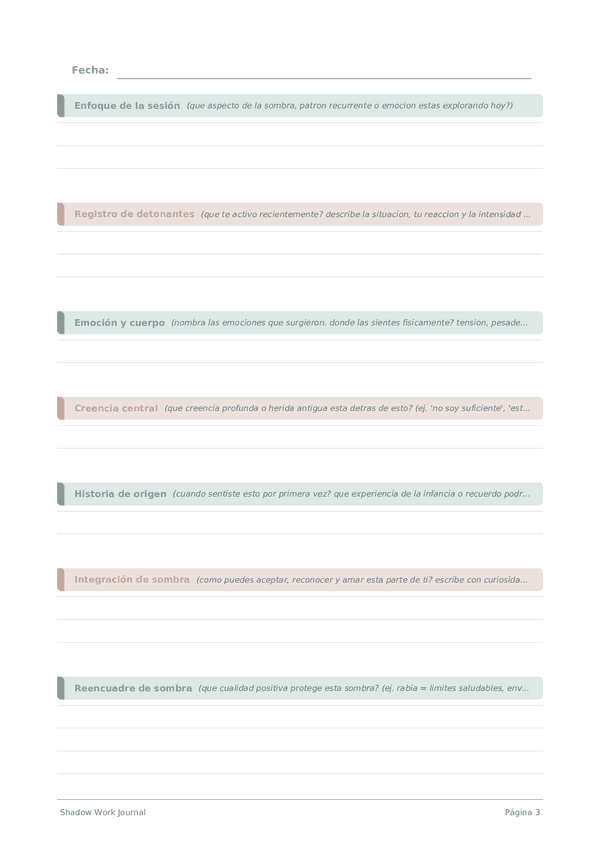
Enfoque de la sesión
Que aspecto de la sombra, patron recurrente o emocion estas explorando hoy?
Registro de detonantes
Que te activo recientemente? Describe la situacion, tu reaccion y la intensidad de la experiencia
Emoción y cuerpo
Nombra las emociones que surgieron. Donde las sientes fisicamente? Tension, pesadez, calor, rigidez...
Creencia central
Que creencia profunda o herida antigua esta detras de esto? (ej. 'No soy suficiente', 'Estoy en peligro')
Historia de origen
Cuando sentiste esto por primera vez? Que experiencia de la infancia o recuerdo podria ser la raiz?
Integración de sombra
Como puedes aceptar, reconocer y amar esta parte de ti? Escribe con curiosidad y compasion
Reencuadre de sombra
Que cualidad positiva protege esta sombra? (ej. rabia = limites saludables, envidia = deseo de amor)
Consejos para el exito
Cuando y con que frecuencia escribir
Write one entry per day in the evening, when the day\u2019s interactions have given you material to examine. Shadow work journaling is intense, so keep sessions to 15-20 minutes to avoid emotional overwhelm. If an entry brings up strong emotions, write them out fully, then close the journal and do something grounding before bed. Weekly, re-read your entries with fresh eyes and notice patterns. Take breaks when needed — shadow work is a marathon, not a sprint, and sustainable consistency matters more than daily perfection.
Preguntas frecuentes
¿Qué es el trabajo de sombra en términos psicológicos?
La sombra son los aspectos rechazados o reprimidos del yo, un concepto de la psicología analítica de Carl Jung (Jung, 'Aion', 1951). Las tradiciones clínicas contemporáneas se solapan con el trabajo de sombra: la terapia de esquemas (Young, Klosko, Weishaar, 2003, 'Schema Therapy', Guilford) aborda los esquemas desadaptativos tempranos; Internal Family Systems (Richard Schwartz) trabaja con las partes exiliadas. La estructura del diario operacionaliza esto mediante el mapeo de detonantes e integración.
¿Cómo se conecta el 'registro de detonantes' con la sombra?
Las reacciones intensas desproporcionadas a la situación suelen apuntar a material de sombra: el detonante activa una parte rechazada. La sección de tres líneas te invita a describir el detonante sin filtrar. La TCC de Beck (Beck, 'Cognitive Therapy and the Emotional Disorders', 1976) y la terapia de esquemas tratan ambas las reacciones desmedidas como diagnósticas: revelan esquemas subyacentes que la mente consciente no registra.
¿Qué es una 'creencia central' en este contexto?
Una creencia nuclear es una afirmación fundamental sobre uno mismo, los demás o el mundo, a menudo formada en la infancia y operando fuera de la conciencia. El modelo cognitivo de Beck y la terapia de esquemas de Young (Young, Klosko, Weishaar, 2003, 'Schema Therapy', Guilford) tratan las creencias nucleares como la estructura profunda bajo los pensamientos situacionales. Dos líneas fuerzan la compresión: escribe la creencia en su forma cruda, 'no soy suficiente', no su versión matizada.
¿Por qué 'historia de origen'?
Rastrear la creencia hasta su período de formación ayuda a separarla de la realidad actual. La terapia de esquemas (Young, Klosko, Weishaar, 2003) usa trabajo con imágenes para acceder a las memorias de origen donde se formaron los esquemas. Dos líneas es espacio para una memoria o período identificativo: la situación que enseñó la creencia. Saber que la creencia es aprendida, no factual, es el primer paso para reevaluarla.
¿Qué implica realmente la 'integración de sombra'?
La integración significa reconocer y aceptar la parte rechazada en lugar de seguir suprimiéndola o proyectándola. Jung enmarcó esto como trabajo de plenitud. IFS (Richard Schwartz) lo operacionaliza como construir una relación con las partes exiliadas. Tres líneas para escribir cómo darías la bienvenida en lugar de rechazar esta parte de ti mismo: qué necesidad portaba, qué protección ofrecía.
¿Es el 'reencuadre de sombra' lo mismo que el pensamiento positivo?
No. El reencuadre positivo reemplaza una interpretación negativa; el reencuadre de sombra encuentra la función protectora o la fuerza oculta que un rasgo de sombra portaba. Las tradiciones junguianas y de terapia de esquemas tratan ambas las sombras como contenedoras de recursos rechazados. Dos líneas: escribe qué valor protegía la parte rechazada (límites, ambición, vulnerabilidad), no fingir que la herida no ocurrió.
¿Es seguro hacer trabajo de sombra en solitario?
Con cuidado, y no para trauma. El material de sombra es por definición difícil; el diario estructurado puede ayudar con trabajo leve, pero el material a nivel de trauma (abuso, negligencia, heridas de apego severas) requiere apoyo profesional. Briere y Scott ('Principles of Trauma Therapy', SAGE, 2014) y la literatura de cuidado informado en trauma recomiendan trabajo supervisado para estos casos. Consulta a un profesional de salud mental con licencia si el material te desestabiliza.
¿Con qué frecuencia y durante cuánto tiempo trabajar la sombra?
Semanal o dos veces por semana, no diariamente. Las siete secciones estructuradas invitan a la profundidad; el trabajo profundo diario arriesga inundación emocional. Los protocolos clínicos de terapia de esquemas suelen espaciar el trabajo con imágenes y silla a lo largo de sesiones semanales durante meses. Espera meses de trabajo sobre los mismos temas recurrentes de sombra: la individuación junguiana y la modificación en terapia de esquemas tratan esto como trabajo a largo plazo, no como resolución rápida.
También Te Puede Gustar
Rueda para ampliar, arrastra para mover