Printable Stress Journal
Daily stress tracking and management journal
Take control of stress with daily tracking, trigger identification, and evidence-based coping strategies. Build resilience by understanding your stress patterns and what truly helps you recover.
Personalizar campos
Activa o desactiva campos. Haz clic en el lápiz para renombrar, o añade tus propios campos.
¿Qué es este diario?
A stress journal is a daily practice that helps you identify patterns in what causes your stress and how it affects your body and mind. By tracking stress levels alongside reflective writing, you create a personal map of your triggers and the coping strategies that actually work for you.
This journal is designed for anyone who feels overwhelmed, burned out, or simply wants to manage stress more effectively. Whether your stress comes from work, relationships, health, or daily pressures, the act of writing it down externalizes the burden and makes it easier to process.
Studies in psychoneuroimmunology show that expressive writing about stressful experiences can reduce cortisol levels and improve immune function. By consistently recording your stress triggers and responses, you build self-awareness that transforms reactive stress into something you can anticipate and manage proactively.
Ejemplo completado
Así es como se ve una entrada típica cuando se rellena:
Cómo rellenar cada campo
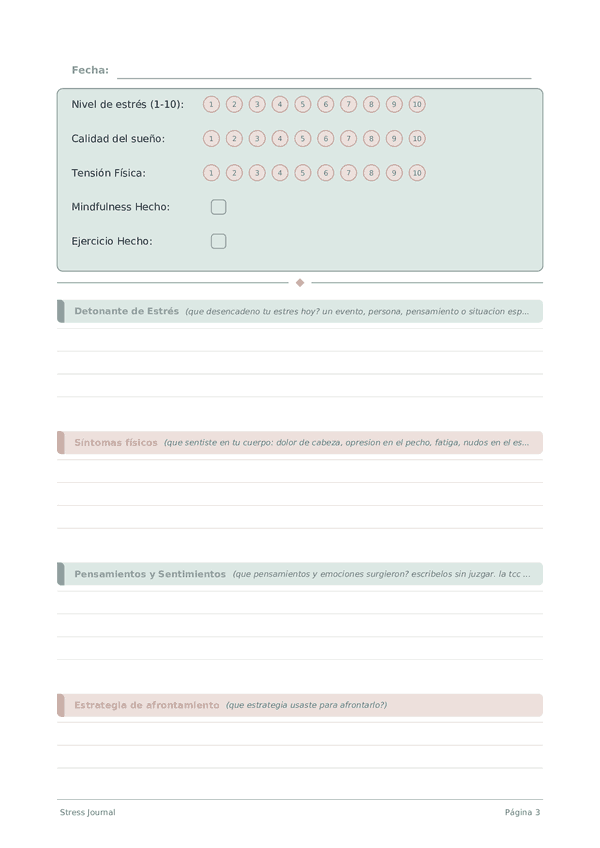
La parte superior de cada pagina tiene campos de llenado rapido (calificaciones, casillas, numeros). Debajo hay una seccion con lineas para escribir. Esto es lo que significa cada campo:
Nivel de estrés (1-10)
Califica tu estres en una escala del 1 al 10. Con el tiempo, identificaras tus patrones de estres y que estrategias de afrontamiento funcionan mejor.
Calidad del sueño
Califica que tan reparador fue tu sueno. 1 significa terrible y agitado, 5 significa profundo y refrescante. La calidad importa tanto como la cantidad.
Tensión Física
Califica la tension fisica en tu cuerpo hoy: hombros tensos, mandibula apretada, opresion en el pecho. La conciencia corporal es la base del manejo del estres.
Mindfulness Hecho
Practicaste atencion plena hoy? Incluso 5 minutos de respiracion consciente o un escaneo corporal reduce el cortisol y fortalece la resiliencia ante el estres con el tiempo.
Ejercicio Hecho
Hiciste ejercicio hoy? Incluso una caminata corta cuenta. El movimiento es uno de los reductores naturales de ansiedad mas efectivos.
Detonante de Estrés
Que desencadeno tu estres hoy? Un evento, persona, pensamiento o situacion especifica? Identificar los desencadenantes es el primer paso en el manejo del estres basado en TCC.
Síntomas físicos
Que sentiste en tu cuerpo: dolor de cabeza, opresion en el pecho, fatiga, nudos en el estomago? Los sintomas fisicos son las senales de estres de tu cuerpo que vale la pena rastrear.
Pensamientos y Sentimientos
Que pensamientos y emociones surgieron? Escribelos sin juzgar. La TCC ensena que examinar nuestros pensamientos ayuda a romper el ciclo pensamiento-estres.
Estrategia de afrontamiento
Que estrategia usaste para afrontarlo?
Lo que Puedo Controlar
Separa lo que puedes controlar de lo que no. Enfoca tu energia en lo controlable: esta es una tecnica central de resiliencia de la TCC y el estoicismo.
Consejos para el exito
Cuando y con que frecuencia escribir
Fill in the tracker every evening. On high-stress days, use the writing section during the day as an emergency release valve — even 3 minutes of writing reduces cortisol levels. Weekly, review your stress scores to identify your most stressful day of the week and your most effective coping strategies. This journal works best as a daily practice, but even 4 times a week captures enough data to reveal patterns.
Preguntas frecuentes
¿Cómo usa este diario el análisis de 'detonante de Estrés'?
Aplica el modelo transaccional de estrés de Lazarus y Folkman (1984, 'Stress, Appraisal, and Coping', Springer). El estrés surge de la evaluación de las demandas relativas a los recursos, no del evento solo. La sección de seis líneas del desencadenante pregunta qué ocurrió y cómo lo interpretaste. Nombrar la valoración —'lo vi como una amenaza'— separa el estresor de la respuesta al estrés, que es donde actúa la intervención.
¿Por qué registrar 'tensión Física' por separado de nivel de estrés (1-10)?
El estrés aparece somáticamente antes que las etiquetas conscientes. La investigación de carga alostática de McEwen (2007, Physiological Reviews, 87(3)) documenta las firmas fisiológicas del estrés crónico, incluida la tensión muscular. Valorar tensión Física de 0-10 junto al nivel de estrés (1-10) subjetivo revela disociaciones: alta tensión corporal con estrés reportado leve señala que estás infrainformando la carga, un patrón común en el burnout.
¿Qué debe identificar 'lo que Puedo Controlar'?
Separa los aspectos controlables e incontrolables del estresor: la base del afrontamiento centrado en el problema (Folkman y Lazarus). Los marcos estoicos formalizan esta distinción; la TCC la aplica mediante la reestructuración cognitiva (Beck, 1976). La línea obliga a hacer la pregunta que muchos omiten bajo estrés: ¿qué parte de esto puedo realmente influir con acción? Dos líneas te centran en la agencia.
¿Por qué la casilla 'mindfulness Hecho'?
La reducción del estrés basada en mindfulness (Kabat-Zinn; Khoury et al., 2015, Journal of Psychosomatic Research, 78(6)) mostró efectos moderados sobre el estrés en adultos sanos. La casilla refuerza el seguimiento conductual. Con el tiempo, correlaciona los días con mindfulness Hecho=true frente a nivel de estrés (1-10); muchos usuarios notan una reducción de 1-2 puntos asociada con la práctica regular, pero solo cuando está documentada.
¿En qué se diferencia de un diario de estado de ánimo genérico?
Este diario apunta específicamente al sistema de respuesta al estrés: nivel de estrés (1-10) valorado, calidad del sueño, tensión Física, afrontamiento conductual (ejercicio Hecho, mindfulness Hecho) más análisis estructurado de desencadenante y valoración. Un diario de estado de ánimo captura el estado emocional ampliamente. El modelo de estrés de Lazarus y Folkman y la carga alostática de McEwen tratan el estrés como un constructo distinto con sus propios puntos de intervención.
¿Qué patrones debo buscar después de dos semanas?
Tres: qué stress triggers se repiten, si calidad del sueño precede el nivel de estrés (1-10) del día siguiente, y qué estrategias de afrontamiento reducen realmente las puntuaciones en entradas posteriores. Aldao, Nolen-Hoeksema, Schweizer (2010, Clinical Psychology Review, 30(2)) analizaron estrategias de afrontamiento y hallaron que la revaluación y la resolución de problemas superan consistentemente a la evitación y la rumiación.
¿Es seguro si estoy experimentando burnout?
Con cuidado. El burnout (Maslach y Leiter, 2016, World Psychiatry, 15(2)) implica agotamiento emocional que el simple seguimiento no revertirá. El diario puede identificar patrones útiles para el cambio sistémico —reducir demandas, aumentar la recuperación—, pero si estás persistentemente agotado, cínico y desconectado, consulta a un médico de salud laboral o a un profesional de salud mental con licencia. El burnout no se resuelve con un mejor diario.
¿Cuánto tiempo hasta ver resultados?
De dos a cuatro semanas para la visibilidad de patrones; ocho semanas para la reducción autoinformada del estrés. Khoury et al. (2015, Journal of Psychosomatic Research, 78(6)) encontraron que los programas de mindfulness tardaron aproximadamente ocho semanas en producir efectos medibles sobre el estrés. El rastreador del diario combinado con conductas de afrontamiento se aproxima a mecanismos similares; espera comprensión antes que alivio de síntomas, especialmente cuando los desencadenantes son ambientales.
También Te Puede Gustar
Rueda para ampliar, arrastra para mover