Printable Therapy Journal
Maximize the benefits of your therapy sessions
Capture key takeaways from therapy sessions, track homework assignments, and reflect on progress between appointments. A valuable bridge between sessions.
Personalizar campos
Activa o desactiva campos. Haz clic en el lápiz para renombrar, o añade tus propios campos.
Beneficios
Cómo Usar
¿Qué es este diario?
A therapy journal is a guided writing practice designed to complement your therapeutic work. By tracking your mood and anxiety alongside structured reflections on situations, automatic thoughts, and cognitive reframes, you practice the core skills of cognitive behavioral therapy between sessions.
This journal is ideal for anyone currently in therapy or practicing self-guided CBT techniques. It provides a framework for examining the connection between situations, thoughts, and emotional responses — the foundation of most evidence-based therapeutic approaches.
Clinical research consistently shows that clients who journal between therapy sessions make faster progress and retain therapeutic gains longer. Writing down automatic thoughts and practicing reframes strengthens neural pathways for healthier thinking patterns, turning therapeutic insights into lasting cognitive habits.
Ejemplo completado
Así es como se ve una entrada típica cuando se rellena:
Cómo rellenar cada campo
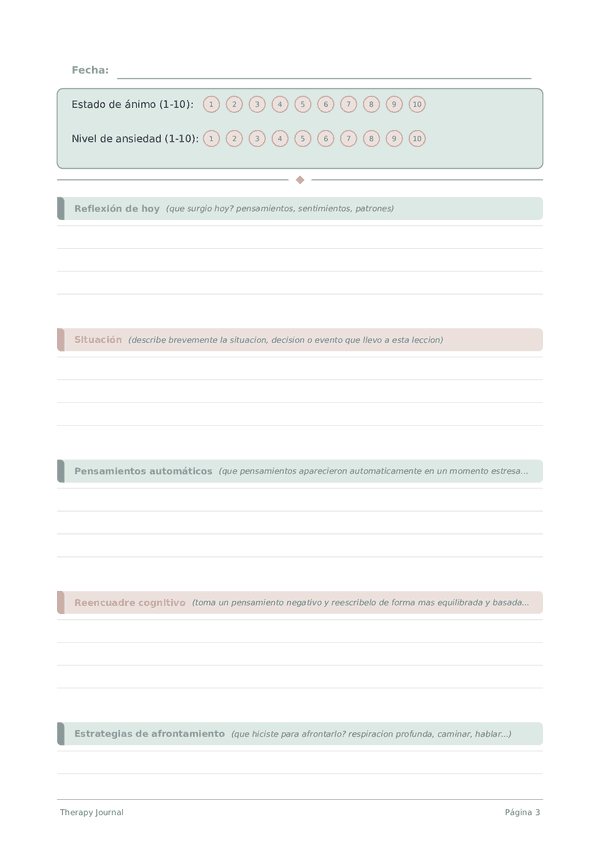
La parte superior de cada pagina tiene campos de llenado rapido (calificaciones, casillas, numeros). Debajo hay una seccion con lineas para escribir. Esto es lo que significa cada campo:
Estado de ánimo (1-10)
Califica tu estado emocional general del dia. 1 significa muy bajo o deprimido, 10 significa excepcionalmente feliz y positivo. No lo pienses demasiado: ve con tu instinto.
Nivel de ansiedad (1-10)
Califica tu nivel de ansiedad hoy. Ponerle un numero hace que el sentimiento sea mas manejable y rastreable.
Reflexión de hoy
Mira atras a tu dia con honestidad. Que salio bien? Que podria mejorar? No se trata de juzgar, sino de aprender y crecer.
Situación
Describe la situacion o evento objetivamente, como si fueras un observador neutral. Separar los hechos de los sentimientos te ayuda a ver las cosas con mas claridad.
Pensamientos automáticos
Que pensamientos aparecieron automaticamente en un momento estresante? Escribelos exactamente como llegaron, aunque parezcan irracionales
Reencuadre cognitivo
Toma un pensamiento negativo y reescribelo de forma mas equilibrada y basada en evidencia. Que diria un amigo sabio?
Estrategias de afrontamiento
Que hiciste para afrontarlo? Respiracion profunda, caminar, hablar...
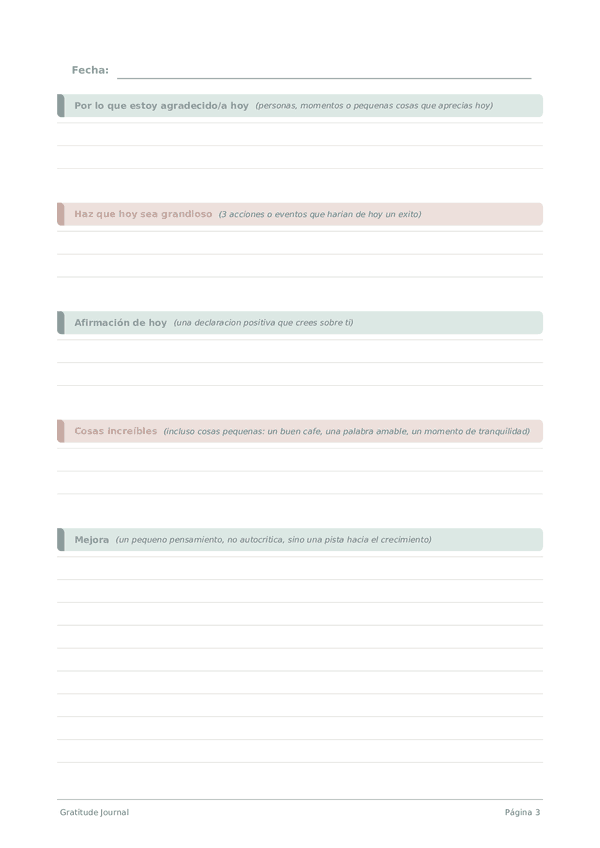
Por lo que estoy agradecido/a hoy
Enumera de 1 a 3 cosas por las que estas agradecido hoy. Pueden ser grandes o pequenas: una buena comida, una palabra amable, el sol. El diario de gratitud es una de las practicas de bienestar con mayor respaldo cientifico.
Consejos para el exito
Cuando y con que frecuencia escribir
Write after every therapy session while insights are fresh — ideally within 1 hour. Between sessions, use the journal when you notice automatic thoughts or cognitive distortions in daily life. Before your next session, spend 5 minutes reviewing your entries to identify what you want to explore further. This between-session work is what transforms weekly therapy into continuous growth.
Preguntas frecuentes
¿Cómo apoya este diario la psicoterapia?
Funciona como tarea entre sesiones, una práctica respaldada por la TCC, la ACT y la terapia de esquemas. Kazantzis, Whittington y Dattilio (2010, Clinical Psychology: Science and Practice, 17(2)) analizaron las tareas de terapia y encontraron que completarlas mejoraba los resultados. Los campos estructurados (situation, pensamientos automáticos, reencuadre cognitivo, estrategias de afrontamiento) reflejan el registro diario de pensamientos de Beck utilizado en la terapia cognitivo-conductual.
¿Qué va en 'pensamientos automáticos' frente a 'reencuadre cognitivo'?
Pensamientos automáticos capta los pensamientos literales que surgieron en la situación: exactamente como aparecieron. Reencuadre cognitivo es la alternativa reestructurada y equilibrada con evidencia. Esta es la técnica clásica de dos columnas de Beck ('Cognitive Therapy and the Emotional Disorders', 1976). La sección de 10 líneas da espacio para ambas. No te saltes el pensamiento original: el reencuadre solo funciona en contraste.
¿Cómo llevar esto a mi terapeuta de forma productiva?
Lleva dos a cuatro semanas de entradas y destaca los patrones. Las directrices de práctica clínica de la APA y Kazantzis et al. (2010, Clinical Psychology: Science and Practice, 17(2)) recomiendan que los datos generados por el cliente anclen el trabajo de la sesión. Marca las entradas donde el reencuadre resultó difícil: ahí probablemente se concentra el trabajo terapéutico. No esperes que el terapeuta lea todo; ofrece un resumen más detalles seleccionados.
¿Por qué 'mood' y 'nivel de ansiedad (1-10)' son los únicos campos del rastreador?
Estos dos indicadores cubren los objetivos terapéuticos más comunes —síntomas de depresión y ansiedad— y se alinean conceptualmente con los cribados breves (PHQ-9 para depresión, GAD-7 para ansiedad). Mantener el rastreador mínimo preserva la función principal del diario como reflexión que une sesiones. Añade más dimensiones a través del Diario de Salud Mental si es necesario.
¿Este diario reemplaza la terapia?
No. La complementa pero no sustituye la psicoterapia. Las directrices de la APA, el NIMH y la OMS tratan la psicoterapia como una intervención clínica que requiere proveedores capacitados. El diario es una herramienta para extender los efectos de la terapia entre sesiones, bajo la guía de un profesional de salud mental con licencia.
¿Qué hago si actualmente no voy a un terapeuta?
El diario sigue teniendo valor para el autoayuda, pero sé consciente de sus límites. Cuijpers et al. (2010, Clinical Psychology Review, 30(1)) revisaron la TCC de autoayuda y encontraron efectos menores pero reales comparados con la TCC guiada por terapeuta. La secuencia de reestructuración cognitiva es utilizable en solitario. Si te quedas atascado en el mismo contenido o el malestar empeora, consulta a un clínico con licencia.
¿Cuán honesto debo ser en el diario?
Lo más honesto posible: las entradas selectivas reducen su valor terapéutico. Pennebaker (1997, Psychological Science, 8(3)) sobre la escritura expresiva mostró que los beneficios escalaban con el compromiso emocional. Si te preocupa que alguien lo lea, guárdalo de forma segura o usa un código personal. La escritura editada para otros anula el procesamiento cognitivo que produce el beneficio.
¿Con qué frecuencia debo escribir entre sesiones?
Apunta a dos a cuatro entradas entre sesiones semanales. A diario puede cansar; menos de una vez por semana pierde impulso. Kazantzis et al. (2016, Cognitive Therapy and Research, 40(6)) encontraron que un compromiso moderado con las tareas (varias entradas semanales) es óptimo: demasiado poco y los efectos desaparecen, demasiado y la calidad cae. Pregunta a tu terapeuta por un ritmo objetivo.
También Te Puede Gustar
Rueda para ampliar, arrastra para mover