Printable Journal de rupture
Guérissez, grandissez et reconstruisez-vous après une peine de cœur
Navigate the emotional journey of heartbreak with a structured daily journal rooted in self-compassion and healing psychology. Each entry guides you through naming your feelings, affirming your worth, setting protective boundaries, extracting wisdom from the experience, and building a vision of your thriving future.
Personnaliser les champs
Activez ou désactivez les champs. Cliquez sur le crayon pour renommer, ou ajoutez vos propres champs.
Avantages
Comment utiliser
Qu'est-ce que ce journal ?
A breakup journal is a guided daily practice for navigating the emotional aftermath of ending a relationship. Each entry creates space for processing difficult feelings while deliberately building self-love, setting boundaries, and envisioning your future — transforming grief into growth.
This journal is for anyone going through a breakup, divorce, or the end of a significant relationship. Whether it was your decision or not, the loss of a partnership reshapes your identity and daily life. This journal provides structure during a time when everything feels unstructured.
Research on post-breakup recovery shows that expressive writing significantly reduces emotional distress and speeds healing. The key is not just venting — it is the structured reflection that combines emotional processing with forward-looking elements like self-affirmation and future visioning. People who journal through breakups report feeling "themselves again" 40% sooner than those who do not.
Exemple rempli
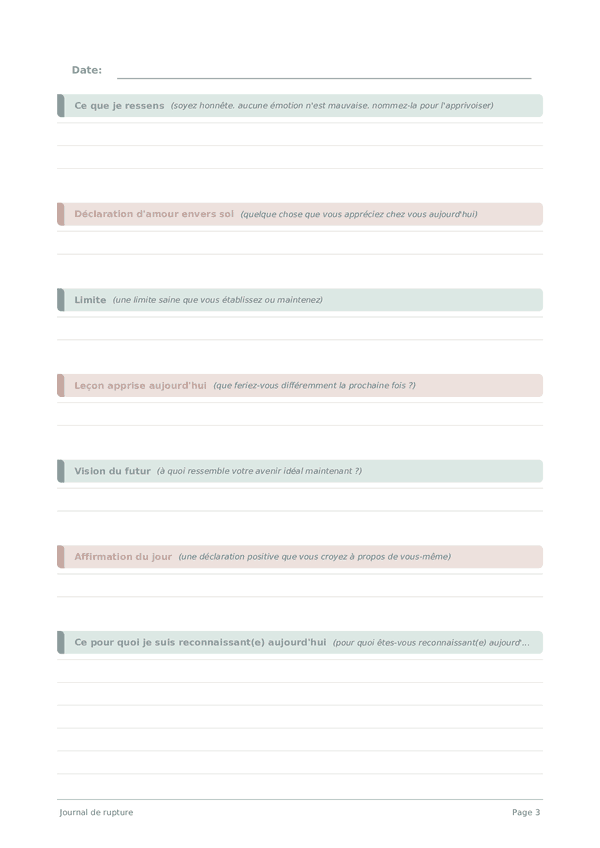
Voici à quoi ressemble une entrée typique une fois remplie :
Comment remplir chaque champ
Chaque jour, vous trouverez plusieurs sections étiquetées avec des lignes pour écrire. Voici à quoi sert chaque section :
Ce que je ressens
Décrivez comment vous vous sentez en ce moment avec vos propres mots. Il n'y a pas de mauvaise réponse. Le simple fait de mettre les sentiments sur papier réduit leur charge émotionnelle.
Déclaration d'amour envers soi
Quelque chose que vous appréciez chez vous aujourd'hui
Limite
Une limite saine que vous établissez ou maintenez
Leçon apprise aujourd'hui
Retenez un enseignement de l'expérience d'aujourd'hui. Avec le temps, ces leçons deviennent une bibliothèque de sagesse personnelle.
Vision du futur
À quoi ressemble votre avenir idéal maintenant ?
Affirmation du jour
Écrivez une déclaration positive sur vous-même au présent, comme si c'était déjà vrai. Par exemple : « Je suis capable et résilient. » Répéter des affirmations reprogramme vos schémas de pensée avec le temps.
Ce pour quoi je suis reconnaissant(e) aujourd'hui
Listez 1 à 3 choses pour lesquelles vous êtes reconnaissant aujourd'hui. Elles peuvent être grandes ou minuscules — un bon repas, un mot gentil, du soleil. Le journal de gratitude est l'une des pratiques de bien-être les plus soutenues scientifiquement.
Conseils pour réussir
Quand et à quelle fréquence écrire
Write daily during the acute phase (first 2–4 weeks), even if entries are short and raw. As the intensity fades, shift to 3–4 times per week, focusing on progress rather than pain. After 2–3 months, weekly entries help you consolidate growth and recognize how far you have come. Stop journaling about the breakup specifically when you notice entries becoming repetitive — that is a sign you have processed the core emotions and are ready to redirect your energy.
Questions fréquentes
Pourquoi le Journal de rupture passe-t-il par sept sections dans un ordre fixe ?
La séquence — émotions, affirmation d'amour-propre, limite, leçon apprise, vision du futur, affirmation, gratitude — va de la reconnaissance à l'intégration puis à l'orientation vers l'avenir. Cela correspond au travail de deuil qui, contrairement aux « stades » popularisés de Kübler-Ross, est non linéaire mais bénéficie d'un ancrage structuré. Russ Harris dans ACT With Love (Harris, 2009) associe pareillement le contact honnête avec les émotions douloureuses à une action engagée vers les valeurs.
Que doit contenir la section émotions — simplement nommer les ressentis ?
Nomme-les précisément et laisse-les coexister. « Soulagé, solitaire, furieux, honteux, plein d'espoir » dans une même entrée est honnête, pas contradictoire. Les recherches de Brené Brown sur la granularité émotionnelle (Brown, 2012, Daring Greatly) montrent que nommer précisément réduit l'intensité des émotions difficiles. Trois lignes suffisent — c'est une prise en compte initiale, pas une analyse. Les sections suivantes font le travail d'avancer avec ce que tu as nommé.
Comment écrire une affirmation d'amour-propre qui ne semble pas artificielle ?
Évite les affirmations vagues (« je suis suffisant »). Écris des formulations basées sur des preuves : « j'ai été un partenaire stable qui réparait après les disputes » ou « je suis quelqu'un qui a choisi l'honnêteté même quand ça m'a coûté ». La distinction de Brené Brown entre culpabilité et honte (Brown, 2012, Daring Greatly) est pertinente — c'est la reconnaissance précise des valeurs vécues dans les moments difficiles qui reconstruit l'estime de soi, pas la pensée positive générique.
Quel type de limite appartient à la section limite ?
Des limites précises et comportementales que tu t'engages à tenir aujourd'hui : « je ne regarderai pas leur Instagram cette semaine », « je ne répondrai pas aux SMS "juste une question" », « je ne parlerai pas de la relation avec les amis communs ». Les limites concernent ce que toi tu fais, pas ce que tu leur demandes de faire. Traite chaque entrée comme un contrat sur 24 heures ; les engagements plus longs cèdent quand le deuil s'intensifie.
Le journal quotidien suffit-il ou faut-il une thérapie après une rupture ?
Le journal soutient la guérison d'un deuil de rupture ordinaire, mais ne traite pas les traumatismes. En cas de pensées intrusives persistantes, d'incapacité à fonctionner pendant des semaines, d'idées suicidaires ou si tu quittes une relation abusive, consulte un thérapeute agréé. En France : le 3919 (Violences Femmes Info — gratuit, 24h/24) et le 3114 (Numéro National de Prévention du Suicide — gratuit, 24h/24). Les pages t'aident à métaboliser ; la thérapie traite ce qui ne se métabolise pas seul.
Combien de temps aurai-je besoin de ce journal ?
Prévois 6 à 12 semaines d'entrées quasi-quotidiennes comme base, avec une fréquence naturellement décroissante à mesure que la stabilité revient. Les recherches sur l'adaptation après une rupture romantique (Sbarra & Emery, 2005, Personal Relationships, 12(2)) ont montré que la détresse émotionnelle aiguë s'atténue substantiellement dans les huit à dix premières semaines pour les ruptures hors mariage, plus longtemps pour les mariages. Tes entrées vision du futur et ce pour quoi je suis reconnaissant(e) aujourd'hui sont généralement les premières à redevenir sincères.
Et si écrire m'empire plutôt que m'améliore ?
Si les sessions se terminent systématiquement avec une plus grande dérégulation qu'au départ — pendant plus de deux semaines — c'est le signal de mettre en pause le journal en solo et d'apporter ce matériau à un thérapeute agréé. Les recherches sur l'écriture expressive de Pennebaker (Pennebaker & Beall, 1986, Journal of Abnormal Psychology, 95(3)) montrent que les bénéfices émergent avec le temps, mais le modèle suppose une régulation de base. L'écriture sur un traumatisme aigu sans soutien peut aggraver les symptômes.
En quoi la section gratitude est-elle appropriée après une rupture douloureuse ?
La gratitude ici n'est pas gratitude pour la rupture. Ce sont deux lignes sur tout ce qui te soutient aujourd'hui — un ami qui a appelé, ton travail, ton chien, le ciel. Les recherches sur la pratique de la gratitude (Emmons & McCullough, 2003, Journal of Personality and Social Psychology, 84(2)) ont montré de brèves entrées quotidiennes améliorant le bien-être en quelques semaines. L'objectif est de maintenir ton attention sur ce qui reste, pas de simuler une paix que tu n'as pas encore atteinte.
Vous aimerez aussi
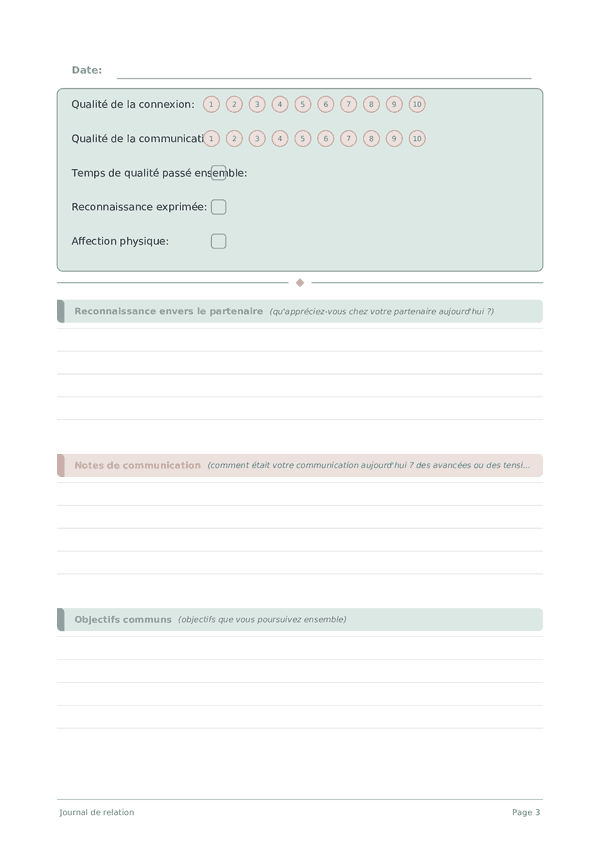
Journal de relation
Nourrissez votre lien par la réflexion quotidienne et la connexion intentionnelle
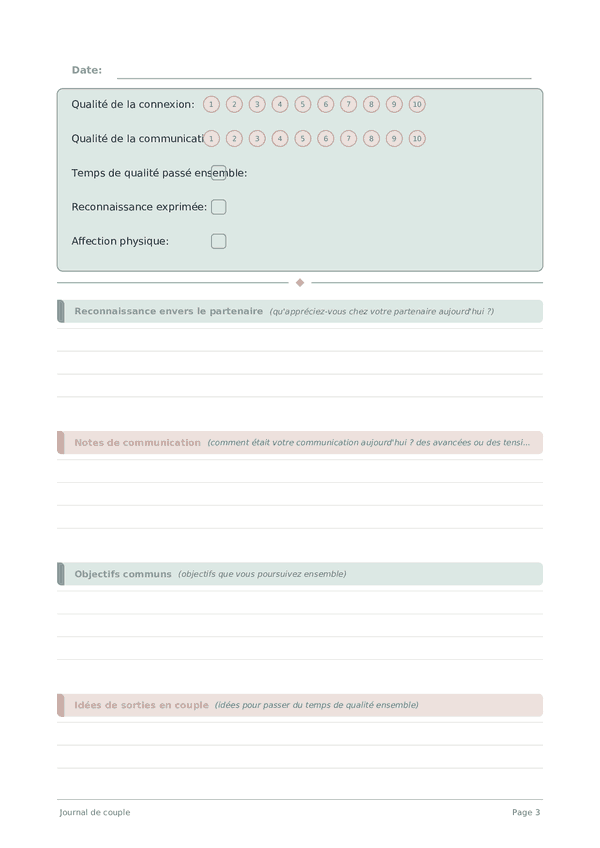
Journal de couple
Renforcez votre lien avec un suivi quotidien de la connexion
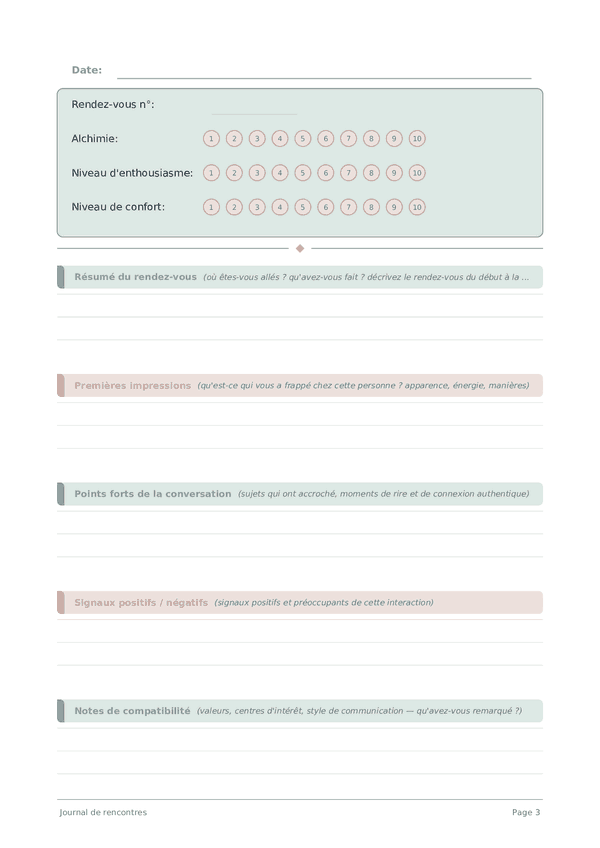
Journal de rencontres
Suivez vos rendez-vous, évaluez la chimie et découvrez ce que vous recherchez vraiment
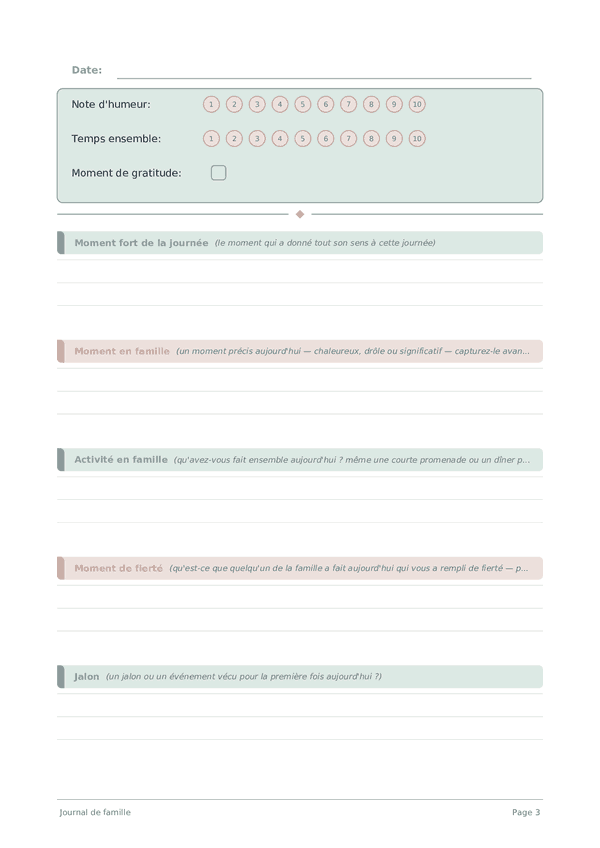
Journal de famille
Capturez les moments et les souvenirs quotidiens de votre famille
Molette pour zoomer, glisser pour déplacer