Printable Journal de couple
Renforcez votre lien avec un suivi quotidien de la connexion
A hybrid journal designed for couples who want to nurture their relationship intentionally. The top section tracks daily connection quality, communication, quality time, appreciation, and physical affection — giving you measurable insight into your relationship patterns. The writing section below guides you through expressing gratitude for your partner, reflecting on communication, aligning on shared goals, planning dates, and honest relationship reflection. Based on Gottman's research and couples therapy best practices, this journal turns relationship maintenance into a simple daily ritual.
Personnaliser les champs
Activez ou désactivez les champs. Cliquez sur le crayon pour renommer, ou ajoutez vos propres champs.
Avantages
Comment utiliser
Qu'est-ce que ce journal ?
A couples journal is a shared daily practice designed for partners to write together — or side by side — about their relationship. It tracks the vital signs of your connection while prompting deeper conversations about appreciation, communication, and shared dreams that busy daily life often crowds out.
This journal is ideal for couples who want to prioritize their relationship amidst demanding schedules, for partners rebuilding after conflict, or for any couple who believes that consistent small investments of attention compound into extraordinary partnership over time.
Couples therapy research consistently identifies two predictors of relationship longevity: expressed appreciation and intentional quality time. This journal builds both into a daily habit. Studies show that couples who regularly discuss their relationship — not just logistics — report 31% higher relationship satisfaction than those who do not.
Exemple rempli
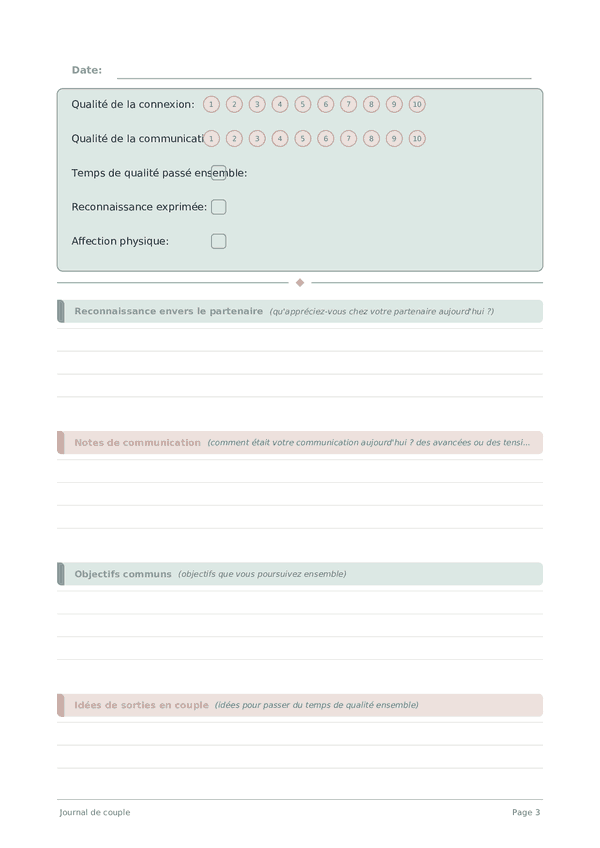
Voici à quoi ressemble une entrée typique une fois remplie :
Comment remplir chaque champ
Le haut de chaque page comporte des champs à remplissage rapide (évaluations, cases à cocher, chiffres). En dessous se trouve une section lignée pour écrire. Voici ce que signifie chaque champ :
Qualité de la connexion
À quel point vous êtes-vous senti connecté à votre partenaire aujourd'hui ? Notez de 1 (distant) à 10 (profondément lié)
Qualité de la communication
Comment avez-vous communiqué aujourd'hui ? Notez de 1 (mal) à 10 (ouvertement et clairement)
Temps de qualité passé ensemble
Avez-vous passé du temps de qualité ensemble aujourd'hui ? Décrivez ce que vous avez fait ou évaluez-le
Reconnaissance exprimée
Avez-vous montré de la gratitude ou de la reconnaissance à votre partenaire aujourd'hui ? Qu'avez-vous dit ou fait ?
Affection physique
Combien d'affection physique avez-vous partagée aujourd'hui ? Notez de 1 (aucune) à 10 (très affectueux)
Reconnaissance envers le partenaire
Qu'appréciez-vous chez votre partenaire aujourd'hui ?
Notes de communication
Comment était votre communication aujourd'hui ? Des avancées ou des tensions ?
Objectifs communs
Objectifs que vous poursuivez ensemble
Idées de sorties en couple
Idées pour passer du temps de qualité ensemble
Réflexion sur la relation
Qu'appréciez-vous chez votre partenaire aujourd'hui ?
Conseils pour réussir
Quand et à quelle fréquence écrire
Ideally, each partner writes individually 3–4 times per week, with one shared journaling session on weekends where you exchange entries or respond to a common prompt. Monthly, set aside 30 minutes to read through your entries side by side and discuss what you notice. This rhythm balances personal reflection with mutual understanding.
Questions fréquentes
En quoi le Journal de couple diffère-t-il d'un simple journal intime partagé ?
Il impose une structure quotidienne plutôt que l'écriture libre : deux scores 1-10 (lien, communication), trois cases à cocher (temps de qualité, gratitude, affection physique) et cinq prompts guidés incluant des idées de rendez-vous et une réflexion honnête sur la relation. Cela reflète l'accent de la méthode Gottman sur les habitudes relationnelles mesurables plutôt que le « partage » généralisé (Gottman, 1999, The Seven Principles for Making Marriage Work) : les schémas et les lacunes apparaissent dans les données, pas dans l'humeur.
Pourquoi l'affection physique et le temps de qualité sont-ils des cases à cocher plutôt que des scores ?
Les cases évitent l'inflation. Évaluer l'affection 7/10 invite à l'auto-justification ; le binaire « est-ce que ça s'est produit aujourd'hui, oui ou non » force l'honnêteté. Les recherches de Gottman sur les petites « offres de connexion » quotidiennes (Gottman, 1999) ont montré que c'est le fait de se tourner vers ces offres — pas l'intensité — qui prédit la trajectoire conjugale. La case mesure la fréquence, la dimension que son laboratoire a trouvée la plus diagnostique pour la stabilité.
Que noter dans le prompt idées de sorties en couple — les sorties passées ou à venir ?
Utilise-le pour les idées à venir que tu ne veux pas perdre : le restaurant mentionné par un ami, une expo qui ferme bientôt, une randonnée pour un samedi libre. Esther Perel soutient que la nouveauté et l'anticipation sont au cœur de l'érotisme durable (Perel, 2006, Mating in Captivity) ; une liste vivante garde la planification fluide. Les sorties passées s'inscrivent mieux dans réflexion sur la relation ou dans le prompt de gratitude.
Chaque partenaire garde-t-il son propre journal ou en partagent-ils un seul ?
Chacun son exemplaire privé. Les scores 1-10 honnêtes exigent que la page t'appartienne ; partager crée de l'autocensure. Compare les entrées lors d'un « état de l'union » hebdomadaire, rituel recommandé par Gottman (Gottman, 1999). Le journal alimente la réunion avec des données concrètes — « lien en moyenne 5 cette semaine » est un point de départ que les impressions vagues ne fournissent pas.
Le prompt de gratitude est-il utile si notre relation va bien ?
Surtout alors. Les travaux longitudinaux de Gottman montrent que le ratio 5:1 d'interactions positives sur négatives distingue les couples durables des couples qui divorcent (Gottman, 1994, Why Marriages Succeed or Fail), et ce ratio se construit dans les périodes calmes, pas pendant les conflits. La gratitude spécifique quotidienne accumule une « bonne volonté » — la dominance du positif — qui amortit la relation quand le stress finit par arriver.
Que faire si mon score qualité de la communication est régulièrement faible ?
Des scores bas persistants appellent à l'action. Repère dans notes de communication les « Quatre Cavaliers » de Gottman — critique, mépris, défensive, stonewalling (Gottman, 1999) ; le mépris en particulier prédit le divorce. Si tu les repères sur plusieurs semaines, consulte un thérapeute de couple formé à la méthode Gottman ou à l'EFT (Johnson, 2008, Hold Me Tight). Le journal documente le schéma ; la thérapie le traite.
Combien de temps prend une entrée significative — quelques cases ou des paragraphes ?
Cinq à sept minutes. Les deux scores et les trois cases prennent moins d'une minute ; les sept lignes et les quatre prompts écrits fonctionnent mieux avec une ou deux phrases spécifiques plutôt que des essais. La précision bat la longueur — « remercié Pierre d'avoir géré le coucher pour que je finisse mon travail » vaut mieux que « reconnaissant envers mon partenaire ». La littérature de Gottman sur les habitudes souligne la régularité plutôt que l'intensité (Gottman, 1999).
Les couples homosexuels et les partenaires non mariés peuvent-ils utiliser ce journal ?
Oui. Les recherches du Gottman Institute sur les couples homosexuels (Gottman et al., 2003, Journal of Homosexuality, 45(1)) ont trouvé les mêmes prédicteurs — affect positif, tentatives de réparation, faible mépris — opèrent quelle que soit l'orientation. Les champs du journal sont neutres quant à la nature du lien. Couples cohabitants, fiancés, à distance ou queer peuvent utiliser la même structure ; c'est le lien, pas le statut légal, que le journal mesure.
Vous aimerez aussi
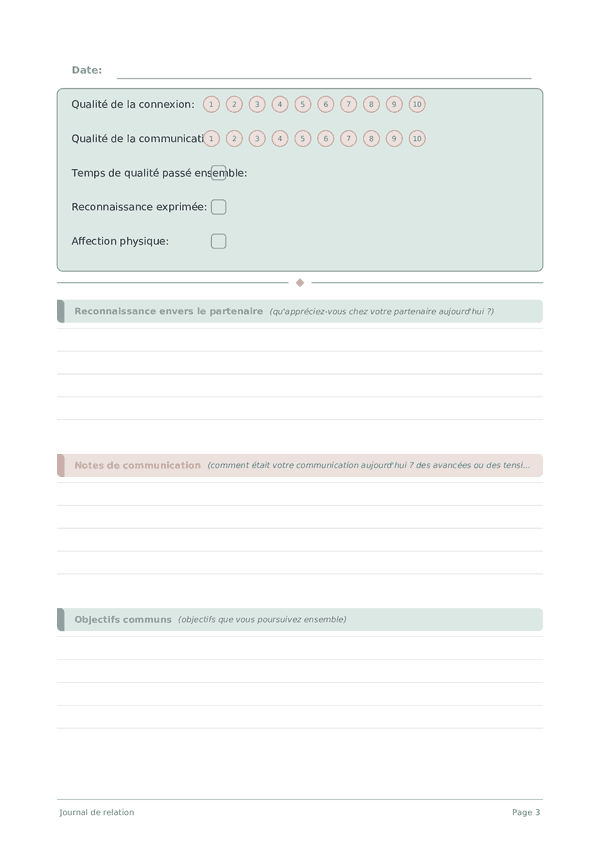
Journal de relation
Nourrissez votre lien par la réflexion quotidienne et la connexion intentionnelle
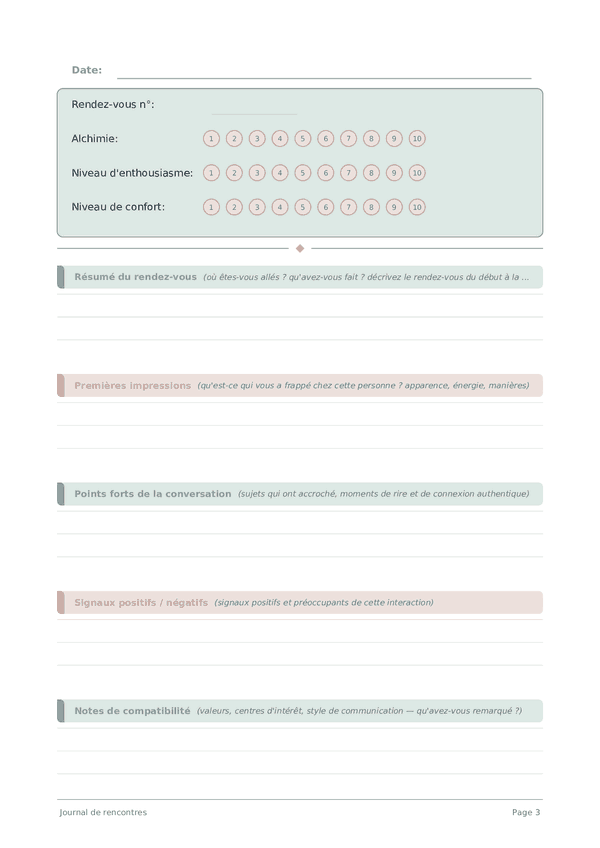
Journal de rencontres
Suivez vos rendez-vous, évaluez la chimie et découvrez ce que vous recherchez vraiment
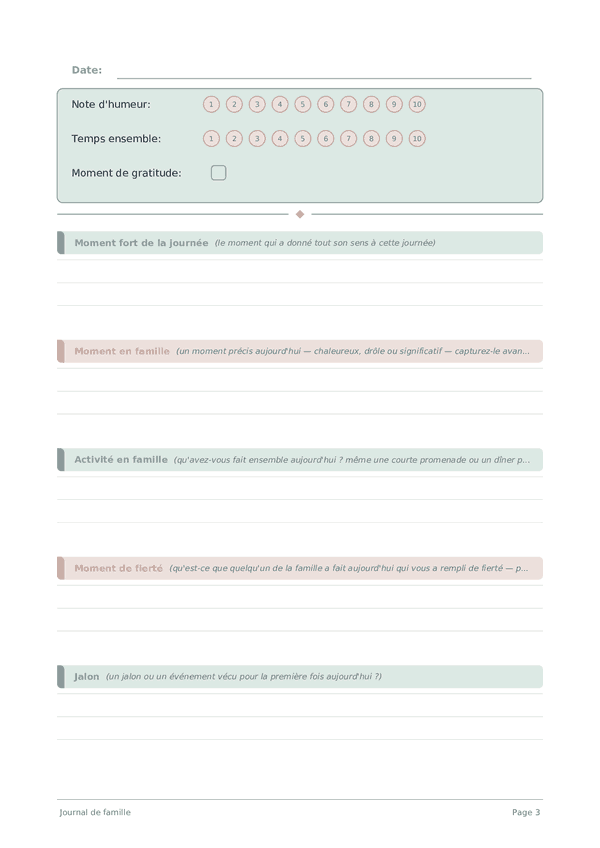
Journal de famille
Capturez les moments et les souvenirs quotidiens de votre famille
Journal de parentalité
Chérissez chaque moment de votre parcours de parent
Molette pour zoomer, glisser pour déplacer