Printable Journal de parentalité
Chérissez chaque moment de votre parcours de parent
A daily journal designed for parents to reflect on their emotional state, track quality time with their child, celebrate milestones, and grow through the beautiful challenges of parenthood. Five minutes a day can transform your relationship with your child and yourself.
Personnaliser les champs
Activez ou désactivez les champs. Cliquez sur le crayon pour renommer, ou ajoutez vos propres champs.
Avantages
Comment utiliser
Qu'est-ce que ce journal ?
A parenting journal is a daily practice for tracking your own well-being as a parent while documenting your child's growth, milestones, and the moments that matter. By monitoring your mood, energy, and patience alongside reflective writing about highlights and proud moments, you create a more conscious parenting practice.
This journal is for parents at any stage — from the sleep-deprived newborn phase to the complex teenage years. It serves both as a self-care tool that helps you notice when you are running on empty and as a memory book that captures the fleeting details of your child's development that you think you will remember but often forget.
Parenting research shows that self-aware parents — those who regularly reflect on their emotions and reactions — are more likely to respond thoughtfully rather than react impulsively. This journal builds that reflective capacity while simultaneously creating a treasure trove of memories you will be grateful to have when your children are grown.
Exemple rempli
Voici à quoi ressemble une entrée typique une fois remplie :
Comment remplir chaque champ
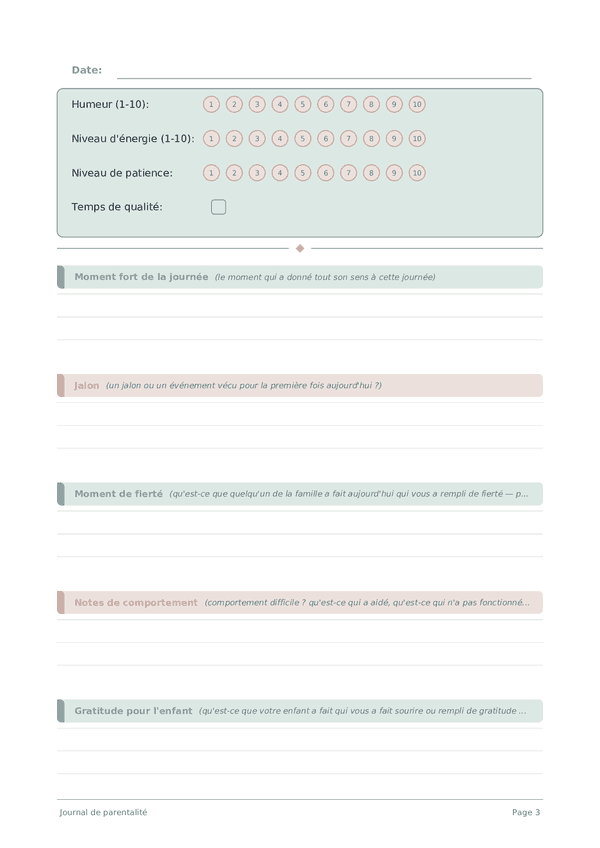
Le haut de chaque page comporte des champs à remplissage rapide (évaluations, cases à cocher, chiffres). En dessous se trouve une section lignée pour écrire. Voici ce que signifie chaque champ :
Humeur (1-10)
Évaluez votre état émotionnel général de la journée. 1 signifie très bas ou déprimé, 10 signifie exceptionnellement heureux et positif. Ne réfléchissez pas trop — fiez-vous à votre instinct.
Niveau d'énergie (1-10)
Évaluez votre niveau d'énergie physique et mentale. 1 signifie épuisé et vidé, 10 signifie plein d'énergie et alerte. Cela vous aide à identifier quelles activités stimulent ou drainent votre énergie.
Niveau de patience
Avez-vous été patient avec votre enfant aujourd'hui ? Notez de 1 (difficile) à 10 (serein)
Temps de qualité
Avez-vous eu un moment de présence et d'attention avec votre enfant aujourd'hui ? Décrivez-le brièvement
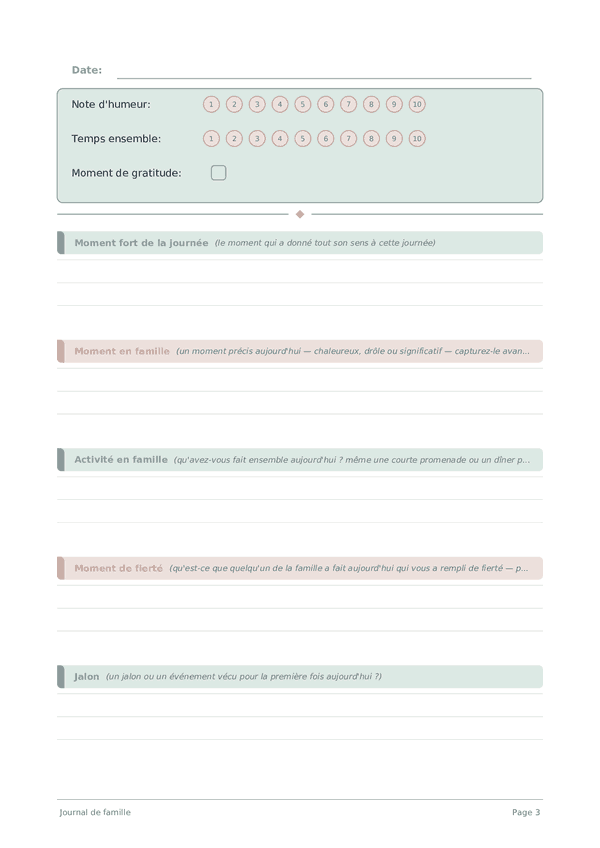
Moment fort de la journée
Quel a été le meilleur moment de votre journée ? Capturez l'instant qui a donné de la valeur à cette journée. Ces moments forts deviennent une collection de vos souvenirs les plus heureux.
Jalon
Un jalon ou un événement vécu pour la première fois aujourd'hui ?
Moment de fierté
Qu'est-ce que quelqu'un de la famille a fait aujourd'hui qui vous a rempli de fierté — petit ou grand
Notes de comportement
Comportement difficile ? Qu'est-ce qui a aidé, qu'est-ce qui n'a pas fonctionné ?
Gratitude pour l'enfant
Qu'est-ce que votre enfant a fait qui vous a fait sourire ou rempli de gratitude aujourd'hui ?
Notes
Ajoutez tout contexte ou réflexion supplémentaire. Cette colonne fourre-tout est pour tout ce qui ne rentre pas ailleurs mais pourrait être utile plus tard.
Conseils pour réussir
Quand et à quelle fréquence écrire
Write at least 3 times per week, ideally after the children are in bed when you can reflect calmly. Brief entries work fine on hectic days — even two sentences about what went well. Weekly, do a longer entry assessing the overall emotional climate at home. During particularly challenging phases (sleep regressions, school transitions, behavioral shifts), daily entries help you stay grounded and notice when things start improving.
Questions fréquentes
Pourquoi le Journal parental suit-il la patience et l'énergie en plus de l'humeur ?
La patience et l'énergie sont tes leviers de ressources, pas le comportement de l'enfant. Le cadre de neurobiologie interpersonnelle de Daniel Siegel (Siegel, 2011, The Whole-Brain Child) souligne que la régulation du parent entraîne la co-régulation de l'enfant — un parent épuisé ne peut pas modéliser le calme. Évaluer patience et énergie chaque jour expose les trajectoires d'épuisement avant d'en arriver à « j'ai crié sans comprendre pourquoi », transformant une fatigue vague en signal mesurable.
Que compte-t-on comme temps de qualité pour la case à cocher ?
Un temps focalisé avec ton enfant, sans téléphone ni attention partagée. Les recommandations de l'AAP sur l'utilisation des médias et le temps en famille insistent constamment sur la présence parentale plutôt que la durée ; dix minutes sans téléphone dans une activité choisie par l'enfant valent mieux qu'une heure de jeu parallèle distrait. La case binaire évite de gonfler une simple coprésence en « temps de qualité » que ce n'était pas.
Faut-il écrire même les jours où on s'est senti mauvais parent ?
Surtout ces jours-là. Un jour à patience 3/10 est une donnée diagnostique, pas un échec. Les recherches de Brené Brown sur la honte et la culpabilité (Brown, 2012, Daring Greatly) distinguent « j'ai fait quelque chose de difficile » de « je suis mauvais » — noter le moment précis dans notes de comportement empêche la honte de généraliser un après-midi difficile en identité. Les schémas des jours durs pointent souvent vers un déclencheur corrigeable : sommeil, faim, transitions, surcharge d'écrans.
En quoi milestone diffère-t-il de moment de fierté dans ce modèle ?
Les milestones sont les premières fois et transitions significatives sur le plan du développement (premiers mots, vélo, lecture autonome, entrée à l'école) — des repères que les pédiatres utilisent (recommandations de l'AAP). Les proud moments sont des aperçus de caractère : ton enfant s'est excusé spontanément, a défendu un plus petit, a persévéré malgré la frustration. Les milestones suivent « ce que » l'enfant sait faire ; les proud moments, « qui » il devient.
Le journal suffit-il ou faut-il aussi lire des livres sur la parentalité ?
Le journal est une réflexion sur la pratique, pas la pratique elle-même. Associe-le à des cadres basés sur des preuves : les outils de communication de Faber & Mazlish (Faber & Mazlish, 1980, How to Talk So Kids Will Listen), les recherches sur la parentalité autoritaire de Baumrind (Baumrind, 1967, Genetic Psychology Monographs, 75) et le cadre « whole-brain » de Siegel (Siegel, 2011, The Whole-Brain Child). Le journal t'aide à voir si ce que tu lis se manifeste réellement dans ton quotidien.
Que faire si mon score de patience est régulièrement à 4 ou moins ?
Une patience durablement faible signale un problème systémique, pas un problème de volonté. Consulte les entrées d'énergie et de temps de qualité : une faible énergie chronique pointe vers le sommeil, la charge du partenaire ou un stress parental non traité. Une chute de patience en période post-partum ou péri-ménopausique mérite un suivi médical. Si l'irritabilité s'accompagne de sentiments d'impuissance ou de pensées intrusives concernant des blessures, contacte rapidement un médecin — les scores du journal ne remplacent pas une évaluation clinique.
Comment utiliser notes de comportement de façon constructive sans étiqueter mon enfant ?
Note le comportement plus le contexte : « crise à 17h, a manqué le goûter, transition depuis les écrans ». L'approche de Faber & Mazlish (Faber & Mazlish, 1980) et les recommandations de l'AAP insistent toutes deux sur la description du comportement plutôt que de l'enfant (« il a frappé » pas « il est agressif »). Les notes sur plusieurs semaines révèlent les antécédents — faim, manque de sommeil, surcharge sensorielle — que tu peux anticiper.
À quel moment la revue hebdomadaire doit-elle signaler des préoccupations suffisamment sérieuses pour un médecin ?
Apporte les données à un pédiatre ou un psychologue pour enfants si tu observes : régression persistante sur les milestones, changements de comportement marqués pendant des semaines, ta propre patience ou humeur à 3/10 la plupart des jours, ou toute pensée de blesser soi-même ou l'enfant. L'AAP recommande une prise de décision partagée pour les préoccupations de développement. Tes entrées de journal rendent la consultation concrète — ne laisse pas la documentation retarder un appel que tu sens nécessaire.
Vous aimerez aussi
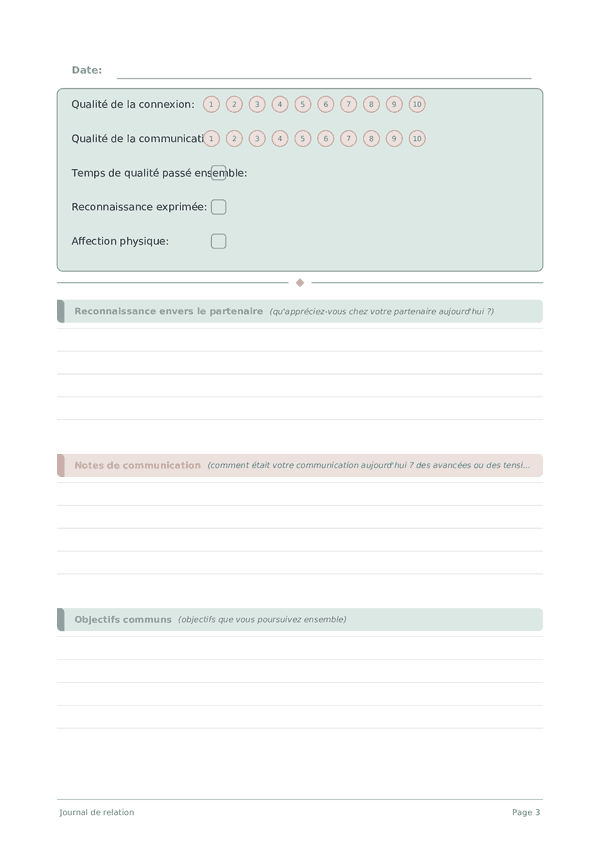
Journal de relation
Nourrissez votre lien par la réflexion quotidienne et la connexion intentionnelle
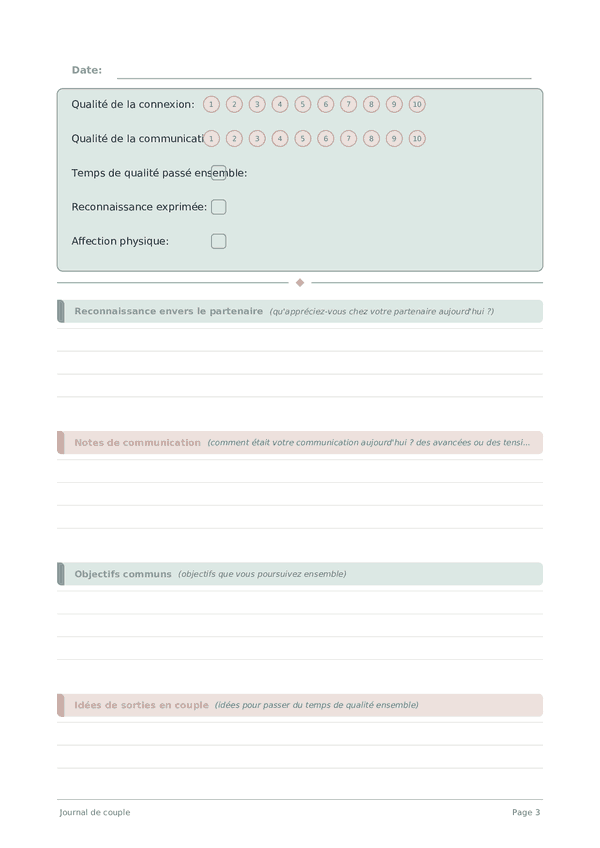
Journal de couple
Renforcez votre lien avec un suivi quotidien de la connexion
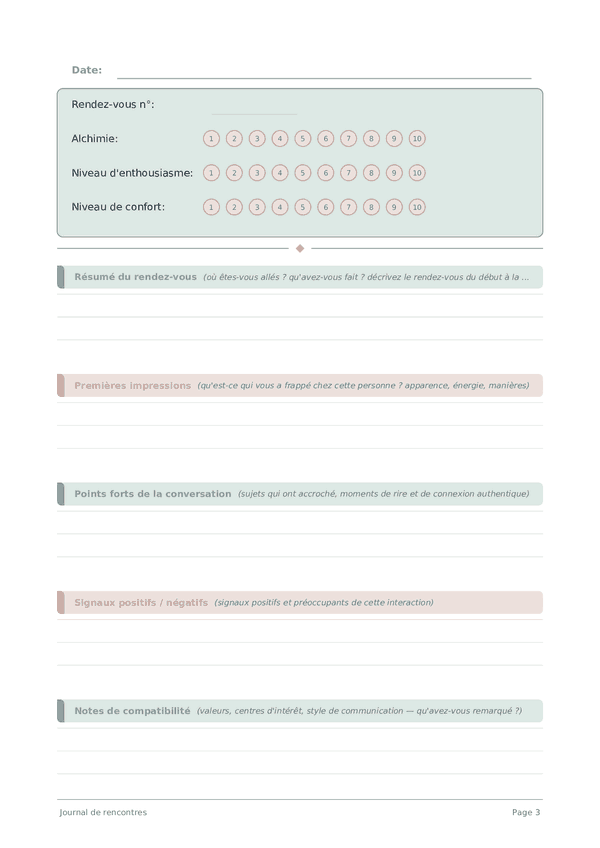
Journal de rencontres
Suivez vos rendez-vous, évaluez la chimie et découvrez ce que vous recherchez vraiment
Journal de famille
Capturez les moments et les souvenirs quotidiens de votre famille
Molette pour zoomer, glisser pour déplacer