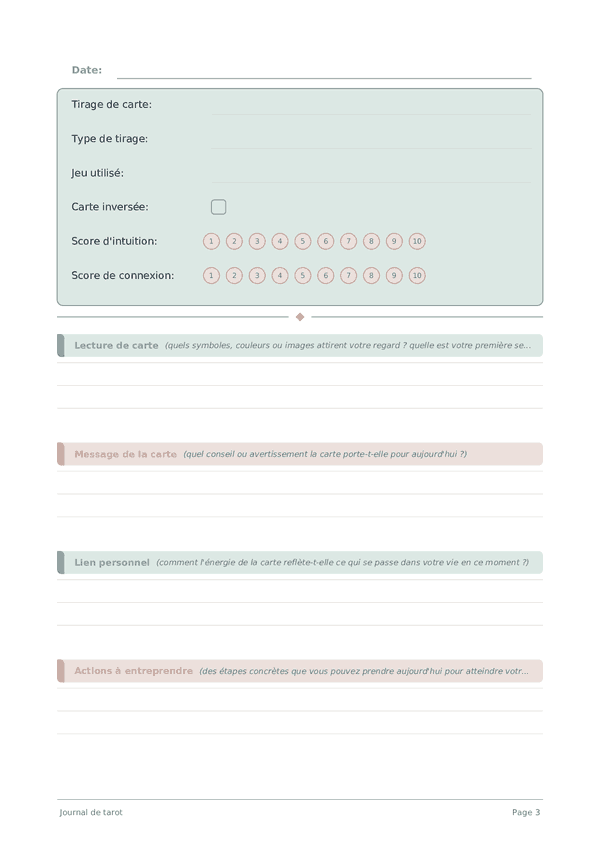
Printable Journal de tarot
Suivez vos tirages quotidiens, vos étalements et vos intuitions
A structured daily practice for tarot readers of all levels. Each entry guides you to record your card draw and spread details, capture your first impressions and symbolic observations, explore the card's personal message, and reflect on how the reading connects to your life. Over time, you build a rich record of recurring cards, evolving interpretations, and patterns that deepen your intuitive reading practice.
Personnaliser les champs
Activez ou désactivez les champs. Cliquez sur le crayon pour renommer, ou ajoutez vos propres champs.
Avantages
Comment utiliser
Qu'est-ce que ce journal ?
A tarot journal is a daily practice for recording and reflecting on your card readings, deepening your relationship with the tarot and your own intuition. By logging the cards drawn, spread type, and deck used alongside reflective writing about messages and personal connections, you build a rich archive of symbolic dialogue with your inner wisdom.
This journal is for tarot enthusiasts at any level — from beginners learning card meanings to experienced readers refining their interpretive skills. It serves as both a study tool and a spiritual diary, tracking how your understanding of each card evolves through personal experience rather than just memorized definitions.
Whether you view tarot as a spiritual tool, a psychological mirror, or a creative thinking framework, consistent journaling dramatically accelerates learning. Tracking patterns in which cards appear frequently, which spreads resonate most, and how readings connect to actual life events builds intuitive pattern recognition that cannot be gained from studying books alone.
Exemple rempli
Voici à quoi ressemble une entrée typique une fois remplie :
Comment remplir chaque champ
Le haut de chaque page comporte des champs à remplissage rapide (évaluations, cases à cocher, chiffres). En dessous se trouve une section lignée pour écrire. Voici ce que signifie chaque champ :
Tirage de carte
Quelle carte avez-vous tirée aujourd'hui ? Écrivez le nom et le numéro de la carte
Type de tirage
Trois cartes, Croix celtique, tirage simple...
Jeu utilisé
Quel jeu de tarot avez-vous utilisé ?
Carte inversée
La carte était-elle à l'endroit ou inversée ? Notez l'orientation et votre ressenti
Score d'intuition
Quelle était la force de votre connexion intuitive pendant le tirage ? Notez de 1 à 10
Score de connexion
À quel point le message de la carte a-t-il résonné en vous ? Notez de 1 à 10
Lecture de carte
Quels symboles, couleurs ou images attirent votre regard ? Quelle est votre première sensation ?
Message de la carte
Quel conseil ou avertissement la carte porte-t-elle pour aujourd'hui ?
Lien personnel
Comment l'énergie de la carte reflète-t-elle ce qui se passe dans votre vie en ce moment ?
Actions à entreprendre
Décomposez votre objectif en actions concrètes. Que ferez-vous exactement, quand et comment ? Plus c'est précis, mieux c'est.
Leçon apprise aujourd'hui
Retenez un enseignement de l'expérience d'aujourd'hui. Avec le temps, ces leçons deviennent une bibliothèque de sagesse personnelle.
Conseils pour réussir
Quand et à quelle fréquence écrire
Pull and journal about a daily single-card draw each morning to build interpretive fluency and track evolving themes. Do fuller spreads (3-card or Celtic Cross) weekly or when facing a specific decision or transition. After major life events, a detailed reading and entry can provide valuable perspective. Monthly, review your card frequency log and past readings to assess accuracy and growth. Avoid pulling repeatedly on the same question — if you feel the urge, journal about why the first answer was unsatisfying instead.
Questions fréquentes
À quoi sert le Journal de tarot ?
C'est un traqueur quotidien structuré pour les tirages de cartes, les types de spreads, le jeu utilisé, le statut renversé et deux scores — score d'intuition et score de connexion — associés à huit lignes de réflexion sur le message de la carte, la connexion personnelle, les actions à entreprendre et les leçons. Le journal ne revendique aucune précision divinatoire ; c'est un outil de réflexion personnelle, similaire aux pratiques d'écriture expressive étudiées par James Pennebaker pour le traitement émotionnel.
Comment utiliser les champs score d'intuition et score de connexion ?
Note le score d'intuition le matin pour capturer à quel point la carte t'a parlé sur une échelle de 1 à 10. Note le score de connexion le soir pour capturer comment la carte a reflété ta journée. Comparer les deux sur plusieurs semaines révèle quand les premières impressions correspondent à l'expérience vécue. Traite cela comme une pratique réflexive, pas une validation de prédiction — il n'existe pas de preuve évaluée par des pairs soutenant le tarot comme outil de prévision.
Pourquoi le journal demande-t-il si la carte est renversée ?
L'orientation renversée est une convention de lecture de longue date introduite dans la tradition occidentale moderne du tarot (système Rider-Waite, 1909). La case permet d'enregistrer l'orientation précisément pour que les notes message de la carte et lien personnel restent cohérentes dans les lectures de la même carte. Sans ce marqueur, revenir sur d'anciennes entrées pour comparer les interprétations devient peu fiable, car une carte renversée et sa forme droite portent généralement un poids symbolique différent dans la plupart des systèmes de lecture.
En quoi tenir un journal de tarot est-il différent d'utiliser une appli de tarot ?
Les applications délivrent des interprétations pré-écrites à la demande ; ce modèle capture tes propres premières impressions, le jeu utilisé, le type de spread et les résultats vécus. Sur des mois tu construis une bibliothèque personnelle de significations enracinée dans l'expérience réelle plutôt que dans le guide d'un autre auteur. Les recherches sur l'écriture expressive de James Pennebaker démontrent que l'écriture à la main sur du matériel personnellement significatif a des effets mesurables sur le bien-être, indépendamment de tout cadre divinatoire autour de la pratique.
Existe-t-il des preuves scientifiques que le tarot révèle la vérité ?
Aucune preuve évaluée par des pairs ne soutient le tarot comme moyen d'accéder à des informations cachées. Les bénéfices documentés en psychologie sont projectifs — la carte devient un prompt pour la réflexion sur soi, similaire aux techniques projectives cliniques. Utilise le journal en conséquence : traite message de la carte et lien personnel comme tes interprétations, pas comme des prévisions objectives. Pour des problèmes de santé mentale, consulte un clinicien agréé plutôt que de t'appuyer sur les tirages comme source de décisions.
Un débutant sans formation au tarot peut-il utiliser ce journal ?
Oui. Commence par des tirages d'une seule carte et note jeu utilisé et type de tirage comme Daily Draw. Ignore la case renversée jusqu'à ce que tu adoptes cette convention. Les prompts du bas (message de la carte, lien personnel, actions à entreprendre, leçon apprise aujourd'hui) fonctionnent sans significations mémorisées — tu réponds à l'imagerie elle-même. À mesure que tu lis davantage, tes interprétations s'enrichissent ; cette croissance est ce que le score de connexion suit.
Quelle est l'erreur la plus courante des nouveaux teneurs de journal de tarot ?
Copier des significations génériques de guides dans message de la carte au lieu d'écrire ce que l'imagerie a évoqué. Les interprétations pré-chargées empêchent le champ lien personnel de faire son travail — relier la carte à ta situation spécifique. Écris ton impression brute d'abord, consulte le livre ensuite si tu le souhaites, et note la différence. Avec le temps, ton score d'intuition reflète tes propres lectures, pas celles de quelqu'un d'autre.
À quelle fréquence tirer et tenir un journal pour voir des schémas ?
Des tirages quotidiens d'une seule carte pendant un mois produisent assez de données pour repérer les cartes et thèmes récurrents. Les cinq champs du traqueur plus les huit lignes de réflexion s'accumulent rapidement. La revue hebdomadaire est le moment où les schémas deviennent visibles — même carte apparaissant les jours stressants, certaines couleurs se concentrant sur des semaines spécifiques. Traite cela comme une pratique symbolique personnelle ; elle complète, mais ne remplace pas, la thérapie ou les soins médicaux.
Vous aimerez aussi
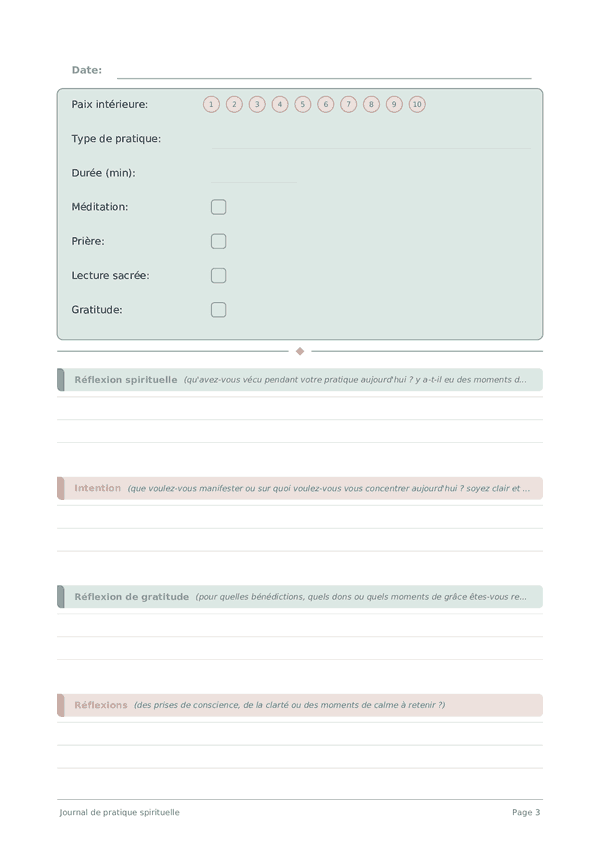
Journal de pratique spirituelle
Nourrissez votre vie intérieure par la pratique et la réflexion quotidiennes
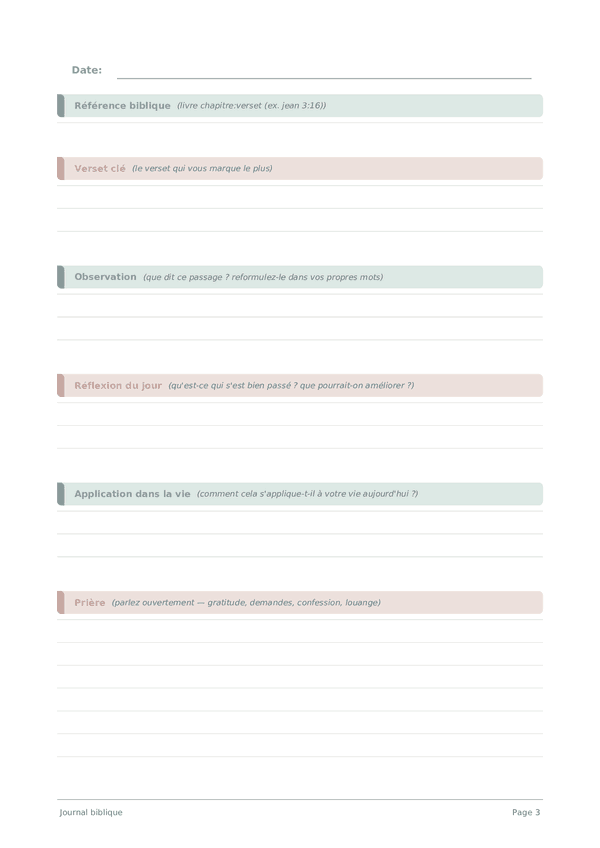
Journal biblique
Écriture, Observation, Application, Prière — la méthode SOAP
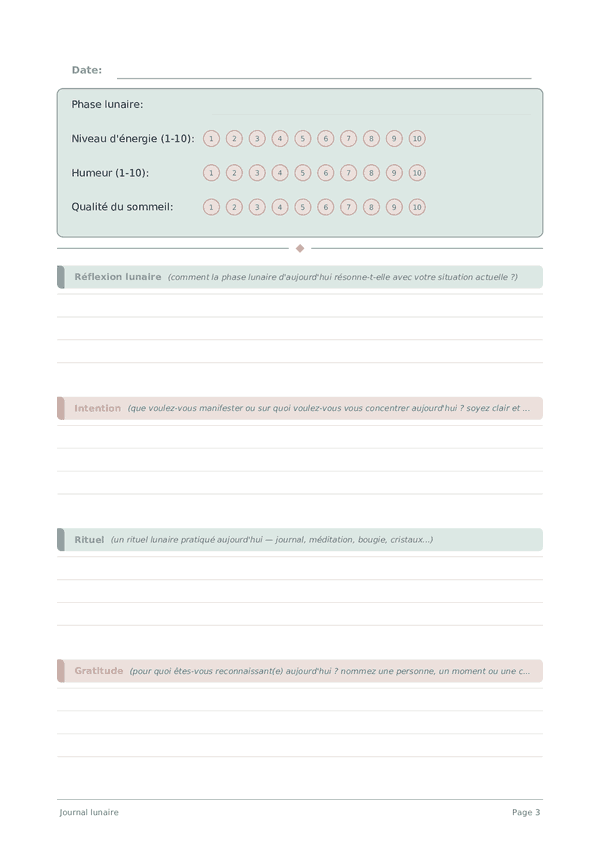
Journal lunaire
Alignez-vous avec le cycle lunaire — suivez, réfléchissez et lâchez prise
Journal d'astrologie
Décryptez les astres, suivez les transits et alignez votre quotidien avec les rythmes cosmiques
Molette pour zoomer, glisser pour déplacer