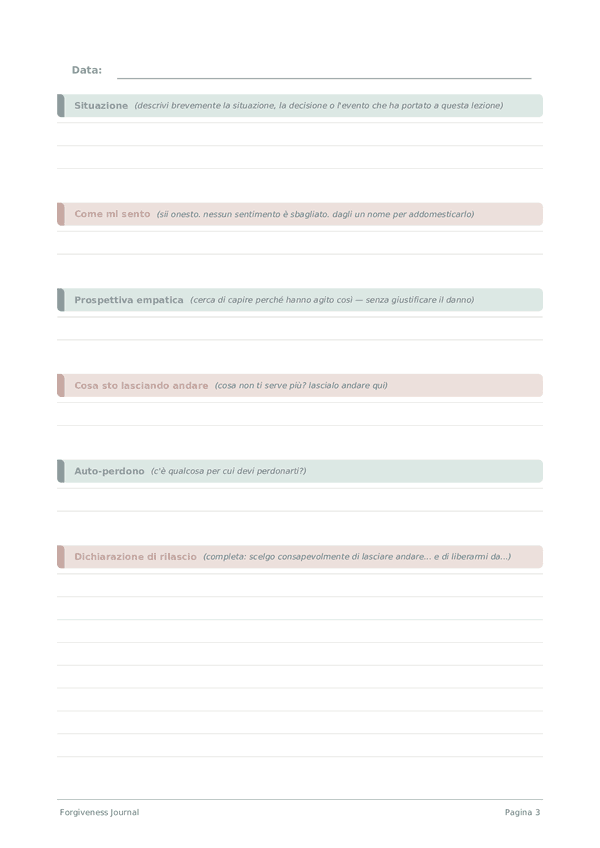
Printable Diario del Perdono
Pratica guidata del perdono e diario di liberazione emotiva
Personalizza campi
Attiva o disattiva i campi. Clicca la matita per rinominare, oppure aggiungi i tuoi campi.
Cos'è questo diario?
Questo è un diario con inserimenti giornalieri — ogni pagina rappresenta un giorno con domande strutturate che guidano la tua riflessione. Le sezioni sono progettate in modo che compilarle richieda solo 5–10 minuti, rendendo facile mantenere un'abitudine quotidiana.
Come compilare ogni campo
Ogni giorno troverai diverse sezioni etichettate con righe per scrivere. Ecco a cosa serve ogni sezione:
Situazione
Descrivi la situazione o l'evento in modo oggettivo, come se fossi un osservatore neutrale. Separare i fatti dai sentimenti ti aiuta a vedere le cose più chiaramente.
Come mi sento
Descrivi come ti senti adesso con parole tue. Non esistono risposte sbagliate. Semplicemente mettere i sentimenti su carta riduce il loro peso emotivo.
Prospettiva empatica
Cerca di capire perché hanno agito così — senza giustificare il danno
Cosa sto lasciando andare
Scrivi qualcosa che sei pronto a lasciare andare — una preoccupazione, un risentimento, un'aspettativa. Nominare ciò che lasci andare è il primo passo verso la libertà da esso.
Auto-perdono
C'è qualcosa per cui devi perdonarti?
Dichiarazione di rilascio
Completa: Scelgo consapevolmente di lasciare andare... e di liberarmi da...
Consigli per il successo
Quando e con quale frequenza scrivere
Compila una pagina al giorno. La maggior parte delle persone trova che la mattina (10 minuti dopo il risveglio) o la sera (prima di dormire) funzionino meglio. Scegli un orario e mantienilo per almeno due settimane prima di cambiare. La chiave è la regolarità, non la perfezione.
Domande frequenti
Cos'è il modello REACH usato in questo diario?
REACH è il modello del perdono di Everett Worthington — Ricorda il dolore, Empatizza, Dono Altruistico, Impegnati, Mantieni (Recall, Empathize, Altruistic gift, Commit, Hold on). Worthington e Scherer (2004, Psychology and Health, 19(3)) e successivi studi randomizzati ne hanno documentato gli effetti su ostilità e benessere. Le sezioni del diario — situation, feelings, prospettiva empatica, cosa sto lasciando andare, dichiarazione di rilascio — corrispondono direttamente alla sequenza REACH.
Perdonare significa approvare quello che è successo?
No. La ricerca di Worthington e le risorse APA sul perdono distinguono esplicitamente il perdono dall'approvazione, dal dimenticare o dal riconciliarsi. Il perdono è un rilascio interno del risentimento; la riconciliazione richiede il lavoro di riparazione dell'altra parte. La sezione cosa sto lasciando andare del diario affronta il tuo rapporto con il dolore, non la responsabilità dell'offensore. Puoi perdonare senza contatto o fiducia.
Come scrivo 'prospettiva empatica' senza minimizzare il danno?
Il modello di Worthington usa l'empatia per ammorbidire l'emozione senza giustificare il comportamento. Due righe: scrivi i fattori che potrebbero spiegare le azioni dell'altra persona — non scusarle. McCullough, Pargament, Thoresen (2000, «Forgiveness: Theory, Research, and Practice», Guilford) descrivono questo come umanizzare senza assolvere. Il danno rimane tale; l'empatia riduce la ruminazione che alimenta la tua sofferenza.
Perché includere 'auto-perdono'?
Il perdono di sé è un costrutto distinto dal perdonare gli altri. Hall e Fincham (2005, Journal of Social and Clinical Psychology, 24(5)) e Wohl, DeShea, Wahkinney (2008, Canadian Journal of Behavioural Science, 40(1)) hanno mostrato che il perdono di sé riduce depressione e vergogna quando abbinato alla responsabilità. Due righe impongono il lavoro più difficile: nomina ciò di cui ti penti, poi offri lo stesso rilascio che daresti a un'altra persona.
A cosa serve 'dichiarazione di rilascio'?
Funziona come un impegno comportamentale — quello che Worthington chiama «mantenersi nel perdono». La singola riga cristallizza la scelta. Karremans et al. (2003, JPSP, 84(5)) hanno rilevato che le dichiarazioni esplicite di perdono predicevano risultati migliori rispetto alle intenzioni vaghe. Scrivi la dichiarazione al presente, facendo tua la decisione: «Rilascio il peso di questo» anziché «ci proverò».
Il journaling del perdono è appropriato per il trauma?
Con cautela. Worthington e altri (Wade, Hoyt, Kidwell, Worthington, 2014, Journal of Counseling Psychology, 61(2), meta-analisi) hanno rilevato che gli interventi sul perdono erano efficaci per molti, ma il perdono forzato può danneggiare i sopravvissuti a traumi. Se il dolore riguarda abusi, aggressioni o trauma prolungato, consulta un professionista della salute mentale abilitato con formazione nel trauma prima di un lavoro di perdono sostenuto. Il perdono prematuro può aggravare il danno.
Quanto tempo richiede questo lavoro?
Da giorni a mesi, a seconda della gravità del dolore. Worthington e Scherer (2004, Psychology and Health, 19(3)) e Wade et al. (2014, Journal of Counseling Psychology, 61(2)) hanno rilevato che gli effetti degli interventi sul perdono crescevano con il numero di sessioni e la profondità del dolore. Il diario può essere ripreso per la stessa situazione nel corso delle settimane; i progressi sulla stessa ferita sono uno schema normale, non un segno che la pratica è fallita.
Perdonare qualcuno riconcilia il rapporto?
Non necessariamente. Il perdono è interno; la riconciliazione richiede il lavoro di riparazione dell'altra parte. Le risorse APA sul perdono e la letteratura clinica le trattano come scelte separabili. Il diario supporta il perdono — la tua pace — senza richiedere contatto o fiducia ripristinata. Alcuni perdonano senza riconciliarsi; altri si riconciliano senza un perdono completo. Il dichiarazione di rilascio appartiene solo a te.
Potrebbe piacerti anche
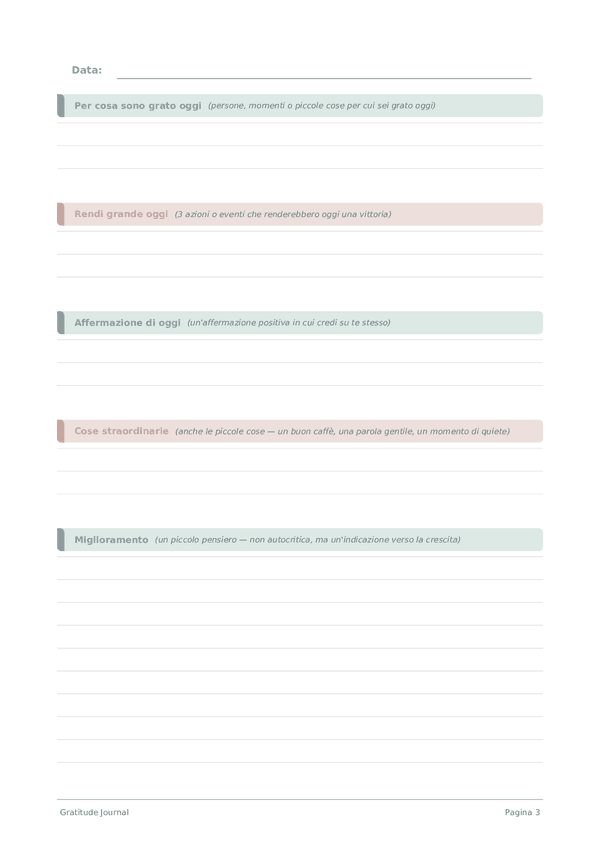
Diario della Gratitudine
Coltiva la riconoscenza e la positività ogni giorno
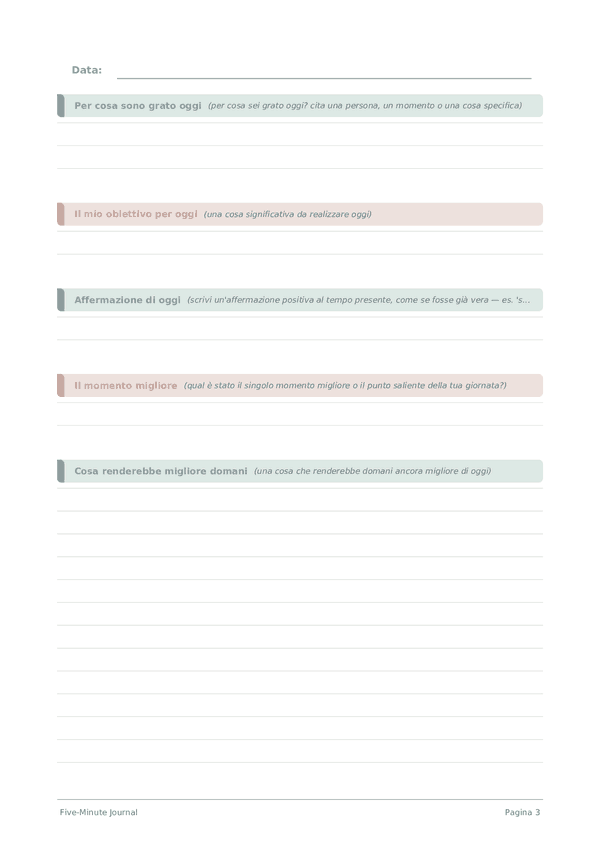
Diario dei Cinque Minuti
Diario quotidiano di gratitudine e riflessione in cinque minuti
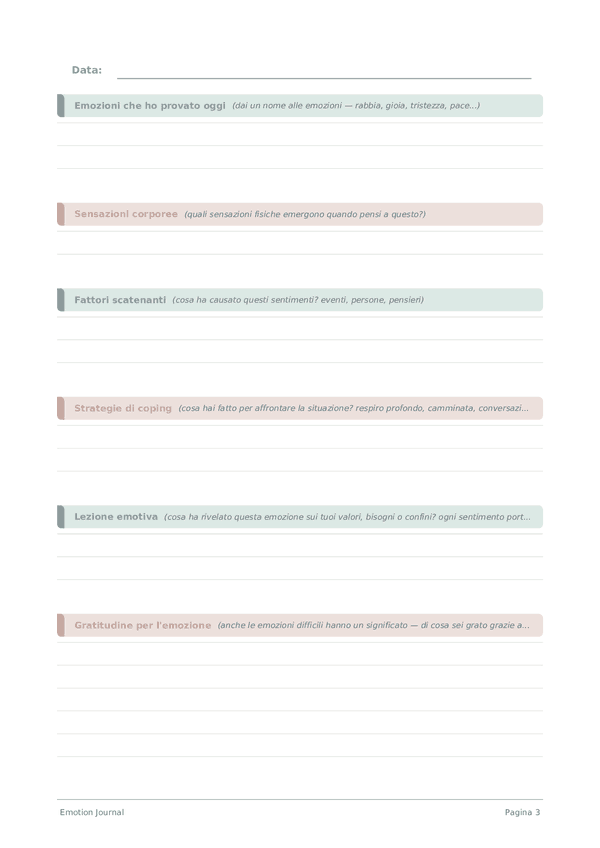
Diario delle Emozioni
Comprendi, elabora e cresci attraverso le tue emozioni
Tracker delle Abitudini
Costruisci abitudini migliori un giorno alla volta
Scorri per ingrandire, trascina per spostare