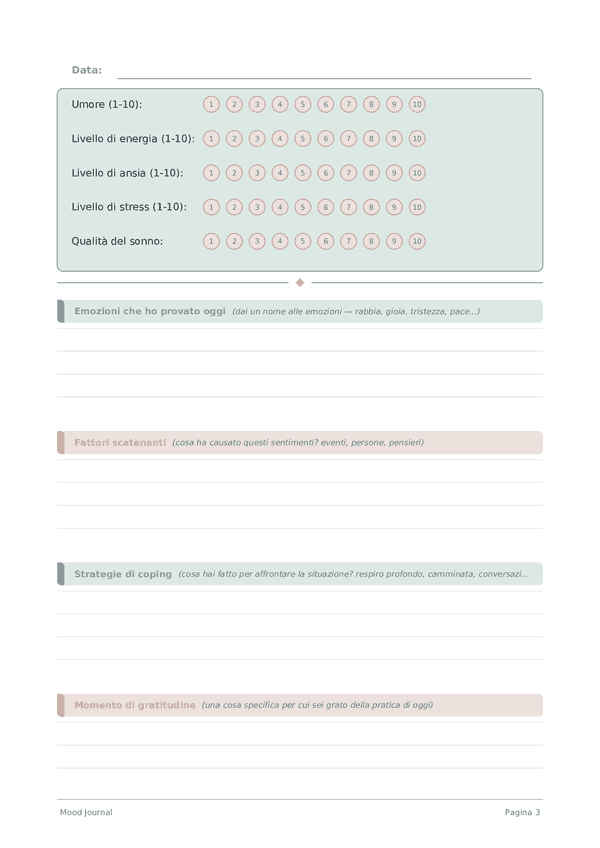
Printable Diario dell'Umore
Monitora le emozioni, individua i pattern e sviluppa la consapevolezza emotiva
Personalizza campi
Attiva o disattiva i campi. Clicca la matita per rinominare, oppure aggiungi i tuoi campi.
Cos'è questo diario?
Questo è un diario ibrido — ogni pagina combina una sezione di tracciamento rapido in cima con un'area di scrittura a righe in basso. Ciò ti consente di catturare sia dati misurabili che riflessioni in forma libera in un unico posto.
Come compilare ogni campo
La parte superiore di ogni pagina ha campi a compilazione rapida (valutazioni, caselle di controllo, numeri). Sotto c'è una sezione a righe per scrivere. Ecco cosa significa ogni campo:
Umore (1-10)
Valuta il tuo stato emotivo complessivo della giornata. 1 significa molto basso o depresso, 10 significa eccezionalmente felice e positivo. Non pensarci troppo — vai con la tua sensazione istintiva.
Livello di energia (1-10)
Valuta il tuo livello di energia fisica e mentale. 1 significa esausto e svuotato, 10 significa pieno di energia e sveglio. Questo ti aiuta a identificare quali attività aumentano o drenano la tua energia.
Livello di ansia (1-10)
Valuta il tuo livello di ansia oggi. Dare un numero alla sensazione la rende più gestibile e monitorabile.
Livello di stress (1-10)
Valuta il tuo stress su una scala da 1 a 10. Nel tempo, identificherai i tuoi schemi di stress e le strategie di coping più efficaci.
Qualità del sonno
Valuta quanto è stato riposante il tuo sonno. 1 significa terribile e agitato, 5 significa profondo e rigenerante. La qualità conta quanto la quantità.
Emozioni che ho provato oggi
Nomina le emozioni specifiche che hai provato. La ricerca mostra che dare un nome alle emozioni riduce la loro intensità e aumenta la consapevolezza di sé.
Fattori scatenanti
Identifica cosa ha causato le tue reazioni emotive — eventi, persone, pensieri, ambienti. Riconoscere i trigger ti dà il potere di prepararti o evitarli.
Strategie di coping
Cosa hai fatto per affrontare la situazione? Respiro profondo, camminata, conversazione...
Momento di gratitudine
Una cosa specifica per cui sei grato della pratica di oggi
Intuizione sull'umore
Quale schema o lezione sulle tue emozioni hai notato oggi?
Consigli per il successo
Quando e con quale frequenza scrivere
Compila una pagina al giorno. La parte del tracker richiede meno di un minuto; cerca di farlo a un orario costante. La sezione di scrittura può essere fatta nello stesso momento o riservata quando hai 5 minuti tranquilli. Entrambe le parti insieme ti danno il quadro più completo della tua giornata.
Domande frequenti
Come cinque valutazioni più narrazione battono un singolo punteggio dell'umore?
Cinque scale 0-10 — mood, energy, livello di ansia (1-10), livello di stress (1-10), qualità del sonno — separano costrutti distinti che si muovono indipendentemente. La ricerca PANAS di Watson, Clark e Tellegen (1988, JPSP, 54(6)) ha stabilito che l'affetto positivo e negativo non sono i poli opposti di un unico asse. Abbinare numeri e narrazione cattura sia la forma dimensionale della tua giornata sia il suo significato.
Cos'è 'intuizione sull'umore' e come ne trovo uno?
Intuizione sull'umore è uno schema, una lezione o un'osservazione che hai notato sulla tua vita emotiva oggi. È il passo di sintesi. Il lavoro di Wilson e Gilbert sulla previsione affettiva (2003, Advances in Experimental Social Psychology, 35) mostra che prevediamo le nostre emozioni in modo impreciso senza dati. Scrivere un'intuizione settimanale dalle tue valutazioni trasforma sentimenti astratti in auto-conoscenza applicabile.
Quanto devo essere specifico in 'emozioni che ho provato oggi'?
Usa parole precise, non «bene» o «male». Kashdan, Barrett, McKnight (2015, Current Directions in Psychological Science, 24(1)) hanno mostrato che la granularità emotiva — distinguere «solitario» da «rifiutato» da «isolato» — predice una migliore regolazione. Una sezione a 7 righe dà spazio per nominare tre o quattro emozioni distinte. Il 'intuizione sull'umore' del diario si basa su questa risoluzione.
Come usa questo diario la psicologia positiva?
Attraverso momento di gratitudine e la sezione delle intuizioni. Il framework della psicologia positiva di Seligman (Seligman et al., 2005, American Psychologist, 60(5)) integra l'identificazione delle emozioni positive con la creazione di significato, entrambi presenti qui. Lyubomirsky («The How of Happiness», Penguin, 2007) riporta che le pratiche di gratitudine contribuiscono a guadagni duraturi di benessere. Il formato ibrido abbina quello al monitoraggio CBT-style dei trigger e del coping.
Quali schemi cercare dopo un mese?
Esegui tre verifiche: quali giorni della settimana si correlano con basso umore, quali trigger appaiono in più di tre voci, e se qualità del sonno precede il cambiamento dell'umore del giorno successivo. La ricerca sull'affetto circadiano e settimanale di Watson et al. e gli schemi di ruminazione mappati da Watkins (2008, Psychological Bulletin, 134(2)) suggeriscono entrambi che la revisione settimanale fa emergere schemi invisibili giorno per giorno.
Le valutazioni dell'umore dovrebbero essere fatte alla stessa ora ogni giorno?
Sì — idealmente la sera per la valutazione retrospettiva della giornata. L'ora del giorno influisce fortemente sull'umore valutato (Stone et al., 2006, Emotion, 6(1) sugli schemi dell'umore diurno). Campionare a orari diversi mescola il rumore diurno nella tua linea di tendenza. Scegli un orario e proteggilo; la coerenza nella misurazione rivela il cambiamento reale anziché l'artefatto dell'ora del giorno.
È sufficiente per i disturbi dell'umore clinici?
No. Il diario supporta l'auto-consapevolezza e può integrare il trattamento, ma i disturbi dell'umore diagnosticati — depressione maggiore, disturbo bipolare, distimia — richiedono cure cliniche. Le linee guida dell'APA, del NIMH e dell'OMS sulla salute mentale raccomandano il trattamento basato sull'evidenza da parte di un professionista della salute mentale abilitato. Molti clinici usano la mappatura dell'umore accanto alla terapia; chiedi al tuo se questo formato è utile.
In cosa si differenzia dalle app di tracciamento delle emozioni?
Le app generano dati longitudinali ma riducono la riflessione a tocchi. Il layout ibrido impone l'elaborazione scritta — Lieberman et al. (2007, Psychological Science, 18(5)) hanno mostrato che etichettare le emozioni in parole riduce la reattività dell'amigdala, un effetto prodotto dal linguaggio e non dalla selezione. La narrazione a sette righe cattura le valutazioni che guidano le rating, il che è ciò che rende i dati applicabili.
Potrebbe piacerti anche
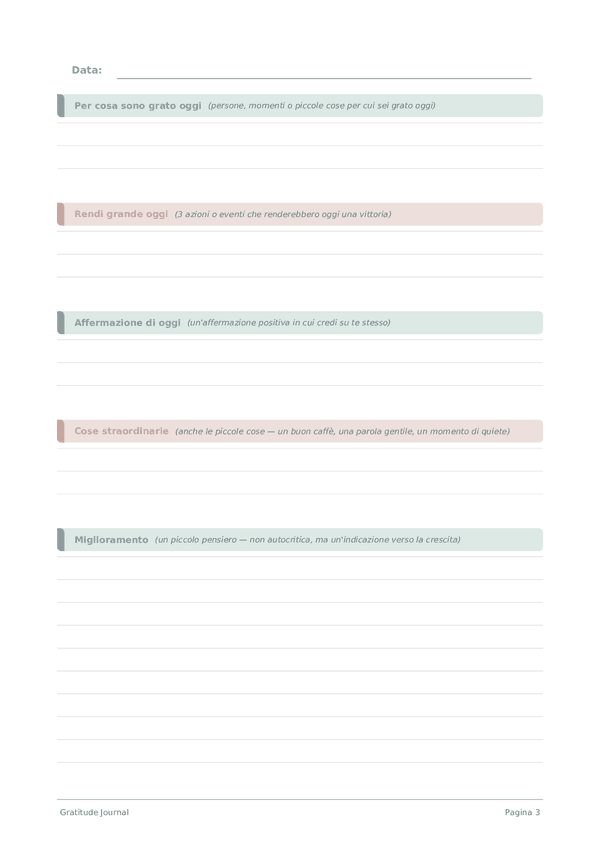
Diario della Gratitudine
Coltiva la riconoscenza e la positività ogni giorno
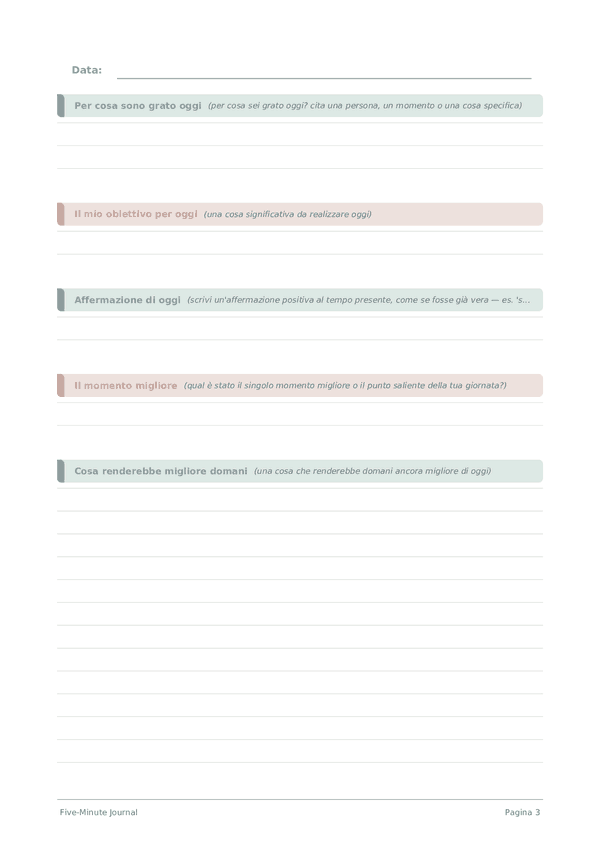
Diario dei Cinque Minuti
Diario quotidiano di gratitudine e riflessione in cinque minuti
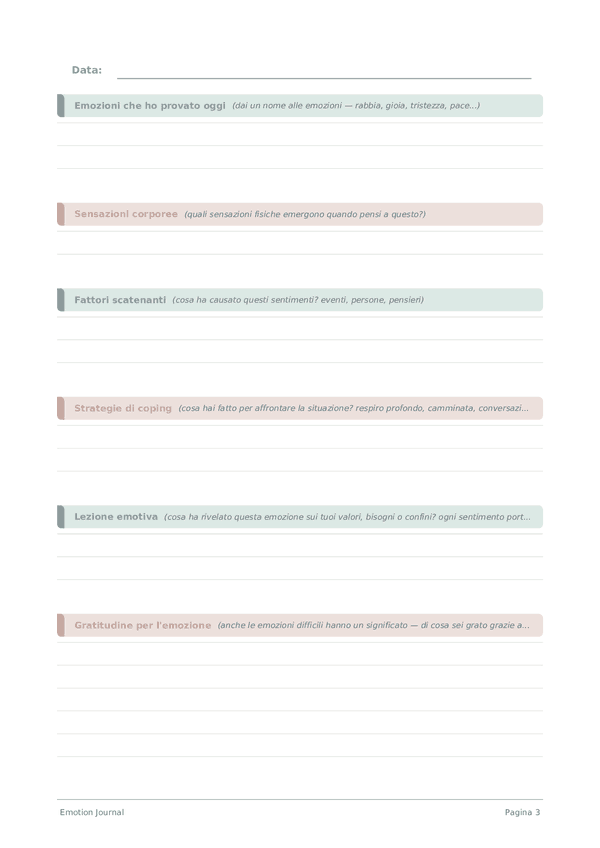
Diario delle Emozioni
Comprendi, elabora e cresci attraverso le tue emozioni
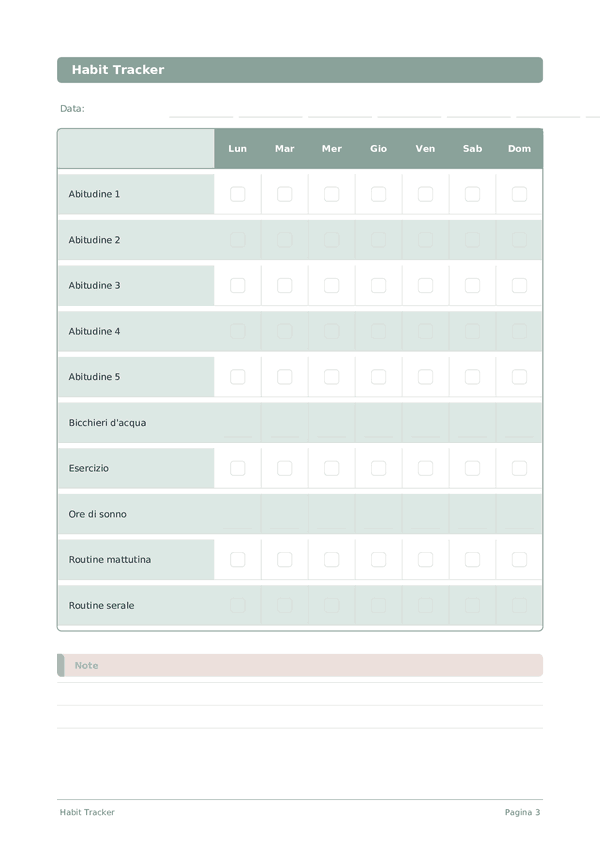
Tracker delle Abitudini
Costruisci abitudini migliori un giorno alla volta
Scorri per ingrandire, trascina per spostare