Printable Suchtgenesungstagebuch
Ihre Nüchternheit verfolgen und täglich Resilienz aufbauen
A structured daily companion for your recovery journey. Track sobriety milestones, monitor cravings and mood patterns, reflect on triggers and coping strategies, celebrate victories, and nurture your support network — all in one place.
Felder anpassen
Schalten Sie Felder ein oder aus. Klicken Sie auf den Stift zum Umbenennen oder fügen Sie eigene Felder hinzu.
Vorteile
Anleitung
Was ist dieses Journal?
An addiction recovery journal is a comprehensive daily tool for supporting your journey out of addiction — any addiction. By tracking sobriety days, cravings, mood, and energy alongside detailed reflections on triggers, coping strategies, and support connections, you create a structured recovery practice that supplements professional treatment.
This journal is for anyone in recovery from substance addiction, behavioral addiction, or compulsive patterns. It is designed to work alongside 12-step programs, therapy, and other recovery frameworks. The structure provides both accountability and a safe space for the complex emotional landscape of recovery.
Clinical research on addiction recovery identifies daily journaling as a powerful relapse prevention tool. The process of writing about cravings and triggers activates the prefrontal cortex — the brain region responsible for impulse control — effectively strengthening the neural infrastructure you need most. Tracking support connections also reinforces the social bonds that are critical to sustained recovery.
Ausgefülltes Beispiel
So sieht ein typischer Eintrag aus, wenn er ausgefüllt ist:
Wie Sie jedes Feld ausfüllen
Oben auf jeder Seite befinden sich schnell ausfüllbare Felder (Bewertungen, Kontrollkästchen, Zahlen). Darunter ist ein linierter Bereich zum Schreiben. Hier erfahren Sie, was jedes Feld bedeutet:
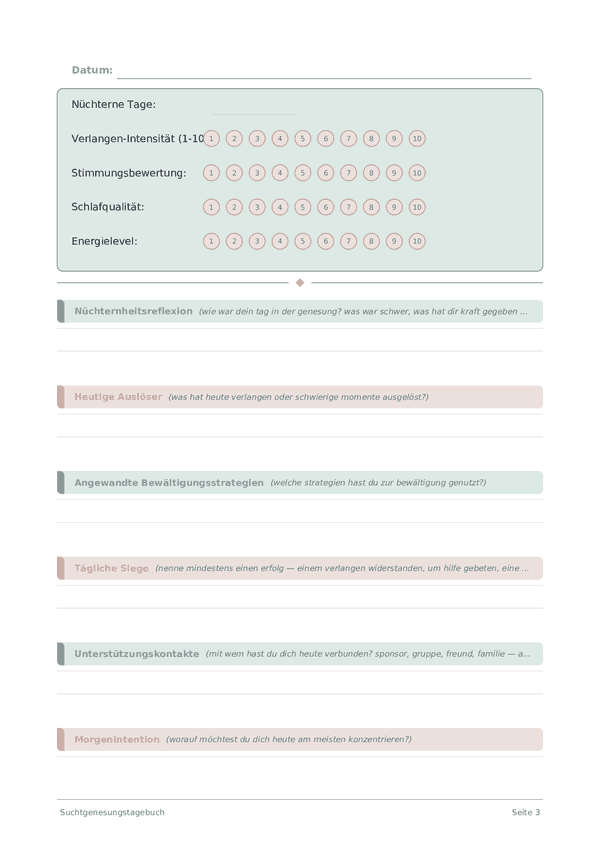
Nüchterne Tage
Notieren Sie, wie viele aufeinanderfolgende Tage Sie nüchtern waren. Diese Zahl wachsen zu sehen, ist eine starke Motivation. Wenn Sie neu beginnen müssen, fangen Sie ohne Scham wieder an zu zählen.
Verlangen-Intensität (1-10)
Wie stark ist dein Verlangen heute? Bewerte von 1 (kaum spürbar) bis 10 (überwältigend)
Stimmungsbewertung
Bewerte deinen emotionalen Zustand (1-10), um deinen Heilungsverlauf zu verfolgen
Schlafqualität
Bewerten Sie, wie erholsam Ihr Schlaf war. 1 bedeutet schrecklich und unruhig, 5 bedeutet tief und erfrischend. Qualität ist genauso wichtig wie Quantität.
Energielevel
Wie energiegeladen fühlst du dich heute Morgen? (1=erschöpft, 5=voll aufgeladen)
Nüchternheitsreflexion
Wie war dein Tag in der Genesung? Was war schwer, was hat dir Kraft gegeben und wie fühlst du dich jetzt?
Heutige Auslöser
Was hat heute Verlangen oder schwierige Momente ausgelöst?
Angewandte Bewältigungsstrategien
Welche Strategien hast du zur Bewältigung genutzt?
Tägliche Siege
Nenne mindestens einen Erfolg — einem Verlangen widerstanden, um Hilfe gebeten, eine gesunde Aktivität gewählt
Unterstützungskontakte
Mit wem hast du dich heute verbunden? Sponsor, Gruppe, Freund, Familie — auch ein kurzes Gespräch zählt
Morgenintention
Worauf möchtest du dich heute am meisten konzentrieren?
Wofür ich heute dankbar bin
Listen Sie 1–3 Dinge auf, für die Sie heute dankbar sind. Es kann Großes oder Kleines sein — eine gute Mahlzeit, ein freundliches Wort, Sonnenschein. Dankbarkeitsjournaling gehört zu den wissenschaftlich am besten belegten Praktiken für das Wohlbefinden.
Tipps für den Erfolg
Wann und wie oft schreiben
Journal every day, ideally in the evening as part of your recovery routine. In early recovery, write twice daily if possible — morning intentions and evening reflection create bookends of accountability. Log every meeting, every support call, every craving and its resolution. Weekly, review your HALT patterns and identify which state triggered the most difficulty. Monthly, celebrate your progress by re-reading your earliest entries and seeing how far you have come.
Häufig gestellte Fragen
Was erfasst das Suchtgenesungstagebuch täglich?
Es protokolliert Nüchternheitstage, vier Bewertungen auf einer Skala von 1–10 (Verlangensintensität, Stimmung, Schlafqualität, Energie) und sieben schriftliche Impulse: Morgenintention, Genesungsreflexion, Auslöser, eingesetzte Bewältigungsstrategien, tägliche Erfolge, Unterstützungskontakte und Dankbarkeit. Diese Struktur spiegelt den Selbstbeobachtungsrahmen aus NIDAs Principles of Drug Addiction Treatment (2020). Es unterstützt — ersetzt aber nicht — formelle Versorgung durch eine lizenzierte Suchtfachkraft. Konsultieren Sie eine Suchtberatungsstelle.
Wie formuliere ich eine nützliche Morgenintention?
Konkret, verhaltensbezogen und an ein für diesen Tag erwartetes Risiko gebunden: „Die Einladung nach Feierabend ablehnen“, „Meinen Sponsor vor dem Familienessen anrufen“. Implementationsintentionen im Wenn-Dann-Format haben evidenzbasierte Belege in der Verhaltensänderungsforschung und stimmen mit der Rückfallpräventionsplanung in NIDA (2020, Principles of Drug Addiction Treatment, 3rd ed.) überein. Vage Vorsätze wie „stark bleiben“ erzeugen weniger Umsetzung als konkrete Situationspläne.
Wie unterscheidet sich dieses Tagebuch von einem 12-Schritte-Arbeitsbuch?
AA- und Twelve-Step-Facilitation-Arbeitsbücher strukturieren Fortschritt entlang 12 spezifischer Schritte (Alcoholics Anonymous World Services, Big-Book-Methodik). Dieses Tagebuch ist programmneutral: Es erfasst tägliche Metriken und Reflexion, die in jedem Rahmen nützlich sind — AA, SMART Recovery, CBT oder medikamentengestützte Behandlung. Viele nutzen beides: ein 12-Schritte-Arbeitsbuch für die Programmstruktur, diese Vorlage für tägliche Verlangens- und Stimmungsdaten, die ihre Beraterin zwischen Sitzungen durchsieht.
Wird dieses Tagebuch meine Sucht heilen?
Nein — es gibt keinen „Heilungsrahmen“ für Substanzgebrauchsstörung, die DSM-5-TR (American Psychiatric Association, 2022) als chronische, mit Rückfällen einhergehende Erkrankung klassifiziert, die lebenslang gemanagt wird. Wirksames Management kombiniert Medikation bei Indikation (FDA-zugelassen: Buprenorphin, Naltrexon, Acamprosat), Psychotherapie und Peer-Unterstützung. Journaling unterstützt Selbstwahrnehmung und Kommunikation mit Klinikerinnen. Für Behandlungszugang in Deutschland rufen Sie die Sucht- und Drogen-Hotline 01806 313031 an — vertraulich, oder besuchen Sie suchthilfeportal.de.
Welche Evidenz unterstützt das gemeinsame Tracking von Verlangen und Stimmung?
Negativer Affekt gehört zu den am stärksten dokumentierten Rückfallauslösern in der Suchtmedizin und wird in kognitiv-behavioralen Rückfallpräventionsmodellen behandelt, die in SAMHSA TIP 35 (Enhancing Motivation for Change in Substance Use Disorder Treatment, 2019) gelehrt werden. Das gemeinsame Protokollieren von Verlangen und Stimmung hilft, die affektiven Auslöser hinter Drängen aufzudecken. Cochrane-Reviews zu CBT bei Substanzgebrauchsstörungen stützen den Selbstbeobachtungsansatz, wenn er mit strukturierter Therapie kombiniert wird, nicht als alleinige Intervention.
Wie nutze ich das Feld für Auslöser produktiv?
Notieren Sie die Situation, wer anwesend war, die Emotion, die dem Verlangen vorausging, und Ihren körperlichen Zustand (hungrig, müde, einsam — das HALT-Akronym, das in vielen Genesungsprogrammen verwendet wird). Prüfen Sie nach zwei Wochen wiederkehrende Muster: gleiche Person, gleicher Ort, gleiche Tageszeit. Bringen Sie diese Auslöserliste zu Ihrer Beraterin — sie informiert den Rückfallpräventionsplan, der in NIDAs Principles of Drug Addiction Treatment (2020, 3rd edition) zentral ist.
Was tun bei einem Rückfall — soll ich weiter Tagebuch führen?
Ja. Rückfall ist Teil des anerkannten Krankheitsverlaufs nach DSM-5-TR (American Psychiatric Association, 2022) und ICD-11 (WHO, 2022), kein persönliches Versagen. Setzen Sie die Einträge am nächsten Tag fort — die Daten darüber, was dem Rückfall vorausging, werden die wertvollste Auslöserkarte sein. Kontaktieren Sie umgehend Ihre Behandlerin. Ohne behandelnde Ärztin rufen Sie die Sucht- und Drogen-Hotline 01806 313031 an — Sie werden an lokale Stellen weitervermittelt. Bei Suizidgedanken Telefonseelsorge 0800 111 0 111.
Wie lange dauert es, bis ich nützliche Muster sehe?
Zwei bis vier Wochen konsistenter täglicher Einträge erzeugen in der Regel genug Daten, um Auslöserthemen, Hochrisikozeiten und wirksame Bewältigungsstrategien zu identifizieren — ein Zeitrahmen, der mit der kognitiv-behavioralen Therapiepraxis in Suchtsettings übereinstimmt. NIDA (2020, Principles of Drug Addiction Treatment) empfiehlt kontinuierliches Monitoring über mindestens 90 Tage in der frühen Genesung, da das Rückfallrisiko in den ersten drei Monaten am höchsten ist. Bringen Sie Trends zu Ihrer Beraterin.
Das könnte Ihnen auch gefallen
Scrollen zum Zoomen, ziehen zum Bewegen