Printable Trauertagebuch
Verlust mit Mitgefühl und Mut bewältigen
A structured companion for the grief journey. Each day you track the intensity of your grief and sleep, write freely about what you feel, honour memories, and practise small acts of self-care. Research shows that directed expressive writing — combining emotional release with meaning-making — supports long-term healing far better than unguided journaling alone.
Felder anpassen
Schalten Sie Felder ein oder aus. Klicken Sie auf den Stift zum Umbenennen oder fügen Sie eigene Felder hinzu.
Vorteile
Anleitung
Was ist dieses Journal?
A grief journal is a gentle daily companion for navigating the landscape of loss. By tracking grief intensity and sleep alongside writing about feelings, memories, and letters to the person you have lost, you create a sacred space where grief can be witnessed, honored, and gradually integrated into your life.
This journal is for anyone moving through grief — the loss of a loved one, a pet, a relationship, a career, or any significant loss that has reshaped your world. Grief does not follow a timeline, and this journal does not ask it to. It simply creates space for whatever is true today.
Bereavement research has moved beyond the outdated "five stages" model to recognize that grief is not linear but wavelike — coming and going with varying intensity. Writing through grief has been shown to reduce complicated grief symptoms, improve physical health markers, and help mourners find meaning in loss. This journal supports the natural rhythm of your grief while ensuring you do not grieve in isolation.
Ausgefülltes Beispiel
So sieht ein typischer Eintrag aus, wenn er ausgefüllt ist:
Wie Sie jedes Feld ausfüllen
Oben auf jeder Seite befinden sich schnell ausfüllbare Felder (Bewertungen, Kontrollkästchen, Zahlen). Darunter ist ein linierter Bereich zum Schreiben. Hier erfahren Sie, was jedes Feld bedeutet:
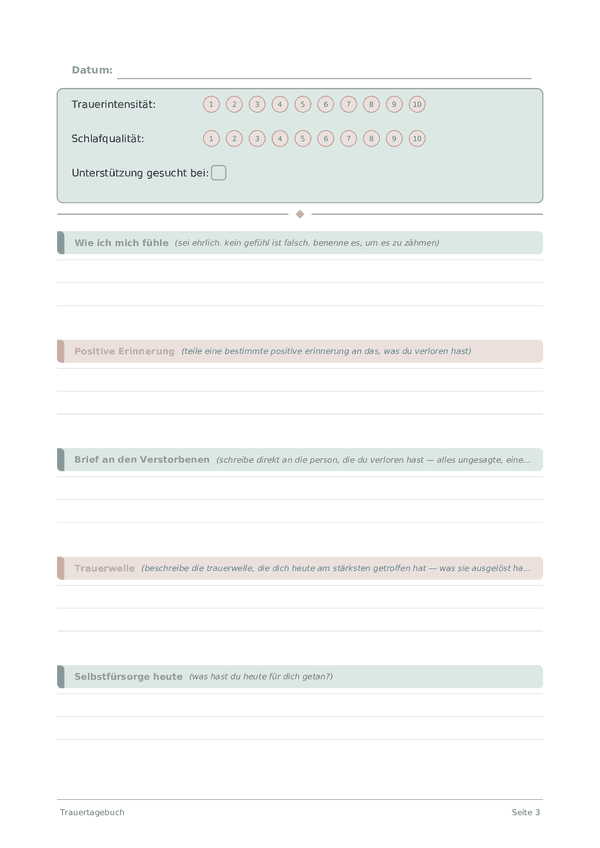
Trauerintensität
Wie intensiv ist deine Trauer gerade? Bewerte von 1 (stiller Schmerz) bis 10 (überwältigende Welle)
Schlafqualität
Bewerten Sie, wie erholsam Ihr Schlaf war. 1 bedeutet schrecklich und unruhig, 5 bedeutet tief und erfrischend. Qualität ist genauso wichtig wie Quantität.
Unterstützung gesucht bei
Hast du jemanden angerufen, angeschrieben oder gesprochen — Freund, Sponsor, Familie oder Berater?
Wie ich mich fühle
Beschreiben Sie in Ihren eigenen Worten, wie Sie sich gerade fühlen. Es gibt keine falschen Antworten. Allein das Aufschreiben von Gefühlen reduziert ihre emotionale Ladung.
Positive Erinnerung
Teile eine bestimmte positive Erinnerung an das, was du verloren hast
Brief an den Verstorbenen
Schreibe direkt an die Person, die du verloren hast — alles Ungesagte, eine Erinnerung, eine Frage oder einfach 'Ich vermisse dich'
Trauerwelle
Beschreibe die Trauerwelle, die dich heute am stärksten getroffen hat — was sie ausgelöst hat, wie sie sich in deinem Körper angefühlt hat, wie lange sie andauerte
Selbstfürsorge heute
Was hast du heute für dich getan?
Wofür ich heute dankbar bin
Listen Sie 1–3 Dinge auf, für die Sie heute dankbar sind. Es kann Großes oder Kleines sein — eine gute Mahlzeit, ein freundliches Wort, Sonnenschein. Dankbarkeitsjournaling gehört zu den wissenschaftlich am besten belegten Praktiken für das Wohlbefinden.
Tipps für den Erfolg
Wann und wie oft schreiben
There is no "right" frequency for grief journaling — write when you need to. In acute grief (the first weeks and months), daily writing provides essential release. As grief becomes integrated, write whenever a wave hits or a memory surfaces. Always journal on significant dates: birthdays, anniversaries, holidays. Over time, you may notice the journal shifts from processing pain to preserving connection — both are healthy and valuable.
Häufig gestellte Fragen
Was erfasst das Trauertagebuch und worüber schreibt man täglich?
Es protokolliert Trauerintensität (1–10), Schlafqualität (1–10) und ob Sie Unterstützung gesucht haben, plus sieben Zeilen freies Schreiben mit Impulsen: Gefühle, eine Erinnerung, ein Brief an die verstorbene Person, Beschreibung einer Trauerwelle, Selbstfürsorge und Dankbarkeit. Diese Kombination aus Tracking und expressivem Schreiben stützt sich auf Pennebaker's Forschungsgrundlage. Es ist eine Bewältigungshilfe, keine Therapie — suchen Sie eine lizenzierte Trauerbegleitung, wenn Trauer das tägliche Funktionieren überfordert.
Wie schreibe ich einen Brief an meine verstorbene geliebte Person produktiv?
Sprechen Sie sie mit Namen an, schreiben Sie, als ob sie lesen würde, und schließen Sie ein, was Sie gerne gesagt hätten, aktuelle Neuigkeiten oder ungelöste Gefühle. Continuing-Bonds-Schreiben ist eine anerkannte Trauerintervention in der heutigen Trauerarbeit, abgegrenzt vom „Abschluss“-Modell. Halten Sie Einträge kurz — auch drei Sätze zählen. Wenn Trauer feststeckt oder sich jenseits von 6–12 Monaten verstärkt (ICD-11-Kriterien für anhaltende Trauerstörung, WHO 2022), konsultieren Sie eine Trauerfachkraft. Online-Ressource: trauernetz.de.
Kann Journaling Trauerberatung ersetzen?
Nein. ICD-11 (WHO, 2022) erkennt die anhaltende Trauerstörung als klinischen Zustand an, wenn intensive Trauer länger als 6 Monate anhält und die Funktionsfähigkeit beeinträchtigt; DSM-5-TR (American Psychiatric Association, 2022) definiert die anhaltende Trauerstörung ähnlich. Journaling unterstützt die tägliche Verarbeitung und liefert Daten für eine Therapeutin. Wenn Trauer Arbeit, Beziehungen stört oder Gedanken an Selbstverletzung umfasst, kontaktieren Sie eine lizenzierte Beraterin oder in der Krise die Telefonseelsorge 0800 111 0 111 (kostenlos, 24/7). TrauerNetz (trauernetz.de) als Online-Ressource.
Was ist eine Trauerwelle und wie beschreibe ich sie?
Eine Trauerwelle ist ein plötzlicher, intensiver Schwall von Trauer — oft ausgelöst durch ein Lied, einen Ort, einen Jahrestag oder einen Sinnesreiz —, der innerhalb von Minuten bis Stunden abklingt. Erfassen Sie im Eintrag den Auslöser, die Körperempfindung (Brustenge, Tränen, Erschöpfung) und die Dauer. Das Tracking von Wellen über Wochen offenbart persönliche Auslöser, eine anerkannte Technik in der Continuing-Bonds-Trauerarbeit. Musterdaten helfen, schwere Tage vorherzusehen und Unterstützung entsprechend zu planen.
Wie unterscheidet sich das von einem normalen leeren Notizbuch?
Ein leeres Notizbuch bietet unstrukturierte Entladung. Diese Vorlage kombiniert Tracking (Intensität, Schlaf, Unterstützung) mit gerichteten Impulsen — Erinnerung, Brief, Trauerwelle, Selbstfürsorge — die sich auf Protokolle des expressiven Schreibens stützen. Pennebaker's Forschungsgrundlage, weit zitiert in der Trauer- und Traumaliteratur, fand, dass gerichtetes Schreiben, das emotionale Offenlegung mit Sinnstiftung verbindet, dauerhaftere Vorteile erzeugte als ungeleitetes Ablassen allein. Die Struktur der Vorlage spiegelt dieses Protokoll auf täglicher Zeitskala wider.
Ist es normal, Trauerintensität nach 10 Wochen oder Monaten mit 10 zu bewerten?
Ja. Akute Trauer ist hochvariabel; die Intensität kann um Jahrestage, Feiertage oder unabhängige Stressoren weit über den ursprünglichen Verlust hinaus ansteigen. ICD-11 (WHO, 2022) und DSM-5-TR (American Psychiatric Association, 2022) markieren die anhaltende Trauerstörung erst, wenn intensive Trauer plus funktionelle Beeinträchtigung über 6–12 Monate fortbesteht. Das Tagebuch hilft Ihnen und einer Klinikerin, normale Wellen von einem Muster zu unterscheiden, das fachliche Versorgung benötigt — bringen Sie Trends zu einer Trauerbegleitung.
Was, wenn das Schreiben über den Verlust mir schlechter macht?
Vorübergehender Distress beim expressiven Schreiben ist in Pennebaker's Forschungsgrundlage dokumentiert und folgt in der Regel Erleichterung; wenn Einträge jedoch Ihren Zustand konstant verschlechtern, intrusive Gedanken verstärken oder Dissoziation auslösen, pausieren Sie die Schreibimpulse und nutzen nur die Tracking-Abschnitte. Dieses Muster kann auf komplizierte Trauer oder Trauma hinweisen, die professionelle Hilfe benötigen. Eine lizenzierte Trauerbegleitung oder Traumatherapeutin kann expressive Techniken sicher für Sie anpassen. Bei Krise: Telefonseelsorge 0800 111 0 111.
Wie oft und wie lange sollte ich das Trauertagebuch nutzen?
Täglich während der akuten Trauer (die ersten 3–6 Monate), wechselnd zu wöchentlich, sobald sich die Intensität stabilisiert. Die ICD-11-Kriterien (WHO, 2022) für anhaltende Trauerstörung messen Persistenz über 6 Monate, prüfen Sie also Ihre Intensitätsbewertungen um diesen Zeitpunkt mit einer Klinikerin, wenn sie konstant hoch bleiben. Jahrestage und Feiertage rechtfertigen oft eine vorübergehende Rückkehr zu täglichen Einträgen. Es gibt keinen festen Endpunkt — nutzen Sie es, solange es hilft. Online-Ressource: trauernetz.de.
Das könnte Ihnen auch gefallen
Scrollen zum Zoomen, ziehen zum Bewegen