Printable Rauchstopp-Tagebuch
Tägliches Tracking und Reflexion für Ihren rauchfreien Weg
Combine daily tracking with reflective journaling to support your quit smoking journey. Rate cravings, mood, stress, and energy each day, then write about triggers, coping strategies, and personal victories. Research shows that writing down goals and tracking progress significantly increases success rates in smoking cessation.
Felder anpassen
Schalten Sie Felder ein oder aus. Klicken Sie auf den Stift zum Umbenennen oder fügen Sie eigene Felder hinzu.
Vorteile
Anleitung
Was ist dieses Journal?
A quit smoking journal is a daily support tool for your journey to becoming smoke-free. By tracking your smoke-free status, cravings, mood, and stress alongside reflective writing about triggers and what helped, you build a personalized quit strategy based on real data from your own experience.
This journal is for anyone in the process of quitting smoking — whether you are on day one or day one hundred. Quitting is not a single event but a daily practice that requires self-awareness, strategy, and self-compassion. This journal provides all three.
Smoking cessation research identifies self-monitoring as one of the most effective behavioral strategies for quitting. People who track their cravings and triggers are 2x more likely to successfully quit long-term. The journaling component adds emotional processing that reduces the stress response — one of the primary drivers of relapse — while the daily format creates accountability without pressure.
Ausgefülltes Beispiel
So sieht ein typischer Eintrag aus, wenn er ausgefüllt ist:
Wie Sie jedes Feld ausfüllen
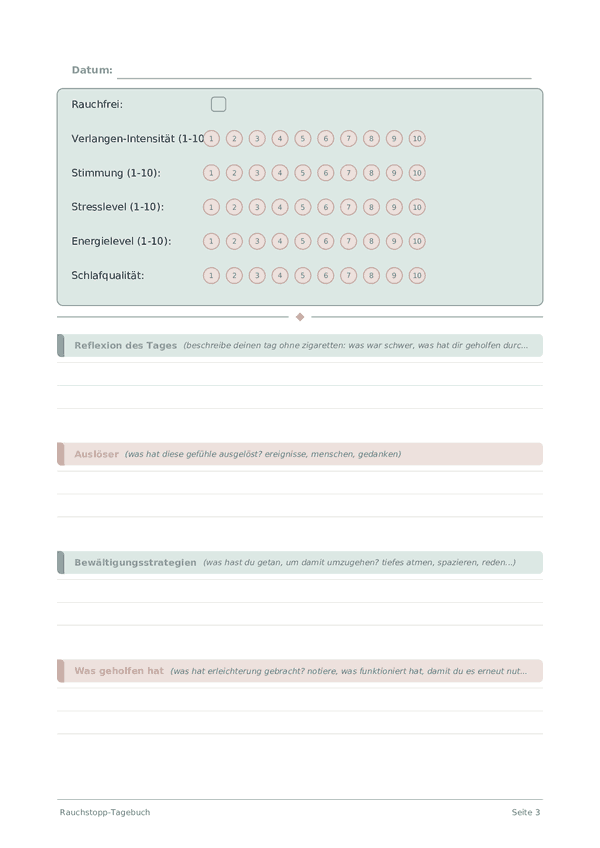
Oben auf jeder Seite befinden sich schnell ausfüllbare Felder (Bewertungen, Kontrollkästchen, Zahlen). Darunter ist ein linierter Bereich zum Schreiben. Hier erfahren Sie, was jedes Feld bedeutet:
Rauchfrei
Haken Sie dies für jeden Tag ab, an dem Sie nicht geraucht haben. Die Visualisierung Ihrer rauchfreien Tage stärkt Ihre Entschlossenheit.
Verlangen-Intensität (1-10)
Wie stark ist dein Verlangen heute? Bewerte von 1 (kaum spürbar) bis 10 (überwältigend)
Stimmung (1-10)
Bewerten Sie Ihren allgemeinen emotionalen Zustand für den Tag. 1 bedeutet sehr niedergeschlagen oder deprimiert, 10 bedeutet außergewöhnlich glücklich und positiv. Denken Sie nicht zu lange nach — vertrauen Sie Ihrem Bauchgefühl.
Stresslevel (1-10)
Bewerten Sie Ihren Stress auf einer Skala von 1–10. Mit der Zeit erkennen Sie Ihre Stressmuster und welche Bewältigungsstrategien am besten funktionieren.
Energielevel (1-10)
Bewerten Sie Ihr körperliches und geistiges Energieniveau. 1 bedeutet erschöpft und ausgelaugt, 10 bedeutet voller Energie und wach. Dies hilft Ihnen zu erkennen, welche Aktivitäten Ihre Energie steigern oder verbrauchen.
Schlafqualität
Bewerten Sie, wie erholsam Ihr Schlaf war. 1 bedeutet schrecklich und unruhig, 5 bedeutet tief und erfrischend. Qualität ist genauso wichtig wie Quantität.
Reflexion des Tages
Blicken Sie ehrlich auf Ihren Tag zurück. Was lief gut? Was könnte besser sein? Es geht nicht um Urteile — es geht um Lernen und Wachstum.
Auslöser
Identifizieren Sie, was Ihre emotionalen Reaktionen ausgelöst hat — Ereignisse, Menschen, Gedanken, Umgebungen. Auslöser zu erkennen gibt Ihnen die Möglichkeit, sich darauf vorzubereiten oder sie zu vermeiden.
Bewältigungsstrategien
Was hast du getan, um damit umzugehen? Tiefes Atmen, Spazieren, Reden...
Was geholfen hat
Was hat Erleichterung gebracht? Notiere, was funktioniert hat, damit du es erneut nutzen kannst, wenn die Angst steigt.
Erfolge
Was hast du heute geschafft? Liste erledigte Aufgaben und Fortschritte auf
Tipps für den Erfolg
Wann und wie oft schreiben
Journal every evening for the first 30 days without exception — this is the critical window where habits form and cravings peak. Log cravings in real-time during the day (even a quick note on your phone to expand later). After the first month, maintain daily entries for at least 3 months total. The craving tracker loses urgency around month 2-3, and that is actually the most dangerous time — keep writing. After 3 months, shift to weekly check-ins to guard against complacency.
Häufig gestellte Fragen
Was erfasst das Raucherentwöhnungstagebuch jeden Tag?
Eine Rauchfrei-Checkbox plus fünf 1–10-Bewertungen (Verlangensintensität, Stimmung, Stress, Energie, Schlafqualität), mit reflektierenden Impulsen zu Auslösern, Bewältigungsstrategien, was geholfen hat und Erfolgen. Die Struktur orientiert sich an der Selbstbeobachtung zur Raucherentwöhnung, beschrieben im U.S. Surgeon General Bericht Smoking Cessation: A Report of the Surgeon General (2020). Es unterstützt — ersetzt aber nicht — evidenzbasierte Entwöhnungsmethoden wie Nikotinersatz, Vareniclin oder Beratung.
Wie tracke ich entzugsbedingte Stimmungs- und Stressschwankungen?
Bewerten Sie Stimmung und Stress täglich zur gleichen Zeit — der Morgen ist üblich, da Nikotinentzugssymptome in der ersten Woche ihren Höhepunkt erreichen und typischerweise innerhalb von 2–4 Wochen abklingen, laut U.S. Surgeon General (2020, Smoking Cessation Bericht). Notieren Sie in der Reflexion, ob Bewertungen mit konkreten Auslösern (Kaffee, nach dem Essen, Autofahren) oder mit allgemeinem Entzug zusammenhängen. Anhaltende schwere Stimmungssymptome rechtfertigen einen Anruf bei Ihrer Ärztin — Depressionsrisiko steigt während der Entwöhnung.
Reicht Journaling allein, um mit dem Rauchen aufzuhören?
Journaling allein hat moderate Effekte; der U.S. Surgeon General (2020, Smoking Cessation: A Report of the Surgeon General) und CDC-Materialien Tips From Former Smokers zeigen, dass die Kombination von verhaltensbezogener Unterstützung mit FDA-zugelassener Pharmakotherapie (Nikotinersatz, Vareniclin, Bupropion) den Entwöhnungserfolg gegenüber reiner Willenskraft etwa verdoppelt. Nutzen Sie dieses Tagebuch zusammen mit dem Rauchfrei-Telefon der BZgA 0800 8 313131, Ihrer Ärztin oder einer Raucherentwöhnungsberatung für die stärkste evidenzbasierte Kombination.
Wofür dient die Bewertung der Verlangensintensität?
Sie misst die Drangstärke auf einer 0–10-Skala im stärksten Moment des Tages. Verlangen erreicht typischerweise innerhalb der ersten Woche der Entwöhnung seinen Höhepunkt und nimmt über 4–12 Wochen ab, laut U.S. Surgeon General (2020, Smoking Cessation Bericht). Das Verknüpfen jeder Bewertung mit dem Auslöser (Ort, Emotion, Person, Zeit) baut eine persönliche Karte auf, die Klinikerinnen in der kognitiv-behavioralen Entwöhnungsberatung nutzen. Fallende Bewertungen über Wochen sind ein dokumentiertes Zeichen von Neuroadaptation.
Wie unterscheidet sich das von einer Raucherentwöhnungs-App?
Apps automatisieren Serien, gespartes Geld und gesundheitliche Erholungsmeilensteine; diese Papiervorlage erfasst reflektierende Inhalte — Auslöser, eingesetzte Bewältigungsstrategien, was konkret funktioniert hat — die kognitiv-behaviorale Entwöhnungsberatung spiegeln, beschrieben in U.S. Surgeon General Materialien (2020). Der Nachteil: keine Benachrichtigungen. Viele Entwöhnungswillige nutzen beides, wobei das Tagebuch als Aufzeichnung dient, die ihre Ärztin oder ein Berater des Rauchfrei-Telefons der BZgA für personalisierte NRT- oder Beratungsanpassungen durchsieht.
Kann ich es nutzen, wenn ich mit Nikotinersatz ausschleiche?
Ja. NRT (Pflaster, Kaugummis, Lutschtabletten) wird vom U.S. Surgeon General (2020, Smoking Cessation Bericht) und vom Rauchfrei-Programm der BZgA als Erstlinienunterstützung empfohlen. Die Checkbox markiert vollständig rauchfreie Tage; die Reflexion erfasst NRT-Zeitpunkt und verbleibendes Verlangen. Teilen Sie diese Daten mit Ihrer verschreibenden Ärztin, damit die Dosis angepasst werden kann. Befolgen Sie immer das NRT-Protokoll Ihrer Ärztin — passen Sie die Dosis nicht eigenständig anhand von Tagebucheinträgen an.
Was, wenn ich eine Zigarette rauche — soll ich alles zurücksetzen?
Ein einzelner Ausrutscher ist kein vollständiger Rückfall, und CDC und U.S. Surgeon General (2020) Entwöhnungsmaterialien betonen, dass die meisten Aufhörenden mehrere Versuche benötigen, bevor die Entwöhnung dauerhaft gelingt. Lassen Sie die Rauchfrei-Checkbox für diesen Tag leer und schreiben Sie ausführlich darüber, was es ausgelöst hat und was Sie anders machen würden. Setzen Sie am nächsten Tag fort. Bei häufigen Ausrutschern kontaktieren Sie das Rauchfrei-Telefon der BZgA 0800 8 313131 — Ihr Unterstützungsplan braucht eventuell Anpassung.
Wie lange soll ich das Tagebuch nach dem Aufhören weiterführen?
Das Rückfallrisiko bleibt mindestens 12 Monate nach dem Aufhörtag erhöht — der U.S. Surgeon General (2020, Smoking Cessation: A Report of the Surgeon General) dokumentiert, dass die meisten Rückfälle innerhalb der ersten drei Monate auftreten. Tägliche Einträge in den Wochen 1–12 haben den höchsten Nutzen; gehen Sie dann bis Monat 12 zu wöchentlichen Sichtungen über. Tracken Sie länger bei größeren Stressereignissen, die dokumentierte Rückfallauslöser sind.
Das könnte Ihnen auch gefallen
Scrollen zum Zoomen, ziehen zum Bewegen