Printable Angsttagebuch
Tägliches Angsttracking und KVT-basiertes Reflexionstagebuch
Manage anxiety with evidence-based daily tracking and reflection. Identify triggers, notice body sensations, challenge anxious thoughts, and document what coping strategies actually work for you.
Felder anpassen
Schalten Sie Felder ein oder aus. Klicken Sie auf den Stift zum Umbenennen oder fügen Sie eigene Felder hinzu.
Was ist dieses Journal?
An anxiety journal is a therapeutic self-monitoring tool specifically designed to help you understand, manage, and gradually reduce anxiety. By combining daily anxiety ratings with structured writing about triggers, body sensations, thought patterns, and coping strategies, you create a personal anxiety management system backed by cognitive behavioral therapy principles.
Anxiety often feels overwhelming because it operates in the background of your mind — vague, persistent, and hard to pin down. This journal brings anxiety into the light where it becomes manageable. Research shows that the simple act of writing about anxious thoughts reduces their intensity by up to 47%. Tracking your anxiety numerically also helps you see that it fluctuates — it is not permanent, even when it feels that way.
The hybrid format combines quick daily ratings (anxiety level, stress, sleep quality, exercise, breathing practice) with guided writing prompts that help you identify triggers, notice physical sensations, examine your thoughts, document what coping strategies you used, and reflect on what actually helped. Over time, this builds a personalized toolkit for managing anxiety.
Ausgefülltes Beispiel
So sieht ein typischer Eintrag aus, wenn er ausgefüllt ist:
Wie Sie jedes Feld ausfüllen
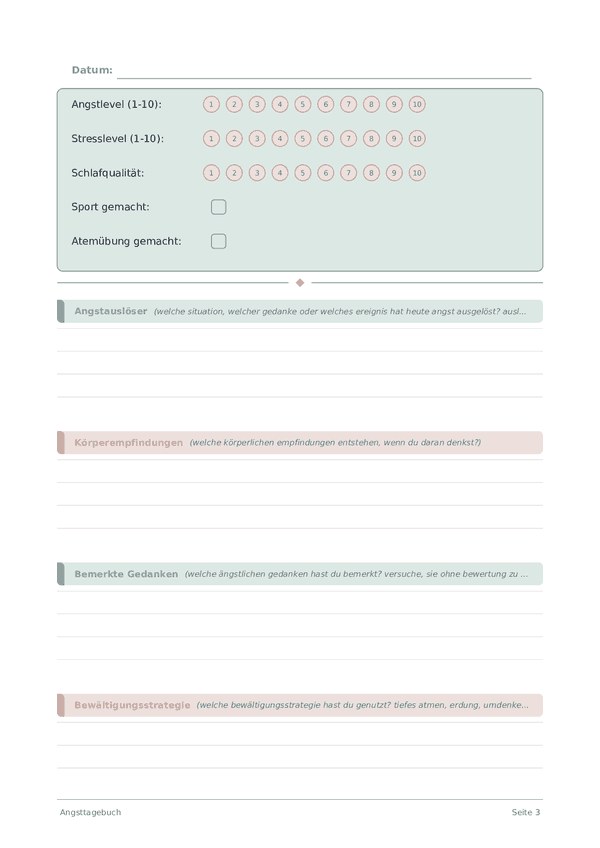
Oben auf jeder Seite befinden sich schnell ausfüllbare Felder (Bewertungen, Kontrollkästchen, Zahlen). Darunter ist ein linierter Bereich zum Schreiben. Hier erfahren Sie, was jedes Feld bedeutet:
Angstlevel (1-10)
Bewerten Sie Ihr Angstniveau heute. Einer Angst eine Zahl zuzuordnen macht das Gefühl handhabbarer und nachverfolgbar.
Stresslevel (1-10)
Bewerten Sie Ihren Stress auf einer Skala von 1–10. Mit der Zeit erkennen Sie Ihre Stressmuster und welche Bewältigungsstrategien am besten funktionieren.
Schlafqualität
Bewerten Sie, wie erholsam Ihr Schlaf war. 1 bedeutet schrecklich und unruhig, 5 bedeutet tief und erfrischend. Qualität ist genauso wichtig wie Quantität.
Sport gemacht
Hast du heute Sport gemacht? Auch ein kurzer Spaziergang zählt. Bewegung ist einer der wirksamsten natürlichen Angstreduzierer.
Atemübung gemacht
Hast du heute bewusste Atemübungen gemacht? Zwerchfellatmung aktiviert das parasympathische Nervensystem und beruhigt die Angst.
Angstauslöser
Welche Situation, welcher Gedanke oder welches Ereignis hat heute Angst ausgelöst? Auslöser zu erkennen ist der erste Schritt im KVT-basierten Angstmanagement.
Körperempfindungen
Welche körperlichen Empfindungen entstehen, wenn du daran denkst?
Bemerkte Gedanken
Welche ängstlichen Gedanken hast du bemerkt? Versuche, sie ohne Bewertung zu beobachten — Gedanken sind keine Fakten.
Bewältigungsstrategie
Welche Bewältigungsstrategie hast du genutzt? Tiefes Atmen, Erdung, Umdenken, Spazierengehen, mit jemandem reden — was hat geholfen?
Was geholfen hat
Was hat Erleichterung gebracht? Notiere, was funktioniert hat, damit du es erneut nutzen kannst, wenn die Angst steigt.
Tipps für den Erfolg
Wann und wie oft schreiben
Fill in the tracker daily, even on calm days — data from low-anxiety days is just as valuable for understanding your patterns. When anxiety spikes during the day, do a quick 'thought dump' in the writing section as soon as possible. Full evening reflection should take 5–10 minutes. Over time, this journal becomes your personal CBT workbook.
Häufig gestellte Fragen
Warum bewertet dieses Journal Angst, Stress und Schlaf separat?
Diese Konstrukte überlappen, sind aber unterscheidbar. Die American Psychological Association definiert Angst als antizipatorische Sorge, Stress als Reaktion auf Anforderung und Schlafqualität als physiologischen Faktor, der beide moderiert. NIMH-Leitlinien zu Angststörungen behandeln sie als verwandt, aber messbar getrennt. Drei 0–10-Bewertungen lassen Sie erkennen, welche Dimension einen schlechten Tag antreibt, statt sie in eine Zahl zusammenzufassen.
Wie fülle ich 'bemerkte Gedanken' nach KVT-Prinzipien aus?
Schreiben Sie den automatischen Gedanken wortgetreu — genau den Satz in Ihrem Kopf — und benennen Sie dann eine vorhandene kognitive Verzerrung. Aaron Beck ('Cognitive Therapy and the Emotional Disorders', 1976) katalogisierte Muster wie Katastrophisieren, Gedankenlesen und Schwarz-Weiß-Denken. Die Verzerrung zu benennen ist der erste Schritt der kognitiven Umstrukturierung, bevor Sie 'was geholfen hat' schreiben. Seien Sie spezifisch: 'Ich werde versagen', nicht 'mir ging es schlecht'.
Wozu 'körperempfindungen' bei Angst protokollieren?
Angst erzeugt somatische Signale — Herzrasen, enge Brust, flaches Atmen — auf die interozeptive Expositionsarbeit (Barlows Unified Protocol; Barlow et al., 2017, Behaviour Research and Therapy, 88) direkt zielt. Empfindungen aufzuzeichnen baut die Wahrnehmung auf, die nötig ist, um eine Panikspitze von einer stabilen erhöhten Grundlinie zu unterscheiden und Atmung oder Grounding vor Eskalation anzuwenden.
Warum gibt es ein 'atemübung gemacht' Häkchen?
Langsame, taktgesteuerte Atmung aktiviert den Vagustonus und reduziert physiologische Erregung. Laborde et al. (2022, Neuroscience and Biobehavioral Reviews, 138) überprüften Protokolle langsamer Atmung und fanden konsistente akute Effekte auf HRV und selbstberichtete Angst. Das Häkchen festigt die Praxisgewohnheit; über Wochen können Sie Tage mit atemübung gemacht=true mit Angst-Bewertungen korrelieren. Tägliche Einträge bauen die Daten auf, die in Therapie oder Selbstüberprüfung helfen.
Ist das ein Ersatz für Therapie bei einer Angststörung?
Nein. Das Journal unterstützt evidenzbasierte Behandlung, ersetzt sie aber nicht. NIMH und APA empfehlen KVT, Expositionstherapie oder Pharmakotherapie bei diagnostizierten Angststörungen. Bei klinischer Angststörung — generalisierte Angst, Panik, soziale Angst — wenden Sie sich an eine/n lizenzierte/n Psychotherapeuten/in. Dieses Journal funktioniert gut als Hausaufgabentool zwischen Sitzungen — dieses Journal ersetzt keine Psychotherapie.
Wie deute ich Wochen von Bewertungen?
Suchen Sie Korrelationen, nicht einzelne Tage. Nach zwei Wochen prüfen Sie, ob angstlevel (1-10) steigt, wenn schlafqualität fällt, oder an Tagen sinkt, an denen sport gemacht angekreuzt ist. Hofmann et al. (2012, Cognitive Therapy and Research, 36(5)) meta-analysierten KVT für Angst und fanden, dass Symptomverfolgung die Behandlungsreaktion durch Klärung von Triggern verbesserte. Bringen Sie Muster zur Therapie, wenn zutreffend.
Was, wenn ich keinen klaren 'angstauslöser' identifizieren kann?
Das ist häufig bei generalisierter Angst, wo Sorge diffus ist. Borkovecs Vermeidungsmodell der Sorge (1994) und Behar et al. (2009, Journal of Anxiety Disorders, 23(8)) beschreiben Sorge als Unterdrückung konkreter befürchteter Bilder. Schreiben Sie auf, was Sie taten, mit wem Sie waren und wie angespannt Ihr Körper war — der Trigger kann als somatischer Kontext auftauchen, nicht als klares Ereignis.
Wie unterscheidet sich das von einem generischen Stimmungsjournal?
Es ist um das KVT-Gedankenprotokoll-Format strukturiert: Situation, automatische Gedanken, Körperempfindungen, eingesetzte Bewältigung und was half. Diese Sequenz — nahe an Becks täglichem Gedankenprotokoll — zielt speziell auf kognitive Umstrukturierung. Ein Stimmungsjournal protokolliert Gefühle; dieses Journal arbeitet an den Bewertungen dahinter, dem aktiven Wirkstoff in Hofmanns KVT-Meta-Analysen.
Das könnte Ihnen auch gefallen
Scrollen zum Zoomen, ziehen zum Bewegen