Printable Emotionstagebuch
Verstehen, verarbeiten und durch Ihre Emotionen wachsen
Explore the full spectrum of your emotional life with this science-backed daily journal. Name what you feel, locate it in your body, uncover what triggered it, discover how you coped, extract the lesson it carries, and find gratitude even in difficulty. Built on evidence-based emotional intelligence practices used by therapists and mindfulness coaches.
Felder anpassen
Schalten Sie Felder ein oder aus. Klicken Sie auf den Stift zum Umbenennen oder fügen Sie eigene Felder hinzu.
Vorteile
Anleitung
Was ist dieses Journal?
An emotion journal is a therapeutic writing practice focused specifically on understanding and processing your emotional experiences. Unlike a mood tracker that captures a snapshot, this journal invites you to explore the full texture of your feelings — what you felt, where you felt it in your body, what triggered it, and what it can teach you.
Emotional awareness is the foundation of emotional intelligence. Research by psychologist James Pennebaker has shown that expressive writing about emotions significantly reduces anxiety, improves immune function, and enhances overall wellbeing. The key is not just naming emotions but exploring them with curiosity rather than judgment.
This journal guides you through six focused sections: identifying emotions, noticing body sensations, exploring triggers, documenting coping strategies, extracting lessons, and finding gratitude within emotional experiences. This structured approach transforms overwhelming feelings into manageable insights.
Ausgefülltes Beispiel
So sieht ein typischer Eintrag aus, wenn er ausgefüllt ist:
Wie Sie jedes Feld ausfüllen
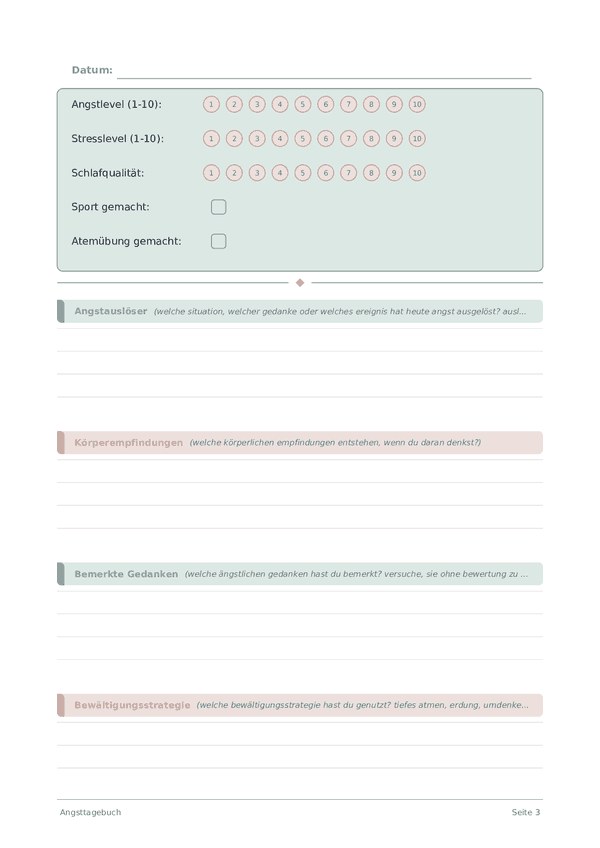
Jeden Tag finden Sie mehrere beschriftete Abschnitte mit Zeilen zum Schreiben. Hier erfahren Sie, wofür jeder Abschnitt gedacht ist:
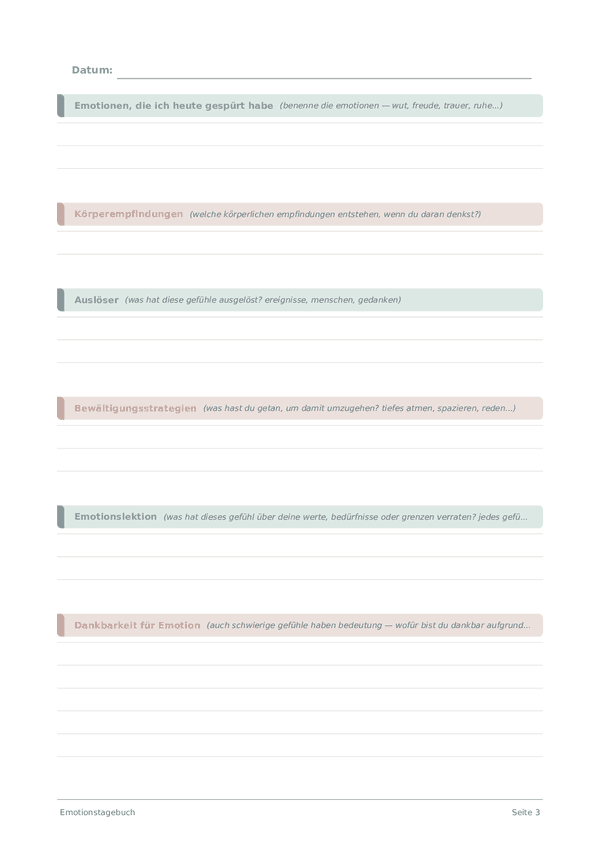
Emotionen, die ich heute gespürt habe
Benennen Sie die konkreten Emotionen, die Sie erlebt haben. Forschungen zeigen, dass das Benennen von Emotionen ihre Intensität verringert und das Selbstbewusstsein steigert.
Körperempfindungen
Welche körperlichen Empfindungen entstehen, wenn du daran denkst?
Auslöser
Identifizieren Sie, was Ihre emotionalen Reaktionen ausgelöst hat — Ereignisse, Menschen, Gedanken, Umgebungen. Auslöser zu erkennen gibt Ihnen die Möglichkeit, sich darauf vorzubereiten oder sie zu vermeiden.
Bewältigungsstrategien
Was hast du getan, um damit umzugehen? Tiefes Atmen, Spazieren, Reden...
Emotionslektion
Was hat dieses Gefühl über deine Werte, Bedürfnisse oder Grenzen verraten? Jedes Gefühl trägt eine Botschaft, die es wert ist, gehört zu werden
Dankbarkeit für Emotion
Auch schwierige Gefühle haben Bedeutung — wofür bist du dankbar aufgrund dessen, was du heute gefühlt hast?
Tipps für den Erfolg
Wann und wie oft schreiben
Write at the end of your day, when emotions from the day are still fresh but you have some distance from them. If a strong emotion hits during the day, jot a quick note to expand on later. Daily practice is ideal for building emotional awareness, but even 3–4 times per week will sharpen your ability to name and navigate feelings.
Häufig gestellte Fragen
Wie spezifisch sollte ich im Abschnitt 'emotionen, die ich heute gespürt habe' sein?
Sehr spezifisch. Lisa Feldman Barretts Forschung zu emotionaler Granularität (Kashdan, Barrett, McKnight, 2015, Current Directions in Psychological Science, 24(1)) zeigt: Menschen, die feine Emotionen unterscheiden — 'frustriert', 'gekränkt', 'gedemütigt' statt nur 'schlecht' — regulieren Emotionen effektiver und greifen seltener zu Alkohol oder Aggression unter Stress. Nutzen Sie die drei Zeilen, um verschiedene Gefühle zu benennen, nicht ein einziges Sammelwort.
Warum fragt das Journal nach 'körperempfindungen'?
Emotionen tauchen als körperliche Signale auf, bevor bewusste Etiketten entstehen. Die Verbindung zwischen Interozeption und Emotion ist in Critchley und Garfinkel (2017, Current Opinion in Psychology, 17) dokumentiert. Das Benennen von Stellen mit Anspannung, Hitze oder Schwere verbessert, was Hayes (Acceptance and Commitment Therapy) kognitive Defusion nennt — das Beobachten des Gefühls statt der Fusion damit. Zwei Zeilen reichen für einen schnellen Bodyscan.
Wie identifiziere ich einen 'trigger' präzise?
Nutzen Sie die drei Zeilen, um Situation, Gedanke und Emotion sequenziell zu kartieren — das A-B-C-Modell aus Albert Ellis' REBT und Aaron Becks kognitiver Therapie ('Cognitive Therapy and the Emotional Disorders', 1976). Der Trigger ist selten das Ereignis allein; es ist die Bedeutung, die Ihr Geist zugewiesen hat. Das Aufschreiben aller drei legt die Bewertung offen, die die Emotion antrieb.
Was zählt als gesunde 'coping strategy', die ich protokollieren sollte?
Unterscheiden Sie Annäherung von Vermeidung. Das transaktionale Modell von Folkman und Lazarus und Carvers COPE-Inventar kategorisieren Strategien als problemfokussiert, emotionsfokussiert oder vermeidend. Dokumentieren Sie, was Sie tatsächlich taten — auch wenig hilfreiches Bewältigen wie Scrollen oder Essen. Aldao, Nolen-Hoeksema, Schweizer (2010, Clinical Psychology Review, 30(2)) fanden, dass Rumination und Suppression schlechtere Ergebnisse vorhersagen als Reappraisal.
Ist dieses Journal dasselbe wie ein Stimmungstracker?
Nein. Stimmungstracker nutzen numerische Bewertungen; dieses Journal baut emotionale Granularität durch Narrativ auf. Drei Zeilen für emotionen, die ich heute gespürt habe plus körperempfindungen, Trigger und Lektion folgen Pennebakers expressivem Schreibformat (Pennebaker, 1997, Psychological Science, 8(3)), das Gesundheits- und Stimmungsvorteile erzeugte, die Bewertungen allein nicht erreichen. Kombinieren Sie es mit einem Tracker für vollständige Daten.
Was bedeutet 'emotionslektion' und wie finde ich eine?
Jede Emotion signalisiert ein unerfülltes Bedürfnis oder einen verletzten Wert. Marc Bracketts RULER-Rahmenwerk (Yale Center for Emotional Intelligence) und Susan Davids Arbeit zu 'emotionaler Agilität' behandeln Emotionen als Information. Fragen Sie: Worauf will dieses Gefühl mich aufmerksam machen — Grenzen, Werte, unerfüllte Bedürfnisse? Drei Zeilen sind Raum für eine ehrliche Einsicht, nicht eine vollständige Philosophie.
Kann ich das für schwierige Emotionen wie Wut oder Scham nutzen?
Ja, das ist seine Stärke. Emotionen zu unterdrücken verschlechtert die Ergebnisse (Gross, 2002, Psychophysiology, 39(3), zu expressiver Suppression). Schwierige Emotionen auf Papier zu benennen — einschließlich dankbarkeit für Emotion am Ende — unterstützt, was Linehans DBT 'radikale Akzeptanz' nennt. Wenn Scham, Wut oder Trauer überwältigend oder anhaltend sind, konsultieren Sie eine/n lizenzierte/n Psychotherapeuten/in zusätzlich zum Journaling.
Wie oft sollte ich es ausfüllen, um Ergebnisse zu sehen?
Streben Sie täglich in emotional aktiven Phasen an, sonst drei- bis viermal wöchentlich. Burton und King (2004, Journal of Research in Personality, 38(2)) fanden, dass zweiminütiges expressives Schreiben an drei Tagen messbare Verbesserungen des Wohlbefindens erzeugte. Konsistenz zählt mehr als Länge. Wöchentlich durchsehen, um wiederkehrende Trigger und Coping-Strategien zu erkennen.
Das könnte Ihnen auch gefallen
Scrollen zum Zoomen, ziehen zum Bewegen