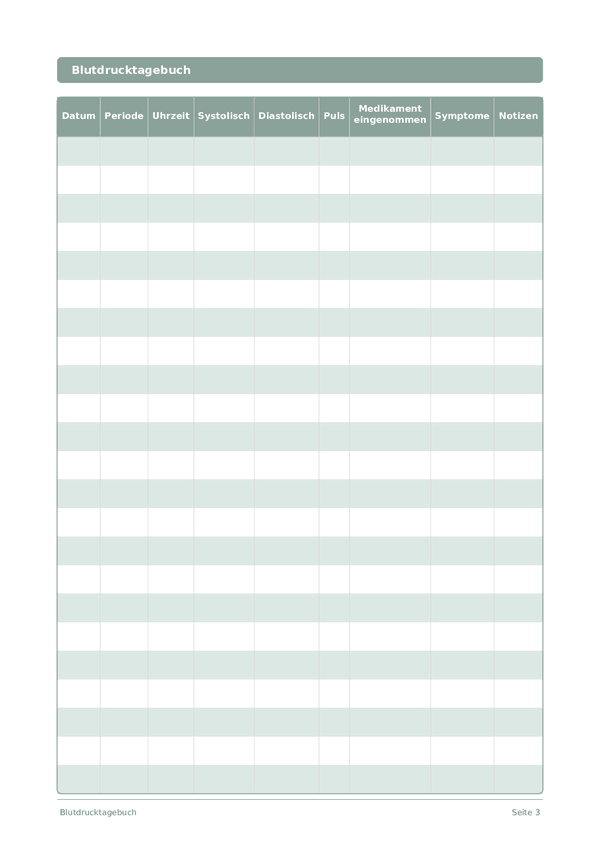
Printable Blutdrucktagebuch
Blutdruck überwachen für die Herzgesundheit
Record systolic, diastolic, and pulse readings with timestamps. Essential for managing hypertension and providing your doctor with accurate blood pressure trends.
Felder anpassen
Schalten Sie Felder ein oder aus. Klicken Sie auf den Stift zum Umbenennen oder fügen Sie eigene Felder hinzu.
Vorteile
Anleitung
Was ist dieses Journal?
A blood pressure journal is a structured daily log designed for anyone who needs to monitor their cardiovascular health. Whether you have been diagnosed with hypertension, are managing pre-hypertension, or simply want to track your readings for wellness purposes, this journal provides a clear, organized way to record every measurement alongside context such as time of day, medications taken, and any symptoms you experience.
Consistent blood pressure tracking is one of the most effective tools for managing heart health. By recording your systolic and diastolic values, pulse rate, and the circumstances around each reading, you create a detailed dataset that reveals patterns your doctor can use to adjust treatment. Many patients discover that certain times of day, activities, or foods correlate with elevated readings — insights that are invisible without a written record.
This journal is especially valuable for those preparing for medical appointments. Instead of relying on a single office reading, you can present weeks of data that paint a complete picture of your cardiovascular health, leading to more informed and personalized care.
Ausgefülltes Beispiel
So sieht ein typischer Eintrag aus, wenn er ausgefüllt ist:
| Datum | Periode | Uhrzeit | Systolisch | Diastolisch | Puls | Medikament eingenommen | Symptome | Notizen |
|---|---|---|---|---|---|---|---|---|
| 2026-03-01 | Morning | 07:15 | 128 | 82 | 72 | Lisinopril 10mg | None | Measured after 5 min rest |
| 2026-03-01 | Evening | 20:30 | 135 | 87 | 78 | Lisinopril 10mg | Mild headache | Stressful day at work |
| 2026-03-02 | Morning | 07:20 | 124 | 80 | 70 | Lisinopril 10mg | None | Slept well, 7.5 hours |
| 2026-03-02 | Evening | 21:00 | 130 | 84 | 74 | Lisinopril 10mg | None | 30 min walk after dinner |
| 2026-03-03 | Morning | 06:50 | 122 | 78 | 68 | Lisinopril 10mg | None | Calm morning, yoga session |
Wie Sie jedes Feld ausfüllen
Jede Seite ist eine Tabelle mit Spalten. Füllen Sie pro Eintrag eine Zeile aus. Hier erfahren Sie, wofür jede Spalte gedacht ist:
Datum
Schreiben Sie das heutige Datum. Dies verankert Ihren Eintrag in der Zeit und hilft beim späteren Durchsehen der Einträge.
Periode
Uhrzeit
Notieren Sie die Uhrzeit der Messung oder des Ereignisses. Gleichmäßige Zeiten machen Daten vergleichbar und zeigen tageszeitabhängige Muster.
Systolisch
Notieren Sie die obere Zahl Ihres Blutdruckwerts (systolisch). Diese misst den Druck, wenn Ihr Herz schlägt.
Diastolisch
Notieren Sie die untere Zahl Ihres Blutdruckwerts (diastolisch). Diese misst den Druck, wenn Ihr Herz zwischen den Schlägen ruht.
Puls
Notieren Sie Ihre Herzfrequenz in Schlägen pro Minute. Trends des Ruhepulses zeigen Veränderungen der kardiovaskulären Fitness im Laufe der Zeit.
Medikament eingenommen
Hast du heute deine Medikamente genommen? Notiere was, wann und ob Dosen ausgelassen wurden
Symptome
Listen Sie Symptome auf, die Sie heute erlebt haben. Seien Sie konkret in Bezug auf Art, Ort und Schwere. Muster bei Symptomen deuten oft auf Auslöser oder Behandlungsbedarf hin.
Notizen
Fügen Sie zusätzlichen Kontext oder Gedanken hinzu. Diese Auffangspalte ist für alles, was nirgendwo anders hinpasst, aber später nützlich sein könnte.
Tipps für den Erfolg
Wann und wie oft schreiben
Measure twice daily: once in the morning before taking medications (this is your «true baseline»), and once in the evening. Take two consecutive readings each time, 1–2 minutes apart, and record both. Before medical appointments, have at least 2 weeks of consistent data to show your doctor. Weekly, review your averages to spot upward or downward trends. If your home readings consistently differ from clinic readings by more than 10 mmHg, discuss «masked hypertension» or «white-coat hypertension» with your provider.
Häufig gestellte Fragen
Welche Blutdruckwerte gelten als normal versus hoch?
Laut AHA/ACC (2017, Hypertension, 71(6)): Normal <120/80 mmHg; Erhöht 120–129/<80; Stadium 1 Hypertonie 130–139/80–89; Stadium 2 ≥140/90. Hypertensive Krise >180/120 erfordert sofortige ärztliche Hilfe. Notieren Sie systolisch und diastolisch in den jeweiligen Spalten. ESC/ESH und deutsche Leitlinien (DEGAM) verwenden teils etwas höhere Schwellen; folgen Sie den Zielwerten Ihres Arztes, die bei Diabetes, Nierenkrankheit oder Alter abweichen können.
Warum zwei Messungen im Abstand von 1–2 Minuten?
AHA (2019, Hypertension, 73(5)) und ESC-Leitlinien empfehlen den Mittelwert aus 2 Messungen, da die erste wegen kurzer sympathischer Aktivierung oft erhöht ist. Sitzen Sie 5 Minuten ruhig vor der Messung. Notieren Sie den Mittelwert beider Messungen oder beide einzeln zur späteren Mittelung. Einzelmessungen überschätzen die Hypertonie-Prävalenz um 10–15% und führen zu Überdiagnose und unnötiger Medikation.
Was ist die korrekte Messtechnik?
AHA-Technik: sitzend mit Rückenstütze, Füße flach, Arm in Herzhöhe gestützt, Manschette am nackten Oberarm in passender Größe (Blase deckt 80% des Armumfangs). Kein Sprechen, Koffein, Sport oder Rauchen 30 Minuten vorher. Blase zuerst leeren. Die Spalten period und time helfen, konsistentes Morgen- und Abendtiming einzuhalten — meist innerhalb einer Stunde nach dem Aufwachen und vor dem Schlafengehen.
Warum Morgen- und Abendmessungen?
Laut Hypertension (2018, 71(5)) und ACC-Leitlinien folgt der Blutdruck einem zirkadianen Muster — Morgenanstieg und Abendsenkung. Patienten ohne nächtliches Absinken ('Non-Dipper') haben ein höheres kardiovaskuläres Risiko. Morgenmessungen vor Medikation bewerten die nächtliche Kontrolle; Abendmessungen zeigen Tageseffekte. Die period-Spalte erfasst dies — Ihr Kardiologe braucht beide zur Bewertung von Medikamentenzeitpunkt und -dosierung.
Wie lange tracken vor dem Arzttermin?
AHA und NICE empfehlen mindestens 7 aufeinanderfolgende Tage mit zweimal täglichen Messungen zur Etablierung einer verlässlichen Baseline; 14 Tage verbessern die Genauigkeit. Verwerfen Sie die Werte des ersten Tages — oft erhöht. Berechnen Sie den Durchschnitt der restlichen Tage. Die 15-zeiligen Seiten des Tagebuchs decken 7+ Tage problemlos ab. Bringen Sie es zu jedem Kardiologie-Termin — Heimwerte unterscheiden sich oft deutlich von Praxismessungen (Weißkittel-Effekt).
Was ist Weißkittel-Hypertonie und wie hilft das Tagebuch?
Laut AHA betrifft Weißkittel-Hypertonie 15–30% der Patienten — erhöhte Praxiswerte, aber normale Heimwerte. Ohne Heim-Monitoring führt dies zu unnötiger Medikation. Umgekehrt wird maskierte Hypertonie (normal in der Praxis, erhöht zuhause) ohne Tracking übersehen. Heim-Tagebuchdaten über 7+ Tage, kombiniert mit periodischem ambulantem Monitoring laut ACC, unterscheiden diese Muster und ermöglichen präzise Diagnose.
Welche Werte erfordern dringende ärztliche Hilfe?
AHA-Kriterien für hypertensive Krise: systolisch ≥180 oder diastolisch ≥120 mmHg. Mit Symptomen (Brustschmerz, Atemnot, Sehveränderungen, starke Kopfschmerzen, neurologische Symptome) ist dies ein hypertensiver Notfall — sofort Notruf 112. Ohne Symptome (hypertensive Dringlichkeit) warten Sie 5 Minuten, messen erneut; bei weiterhin erhöhten Werten kontaktieren Sie Ihren Arzt am selben Tag. Dokumentieren Sie Symptome in der Symptomspalte.
Wie tracke ich Medikamenteneffekte auf den Blutdruck?
Laut Mayo Clinic notieren Sie Medikamentennamen, Dosis und Timing in der medikament eingenommen-Spalte. Antihypertensiva erreichen meist nach 2–4 Wochen einen Steady State. Vergleichen Sie 14-Tage-Mittelwerte vor und nach Medikamentenstart oder Dosisänderungen. Auch die pulse-Spalte ist wichtig — Betablocker senken sowohl Blutdruck als auch Puls; ACE-Hemmer wirken hauptsächlich auf den Blutdruck. Teilen Sie Trends mit Ihrem Kardiologen zur Dosisoptimierung.
Das könnte Ihnen auch gefallen
Scrollen zum Zoomen, ziehen zum Bewegen