Printable Schmerztagebuch
Schmerzmuster, Auslöser und Linderungsstrategien verfolgen
A comprehensive daily pain tracker that combines structured metrics with reflective writing. Rate pain intensity, log location and type, track sleep, mood, and stress levels, and write about what triggers your pain and what brings relief. Build a detailed record to share with your healthcare provider for more effective treatment.
Felder anpassen
Schalten Sie Felder ein oder aus. Klicken Sie auf den Stift zum Umbenennen oder fügen Sie eigene Felder hinzu.
Vorteile
Anleitung
Was ist dieses Journal?
A pain journal is a structured daily record where you track the details of your physical pain — its location, intensity, duration, and the factors that influence it. By writing down this information consistently, you create a detailed picture of your pain patterns that can be difficult to recall from memory alone, especially during medical appointments.
This journal is designed for anyone living with chronic pain, recovering from injury, or managing conditions like migraines, arthritis, fibromyalgia, or back pain. It is equally useful if you are experiencing new or unexplained pain and want to identify triggers or patterns before consulting a doctor.
Keeping a pain journal helps you take an active role in your own care. Over time, you will be able to see which activities, foods, sleep habits, or stress levels correlate with flare-ups, and which treatments or strategies provide genuine relief. This data becomes an invaluable tool for conversations with healthcare providers and for making informed decisions about your treatment plan.
Ausgefülltes Beispiel
So sieht ein typischer Eintrag aus, wenn er ausgefüllt ist:
Wie Sie jedes Feld ausfüllen
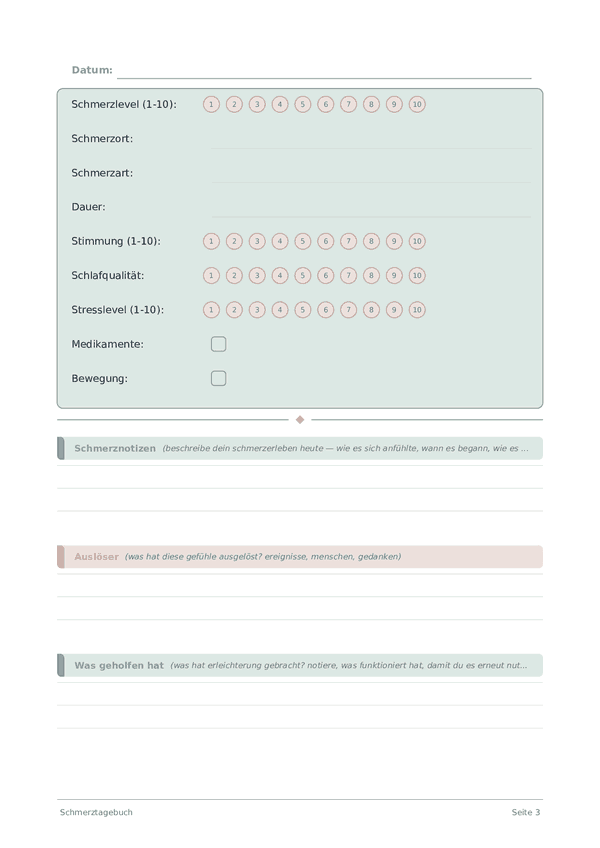
Oben auf jeder Seite befinden sich schnell ausfüllbare Felder (Bewertungen, Kontrollkästchen, Zahlen). Darunter ist ein linierter Bereich zum Schreiben. Hier erfahren Sie, was jedes Feld bedeutet:
Schmerzlevel (1-10)
Bewerten Sie Ihre Schmerzintensität auf einer Skala. Das Verfolgen der Schmerzwerte hilft, Auslöser zu identifizieren, Behandlungen zu bewerten und mit Gesundheitsdienstleistern zu kommunizieren.
Schmerzort
Wo tut es weh? Sei konkret — unterer Rücken, linkes Knie, hinter den Augen usw.
Schmerzart
Beschreibe das Gefühl — stechend, dumpf, pochend, brennend, ziehend oder etwas anderes
Dauer
Notieren Sie, wie lange die Episode oder das Ereignis gedauert hat. Dauerdaten helfen, Muster zu erkennen und die Wirksamkeit der Behandlung zu bewerten.
Stimmung (1-10)
Bewerten Sie Ihren allgemeinen emotionalen Zustand für den Tag. 1 bedeutet sehr niedergeschlagen oder deprimiert, 10 bedeutet außergewöhnlich glücklich und positiv. Denken Sie nicht zu lange nach — vertrauen Sie Ihrem Bauchgefühl.
Schlafqualität
Bewerten Sie, wie erholsam Ihr Schlaf war. 1 bedeutet schrecklich und unruhig, 5 bedeutet tief und erfrischend. Qualität ist genauso wichtig wie Quantität.
Stresslevel (1-10)
Bewerten Sie Ihren Stress auf einer Skala von 1–10. Mit der Zeit erkennen Sie Ihre Stressmuster und welche Bewältigungsstrategien am besten funktionieren.
Medikamente
Notieren Sie eingenommene Medikamente, einschließlich Name und Dosierung. Konsequentes Verfolgen hilft Ihnen und Ihrem Arzt, die Wirksamkeit der Behandlung zu bewerten.
Bewegung
Haken Sie ab, ob Sie heute Sport gemacht haben. Selbst ein 10-minütiger Spaziergang zählt. Das Ziel ist es, ein Bewusstsein für Ihre Aktivitätsmuster zu entwickeln.
Schmerznotizen
Beschreibe dein Schmerzerleben heute — wie es sich anfühlte, wann es begann, wie es sich veränderte
Auslöser
Identifizieren Sie, was Ihre emotionalen Reaktionen ausgelöst hat — Ereignisse, Menschen, Gedanken, Umgebungen. Auslöser zu erkennen gibt Ihnen die Möglichkeit, sich darauf vorzubereiten oder sie zu vermeiden.
Was geholfen hat
Was hat Erleichterung gebracht? Notiere, was funktioniert hat, damit du es erneut nutzen kannst, wenn die Angst steigt.
Tägliche Wirkung
Wie hat der Schmerz heute deine Aktivität, deinen Schlaf, deine Stimmung oder dein Sozialleben beeinflusst?
Tipps für den Erfolg
Wann und wie oft schreiben
Fill in the tracker three times daily: morning (how did you wake up?), midday (how is activity affecting pain?), and evening (how did the day go overall?). Keep the tracker entries brief — just numbers and a few words. Use the writing section when pain is significant or when you notice a new pattern. Bring your weekly summary to medical appointments — doctors consistently report that patients with pain journals receive more targeted treatment. Review monthly to spot seasonal or cyclical patterns.
Häufig gestellte Fragen
Was sollte ein Schmerztagebuch für einen Arzttermin enthalten?
Gemäß der CDC Clinical Practice Guideline for Prescribing Opioids for Pain (2022, MMWR Recommendations and Reports, 71(3)) und Empfehlungen der American Chronic Pain Association: Intensität auf 0–10, Lokalisation, Charakter (brennend/stechend/dumpf), Dauer, Auslöser und Medikamentenwirkung sowie Schlaf, Stimmung, Aktivität. Diese Vorlage deckt alle 9 Kernfelder ab. Bringen Sie 2–4 Wochen Einträge mit — ausreichend, um klinisch relevante Muster zu erkennen. Konsultieren Sie Ihren Arzt.
Wie beschreibe ich den Schmerzcharakter korrekt — brennend, dumpf, pochend?
Die Standardklassifikation ist der McGill Pain Questionnaire (Melzack, 1975, Pain, 1(3), 277–299), bis heute klinisch in Gebrauch. Sensorische Deskriptoren: pochend, schießend, stechend, scharf, brennend, ziehend, drückend. Brennen weist oft auf neuropathische Schmerzen hin; Pochen auf vaskuläre (Migräne); dumpfer Schmerz auf muskuloskelettale Ursachen; Stechen auf entzündliche. Diese Deskriptoren helfen Ihrem Behandler, Schmerztypen zu unterscheiden und die passende Therapie zu wählen.
Eignet sich dieses Tagebuch für Migräne, Fibromyalgie und Arthritis?
Ja. Die American Migraine Foundation, das American College of Rheumatology und die Arthritis Foundation empfehlen offiziell Schmerztagebücher. Bei Migräne erfassen Sie Aura und Auslöser (Nahrung, Hormone, Wetter). Bei Fibromyalgie verfolgen Sie die Schlaf-Stress-Schmerz-Triade (gemäß den ACR 2016 fibromyalgia diagnostic criteria). Bei Arthritis dokumentieren Sie Morgensteifigkeit und Aktivitätskorrelationen. Die Vorlage ist flexibel — passen Sie die Felder an Ihre spezifische Erkrankung an. Konsultieren Sie Ihren Arzt.
Was ist die 0–10-Schmerzskala und wie wird sie genutzt?
Die Numeric Rating Scale (NRS-11) ist das Standardinstrument der International Association for the Study of Pain (IASP). 0 = kein Schmerz, 10 = schlimmster vorstellbarer Schmerz. Hjermstad et al. (2011, Journal of Pain and Symptom Management, 41(6), 1073–1093) validierten sie in einer systematischen Übersicht von 19 Studien. Bewerten Sie "jetzt im Moment", nicht den Tagesdurchschnitt — Momentaufnahmen liefern zuverlässigere klinische Daten.
Wie oft sollte ich ein Schmerztagebuch ausfüllen — einmal täglich oder häufiger?
Dreimal täglich: morgens, mittags, abends. Stone & Broderick (2007, Pain Medicine, 8(suppl 3), S85–S93) zeigten, dass retrospektive Schmerzbewertungen um 20–30% von Echtzeitbewertungen abweichen. Je kürzer der Abstand zwischen Ereignis und Eintrag, desto zuverlässiger die Daten. Bei akuten Episoden oder Schüben tragen Sie sofort ein — erfassen Sie Beginn, Dauer und etwaige Interventionen.
Welche Schmerzauslöser sind dokumentationswürdig?
Gemäß NIH National Institute of Neurological Disorders and Stroke und American Migraine Foundation: Wetter (Luftdruck, Luftfeuchtigkeit), Nahrung (tyraminhaltige Lebensmittel bei Migräne), Schlafmenge und -qualität, Stress, körperliche Aktivität, Hormonzyklus, Haltung, Bildschirmzeit, Koffein und Alkohol. Protokollieren Sie alles aus den 24 Stunden vor einer Schmerzepisode. Muster werden nach 2–4 Wochen systematischer Erfassung sichtbar. Bei anhaltenden Schmerzen konsultieren Sie Ihren Arzt.
Warum ist ein Papier-Schmerztagebuch besser als eine App?
Drei Gründe. Datenschutz medizinischer Daten: Nach dem Flo Health FTC-Vergleich (Januar 2021) ist belegt, dass Gesundheits-Apps Daten an Dritte weitergeben können. Klinikerinnen überfliegen handschriftliche Aufzeichnungen im Termin mühelos — kein Export nötig. Papier funktioniert während migränebedingter Photophobie, ohne Akku oder Verbindung. Apps und Papier schließen sich nicht aus — viele Patientinnen führen beides parallel.
Kann ein Schmerztagebuch helfen, die Ursache unerklärter Schmerzen zu finden?
Das Tagebuch stellt keine Diagnose, zeigt aber Muster, die Klinikerinnen zur Diagnose nutzen. Die International Association for the Study of Pain (IASP) und die American Academy of Pain Medicine schließen Schmerztagebücher in klinische Bewertungsprotokolle für chronische Schmerzen ein. Bringen Sie mindestens 2–4 Wochen Einträge mit — sie liefern Tages-, Wochen- und auslöserbezogene Musterdaten, die aus dem Gedächtnis nicht rekonstruiert werden können. Konsultieren Sie Ihren Arzt.
Das könnte Ihnen auch gefallen
Scrollen zum Zoomen, ziehen zum Bewegen