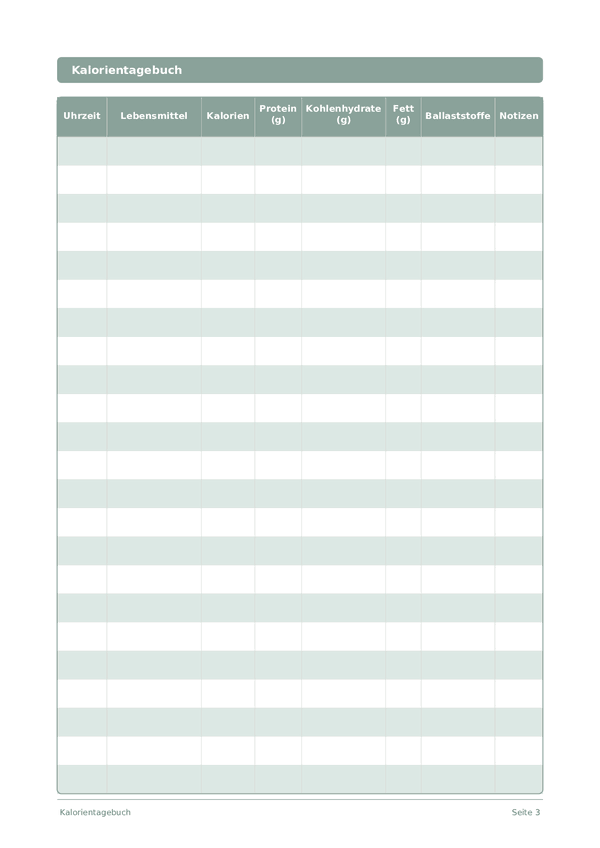
Printable Kalorientagebuch
Kalorien und Makros bei jeder Mahlzeit verfolgen
A structured table log for recording every meal with full macro breakdown — calories, protein, carbs, fat, and fiber. Build awareness of your eating patterns and reach your nutrition goals with data-driven consistency.
Felder anpassen
Schalten Sie Felder ein oder aus. Klicken Sie auf den Stift zum Umbenennen oder fügen Sie eigene Felder hinzu.
Vorteile
Anleitung
Was ist dieses Journal?
A calorie journal is a detailed nutritional log where you track not just the calories in every food item you consume, but also the macronutrient breakdown — protein, carbohydrates, fat, and fiber. This level of detail transforms vague dietary intentions into precise, actionable data that supports specific fitness, health, or body composition goals.
This journal is ideal for people who are serious about understanding their nutrition on a granular level: athletes optimizing performance, individuals following structured meal plans, anyone tracking macros for weight loss or muscle gain, or people managing conditions like diabetes where carbohydrate awareness is essential. It is also an excellent learning tool for anyone who wants to develop an intuitive sense of what is in the food they eat.
By logging each food item with its full nutritional profile, you gain clarity about where your calories actually come from. Many people are surprised to discover how quickly fats add up or how little protein they consume relative to their goals. Over time, this journal helps you make informed adjustments — not through restriction, but through awareness — so that your diet genuinely supports the way you want to feel and perform.
Ausgefülltes Beispiel
So sieht ein typischer Eintrag aus, wenn er ausgefüllt ist:
| Uhrzeit | Lebensmittel | Kalorien | Protein (g) | Kohlenhydrate (g) | Fett (g) | Ballaststoffe | Notizen |
|---|---|---|---|---|---|---|---|
| 7:00 | Scrambled eggs (3 large) | 210 | 18 | 2 | 15 | 0 | Cooked in olive oil spray |
| 7:00 | Whole wheat toast (2 slices) | 180 | 8 | 30 | 3 | 4 | |
| 7:00 | Avocado (half) | 120 | 1 | 6 | 11 | 5 | On toast |
| 10:30 | Protein shake (whey, banana, milk) | 320 | 30 | 35 | 6 | 2 | Post-workout |
| 13:00 | Brown rice (1 cup cooked) | 215 | 5 | 45 | 2 | 3 | |
| 13:00 | Grilled chicken breast (150g) | 230 | 35 | 0 | 9 | 0 | Seasoned with herbs |
| 13:00 | Mixed vegetables, steamed | 85 | 4 | 15 | 1 | 5 | Broccoli, carrots, green beans |
| 16:00 | Almonds (30g) | 175 | 6 | 6 | 15 | 3 | Afternoon snack |
| 19:00 | Pasta with turkey bolognese | 520 | 32 | 60 | 14 | 4 | Whole wheat pasta |
| 19:00 | Side salad with olive oil | 110 | 2 | 5 | 10 | 2 | |
| 21:00 | Greek yogurt with berries | 150 | 12 | 18 | 3 | 2 | Low-fat yogurt |
Wie Sie jedes Feld ausfüllen
Jede Seite ist eine Tabelle mit Spalten. Füllen Sie pro Eintrag eine Zeile aus. Hier erfahren Sie, wofür jede Spalte gedacht ist:
Uhrzeit
Notieren Sie, wann Sie gegessen haben. Die Essenszeiten beeinflussen Energie, Schlaf und Verdauung. Muster werden nach einigen Wochen sichtbar.
Lebensmittel
Schreiben Sie auf, was Sie gegessen haben. Seien Sie konkret genug, um nützlich zu sein (z. B. 'gegrillter Hähnchensalat' statt nur 'Mittagessen'). Das hilft, Nahrungsmittelunverträglichkeiten und Muster zu erkennen.
Kalorien
Protokollieren Sie Ihre ungefähre Kalorienzufuhr. Sie brauchen keine perfekten Zahlen — Schätzungen helfen Ihnen, achtsam mit Essgewohnheiten umzugehen.
Protein (g)
Protokollieren Sie Ihre Proteinzufuhr in Gramm. Ausreichend Protein ist entscheidend für Erholung und Muskelaufbau, typischerweise 1,6–2,2 g pro kg Körpergewicht.
Kohlenhydrate (g)
Fett (g)
Ballaststoffe
Notizen
Fügen Sie zusätzlichen Kontext oder Gedanken hinzu. Diese Auffangspalte ist für alles, was nirgendwo anders hinpasst, aber später nützlich sein könnte.
Tipps für den Erfolg
Wann und wie oft schreiben
Log each meal and snack immediately in the table format: food item, portion size, calories, and macros if tracking them. Total your calories at the end of each day. Weekly, calculate your daily average and compare it to your target — this weekly view is more meaningful than any single day. Monthly, assess whether your target needs adjustment based on how your body is responding. If counting starts feeling obsessive, take a 3-day break and rely on your built-up food awareness instead.
Häufig gestellte Fragen
Hilft Kalorienzählen tatsächlich beim Gewichtsmanagement?
Ja — ein Cochrane Review und die USDA Dietary Guidelines for Americans (2020–2025) bestätigen, dass Bewusstsein für die Energiezufuhr in Kombination mit Makro-Balance bessere Gewichtsergebnisse liefert. Studien im American Journal of Clinical Nutrition zeigen, dass Anwender mit Selbstmonitoring über sechs Monate etwa doppelt so viel Gewicht verlieren. Das Fünf-Makro-Layout der Vorlage (Kalorien, Eiweiß, Kohlenhydrate, Fett, Ballaststoffe) unterstützt den von der ADA empfohlenen Fokus auf Ernährungsqualität, nicht nur auf Kalorienrestriktion.
Wie genau müssen meine Kalorien- und Makro-Schätzungen sein?
Eine Genauigkeit von ±10–15% reicht für Trend-Tracking, so die Academy of Nutrition and Dietetics. Studien im American Journal of Clinical Nutrition (2017) zeigen, dass selbst unvollkommenes Logging zu bedeutsamen Verhaltensänderungen führt. Nutzen Sie Etiketten, USDA FoodData Central oder eine Barcode-App. Konsistenz über Wochen zählt mehr als Mahlzeit-Genauigkeit — fokussieren Sie auf Wochensummen statt einzelne Mahlzeiten.
Warum trennt die Vorlage Ballaststoffe von Kohlenhydraten?
Die USDA Dietary Guidelines (2020–2025) empfehlen 25–34 g Ballaststoffe täglich, doch US-Erwachsene konsumieren nur ~16 g. ADA Standards of Care (2024, Diabetes Care, 47 Suppl 1) betonen die Rolle von Ballaststoffen für Blutzuckerkontrolle und Herz-Kreislauf-Gesundheit. Getrenntes Tracking von Ballaststoffen offenbart Ernährungsqualitätsmuster, die das Zählen von Netto-Kohlenhydraten verbirgt. Streben Sie einen hohen Ballaststoffanteil an — meist besser für die Stoffwechselgesundheit (in Deutschland: DGE-Empfehlung 30 g/Tag).
Wie viel Eiweiß sollte ich pro Mahlzeit anstreben?
USDA empfiehlt 0,8 g/kg Körpergewicht täglich für sitzende Erwachsene; British Journal of Sports Medicine (2018, 52(6)) und ISSN-Konsens schlagen 1,4–2,0 g/kg für Aktive vor. Eine Verteilung auf 3–4 Mahlzeiten mit 20–40 g pro Mahlzeit optimiert die Muskelproteinsynthese. Nutzen Sie die Eiweißspalte zur Verteilungskontrolle — alles Protein am Abend ist häufig, aber weniger wirksam als gleichmäßige Verteilung.
Ist diese Vorlage bei einer Essstörungs-Vorgeschichte geeignet?
Mit Vorsicht. APA und Academy for Eating Disorders warnen, dass detailliertes Kalorien-Tracking restriktives Essen oder Orthorexie verschlechtern kann. Bei Anorexie, Bulimie oder Binge-Eating-Störung in der Vorgeschichte konsultieren Sie eine Ernährungsfachkraft oder Psychotherapeutin vor dem Logging. Die Variante ohne Kalorien (Food-Journal-Slug) ist meist sicherer. Tracking ist ein Werkzeug, kein moralischer Maßstab.
Wie unterscheidet sich das von MyFitnessPal oder Cronometer?
Apps automatisieren das Nachschlagen, fördern aber dauerhafte Handynutzung; diese druckbare Tabelle erzwingt kurze, bewusste Einträge zu den Mahlzeiten. NIH NCCIH (2022) merkt an, dass Tools zur Verhaltensänderung am besten wirken, wenn die Reibung gerade hoch genug für Reflexion ist. Papier-Logs vermeiden zudem die Sozial- und Werbeebenen von Ernährungsapps. Nutzen Sie die App zum Nachschlagen, übertragen Sie aber Schlüsselzahlen ins Tagebuch.
Wie nutze ich die Wochensummen aus dem Tagebuch?
Summieren Sie jede Spalte über alle 7 Tage. Vergleichen Sie mit Zielwerten der USDA Dietary Guidelines (2020–2025): Kalorien gemäß geschätztem Bedarf aus den CDC-BMR-Tabellen, Eiweiß 0,8–2,0 g/kg, Ballaststoffe 25–34 g/Tag, gesättigte Fette unter 10% der Kalorien. Achten Sie auf Werktags- vs. Wochenend-Muster — diese offenbaren oft die wirksamste Anpassung für Gewicht und Stoffwechselmarker (in Deutschland: DGE-Leitlinien).
Was ist der häufigste Logging-Fehler?
Untererfassung von Snacks und Getränken. Daten von CDC NHANES und American Journal of Clinical Nutrition (2019) zeigen, dass Menschen die Zufuhr um 20–40% unterschätzen — meist durch vergessene Snacks und Flüssigkalorien (Limo, Saft, Alkohol, Kaffeespezialitäten). Nutzen Sie die uhrzeit-Spalte für jeden Verzehrmoment — auch für einen einzelnen Keks oder Kaffee mit Sahne. Null-Einträge sind schlechter als eine Schätzung.
Das könnte Ihnen auch gefallen
Scrollen zum Zoomen, ziehen zum Bewegen