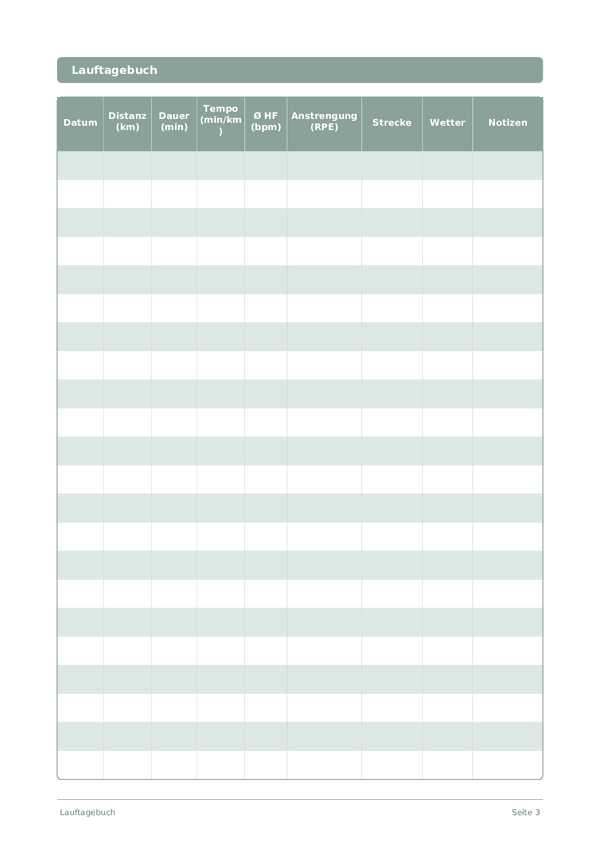
Printable Lauftagebuch
Jeden Lauf verfolgen, Fortschritte messen und Ihre Ziele erreichen
The Running Journal is a structured training log that helps you record key metrics for every run — distance, pace, heart rate, effort level, route, and more. Whether you are training for a race or building a consistent habit, this log gives you the data to analyse trends, identify patterns, and improve over time.
Felder anpassen
Schalten Sie Felder ein oder aus. Klicken Sie auf den Stift zum Umbenennen oder fügen Sie eigene Felder hinzu.
Vorteile
Anleitung
Was ist dieses Journal?
A running journal is a dedicated log where you record the details of every run — distance, duration, pace, heart rate, effort level, route, and conditions. It transforms your running from a series of disconnected outings into a structured training history that reveals trends, celebrates progress, and helps you train smarter.
This journal is for runners of all levels: beginners building up to their first 5K, recreational joggers who want to stay consistent, and experienced runners training for marathons or ultras. It is also valuable for people returning to running after injury, as tracking effort levels and how your body responds helps you avoid doing too much too soon.
Experienced coaches will tell you that a running journal is one of the most important tools a runner can have. By looking back at weeks and months of data, you can see how your pace improves at a given heart rate, identify which training approaches work best for you, and spot warning signs of overtraining before they lead to injury. On days when motivation is low, flipping back through your journal and seeing how far you have come is one of the most powerful reminders of why you run.
Ausgefülltes Beispiel
So sieht ein typischer Eintrag aus, wenn er ausgefüllt ist:
| Datum | Distanz (km) | Dauer (min) | Tempo (min/km) | Ø HF (bpm) | Anstrengung (RPE) | Strecke | Wetter | Notizen |
|---|---|---|---|---|---|---|---|---|
| 2025-01-06 | 5.2 | 28 | 5:23/km | 148 | 6 | River path loop | Overcast, 4°C | Easy recovery run. Legs felt fresh after rest day. |
| 2025-01-08 | 8 | 40 | 5:00/km | 158 | 7 | Park circuit (2 laps) | Sunny, 2°C | Tempo run. Held pace well through km 6, then slowed slightly. |
| 2025-01-10 | 6.5 | 42 | 6:28/km | 135 | 4 | Neighborhood streets | Light rain, 6°C | Easy conversational pace. Practiced nasal breathing. |
| 2025-01-11 | 12 | 65 | 5:25/km | 155 | 8 | Lakeside trail | Cloudy, 3°C | Long run. Felt strong first 10 km, last 2 km were a grind. Fueled with gel at km 8. |
| 2025-01-13 | 5 | 23 | 4:36/km | 172 | 9 | Track (400m) | Clear, 1°C | Interval session: 5 x 1000m at 4:20 pace with 90s rest. Hit all splits. |
| 2025-01-14 | 4 | 24 | 6:00/km | 128 | 3 | Flat neighborhood loop | Overcast, 5°C | Shake-out run after hard intervals. Kept effort very low. |
Wie Sie jedes Feld ausfüllen
Jede Seite ist eine Tabelle mit Spalten. Füllen Sie pro Eintrag eine Zeile aus. Hier erfahren Sie, wofür jede Spalte gedacht ist:
Datum
Schreiben Sie das heutige Datum. Dies verankert Ihren Eintrag in der Zeit und hilft beim späteren Durchsehen der Einträge.
Distanz (km)
Notieren Sie die zurückgelegte Strecke (in km oder Meilen). Zu sehen, wie Ihre Distanz über Wochen zunimmt, ist ein starker Motivator.
Dauer (min)
Notieren Sie, wie lange Sie in Minuten trainiert oder geübt haben. Die Dauer zu verfolgen hilft Ihnen, Ihr Engagement wachsen zu sehen und Ihre optimale Sitzungslänge zu finden.
Tempo (min/km)
Notieren Sie Ihr Tempo (z. B. Min/km oder Min/Meile). Das Tempo zusammen mit Ihrem Befinden zu verfolgen hilft Ihnen, Ihr optimales Maß zu finden.
Ø HF (bpm)
Durchschnittliche Herzfrequenz in Schlägen pro Minute
Anstrengung (RPE)
Subjektive Belastung: 1=sehr leicht, 10=maximale Anstrengung
Strecke
Name der Strecke, des Viertels oder Trails
Wetter
Sonnig, bewölkt, Regen, Wind — aktuelle Bedingungen
Notizen
Fügen Sie zusätzlichen Kontext oder Gedanken hinzu. Diese Auffangspalte ist für alles, was nirgendwo anders hinpasst, aber später nützlich sein könnte.
Tipps für den Erfolg
Wann und wie oft schreiben
Log every run within 15 minutes of finishing, while the details are fresh. Even short recovery jogs deserve an entry — they reveal patterns in how your body responds to training load. At the end of each week, review your total volume and note how it compares to the previous week. A safe progression rule is no more than 10% weekly mileage increase. Monthly, look for pace-at-effort trends: the same heart rate producing faster splits is the clearest sign of fitness gains.
Häufig gestellte Fragen
Warum Pulsfrequenz und RPE (Anstrengung) bei jedem Lauf gemeinsam protokollieren?
British Journal of Sports Medicine (2017, 51(20)) und der Konsens des American College of Sports Medicine zeigen: Die Kombination aus objektiver Herzfrequenz und subjektivem RPE erkennt Fitnessgewinne und Übertraining besser als jeder Wert allein. Steigt die Herzfrequenz bei gleichem RPE, akkumuliert sich Ermüdung. Sinkt das RPE bei gleicher Herzfrequenz, verbessert sich die aerobe Kapazität. Das Zwei-Spalten-Design der Vorlage unterstützt beide Signale.
Wie berechne ich das Tempo aus Distanz und Dauer?
Tempo (min/km) = Dauer ÷ Distanz. Für 5 km in 30 Minuten beträgt das Tempo 6:00/km. Die Vorlage enthält Distanz, dauer (min) und eine eigene Tempo-Spalte, sodass Sie die Rechnung überprüfen können. Medicine & Science in Sports & Exercise (2019, 51(4)) merkt an, dass konsequentes Tempo-Tracking über Wochen aerobe Fitness-Trends zeigt, die in einzelnen Einheiten unsichtbar bleiben.
Was bedeutet die RPE-Skala 1–10 tatsächlich?
Die Borg CR-10-Skala, genutzt von ACSM und British Journal of Sports Medicine, definiert 1 als 'sehr leicht' (Aufwärmjogging), 5 als 'einigermaßen anstrengend' (Unterhaltungs-Tempo), 7 als 'hart' (Schwelle) und 10 als 'maximale Anstrengung'. Der Großteil der Wochenkilometer sollte bei RPE 3–5 liegen (leichtes Aerobes). RPE 7+ auf ein oder zwei Einheiten pro Woche zu beschränken senkt das Verletzungsrisiko laut 80/20-Polarisations-Literatur.
Wie viele Läufe pro Woche reichen für Fortschritt?
USPSTF und WHO Physical Activity Guidelines (2020) empfehlen 150 Minuten moderate aerobe Aktivität pro Woche. Speziell fürs Laufen schlägt ACSM 3–5 Einheiten pro Woche mit mindestens einem Ruhetag vor. Anfänger kommen mit 3 Läufen voran; Fortgeschrittene loggen typisch 4–5. Nutzen Sie die Wochensummen, um das Volumen zu prüfen — Gesamtkilometer und Minuten steuern die meisten Anpassungen.
In welchem Pulsbereich sollten leichte Läufe liegen?
Etwa 60–70% der maximalen Herzfrequenz laut ACSM. Schätzen Sie das Maximum als 220 minus Alter (grobe Formel — tatsächliche Werte variieren). Für 40 Jahre liegt das Maximum bei ≈ 180 Schlägen/min, die leichte Zone also bei 108–126. Reviews im British Journal of Sports Medicine zeigen, dass 75–80% der Wochenkilometer in dieser 'Unterhaltungs-Zone' liegen sollten. Die Ø HF (bpm)-Spalte hilft, leichte Tage nicht zu hart zu pushen.
Wie hilft das Tagebuch, Übertrainings-Verletzungen zu vermeiden?
British Journal of Sports Medicine (2016, 50(17)) zeigt, dass akute zu chronischer Belastung über 1,5 das Verletzungsrisiko stark erhöht. Verfolgen Sie wöchentliche Distanzsummen und vergleichen Sie mit dem 4-Wochen-gleitenden Mittel — Anstiege über 10% pro Woche sind Warnzeichen. Steigender Puls bei gleichem Tempo plus steigendes RPE signalisieren akkumulierende Ermüdung. Die Notizspalte ist der richtige Ort, um Schmerzen und Müdigkeit früh zu kennzeichnen.
Wie unterscheidet sich dieses Tagebuch von Strava oder Garmin Connect?
GPS-Apps automatisieren Distanz und Herzfrequenz, erfassen aber selten qualitativen Kontext. Die Spalten für Notizen und Wetter erlauben es, Gegenwind, Höhenprofile, Schlafqualität und Verpflegung festzuhalten — Variablen, die einen langsamen Lauf erklären, wenn Rohdaten wie Fitnessverlust wirken. NIH NCCIH (2022) zur Verhaltensänderung zeigt: handschriftliche Nachbetrachtung beim Cool-down verbessert Adhärenz und Selbstbewertung stärker als passive Dashboards.
Soll ich leichte Läufe und Aufwärmen loggen oder nur Schlüsseleinheiten?
Loggen Sie alles. ACSM und Medicine & Science in Sports & Exercise betonen die gesamte Trainingsbelastung, nicht nur harte Einheiten. Leichte Läufe bilden den Großteil des Wochenvolumens und treiben aerobe Anpassungen. Sie aus dem Protokoll zu lassen unterschätzt die Belastung und verschleiert das Leicht/Hart-Verhältnis. Eine Zeile pro Lauf — auch für 20-minütige Erholungsjogs — bewahrt das vollständige Bild.
Das könnte Ihnen auch gefallen
Scrollen zum Zoomen, ziehen zum Bewegen