Printable Angst-Überwindungstagebuch
Ängste erforschen und Mut aufbauen
Face your fears with structured analysis and courageous action. Based on fear-setting methodology, this journal helps you examine fears rationally, envision outcomes, and take the steps that transform fear into freedom.
Felder anpassen
Schalten Sie Felder ein oder aus. Klicken Sie auf den Stift zum Umbenennen oder fügen Sie eigene Felder hinzu.
Was ist dieses Journal?
A fear journal is a structured practice for confronting and dismantling the fears that hold you back. Each entry walks you through describing a fear, examining worst and best case scenarios, reality-testing the probability, and identifying concrete steps to move forward despite the fear.
This journal is for anyone who feels stuck, anxious, or held back by fears — whether rational or irrational. It works for major life fears (career changes, public speaking, relationship vulnerability) as well as the quiet, daily anxieties that accumulate and constrict your life over time.
Research from exposure therapy and cognitive behavioral therapy shows that naming fears precisely and examining them objectively reduces their emotional charge. The structured format of this journal mirrors the therapeutic technique of "cognitive defusion" — creating distance between you and your fearful thoughts so you can see them clearly rather than be controlled by them.
Ausgefülltes Beispiel
So sieht ein typischer Eintrag aus, wenn er ausgefüllt ist:
Wie Sie jedes Feld ausfüllen
Jeden Tag finden Sie mehrere beschriftete Abschnitte mit Zeilen zum Schreiben. Hier erfahren Sie, wofür jeder Abschnitt gedacht ist:
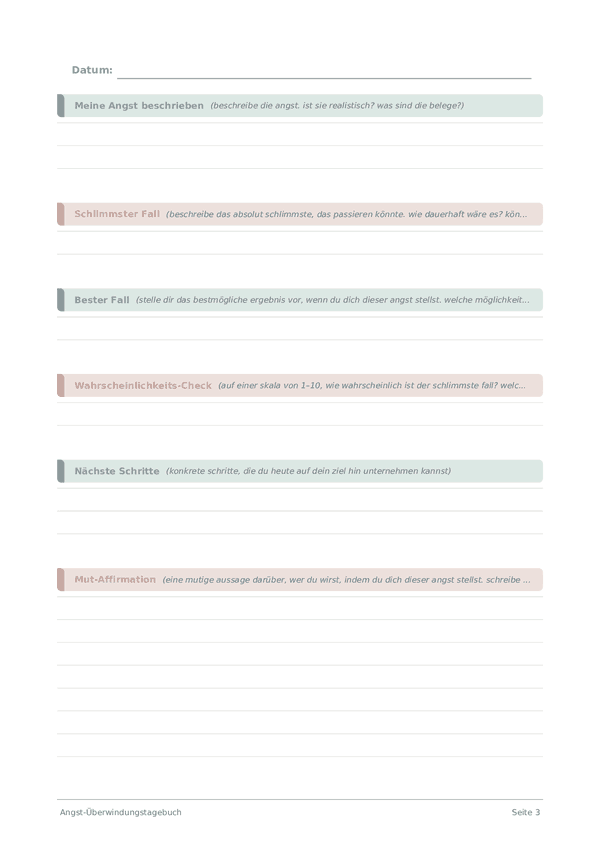
Meine Angst beschrieben
Beschreiben Sie im Detail, wovor Sie sich fürchten. Ängste schrumpfen oft, wenn man sie zu Papier bringt. Seien Sie ehrlich — dieses Journal ist nur für Ihre Augen bestimmt.
Schlimmster Fall
Schreiben Sie das absolut schlimmste Szenario auf. Dann fragen Sie sich: Wie wahrscheinlich ist das wirklich? Und wenn es passieren würde, könnte ich es überstehen? Normalerweise lautet die Antwort: Ja.
Bester Fall
Stelle dir das bestmögliche Ergebnis vor, wenn du dich dieser Angst stellst. Welche Möglichkeiten könnten sich eröffnen?
Wahrscheinlichkeits-Check
Auf einer Skala von 1–10, wie wahrscheinlich ist der schlimmste Fall? Welche Belege stützen oder widerlegen deine Angst?
Nächste Schritte
Unterteilen Sie Ihr Ziel in konkrete nächste Schritte. Was genau werden Sie tun, wann und wie? Je konkreter, desto besser.
Mut-Affirmation
Eine mutige Aussage darüber, wer du wirst, indem du dich dieser Angst stellst. Schreibe sie in der Gegenwartsform.
Tipps für den Erfolg
Wann und wie oft schreiben
Write whenever a fear feels strong enough to influence your decisions — this could be daily or several times a week. The key is capturing the fear while it is active, not after it has passed. Spend 10 minutes examining one fear per entry rather than listing many superficially. Weekly, review your fear entries and notice patterns: are they clustered around certain themes (rejection, failure, loss)? Monthly, celebrate the fears you confronted. This journal is most effective as an as-needed tool with a weekly review ritual.
Häufig gestellte Fragen
Was ist die 'fear-setting' Methodik, die dieses Journal nutzt?
Fear-Setting ist eine strukturierte Angstanalyse, popularisiert von Tim Ferriss, aber verwurzelt in stoischer Premeditation (Seneca, Epiktet) und Entscheidungsanalyse. Die Sequenz schlimmster Fall, bester Fall, wahrscheinlichkeits-Check und nächste Schritte des Journals spiegelt Edwards' Entscheidungsanalyse (1954, Psychological Bulletin, 51(4)) und zeitgenössische strukturierte Entscheidungsforschung wider — Ergebnisse explizit zu untersuchen schwächt vage katastrophale Antizipation, die Vermeidung antreibt.
Wie hilft das Aufschreiben des 'schlimmster Fall' tatsächlich?
Es nutzt imaginale Exposition plus kognitive Umstrukturierung. Beck ('Cognitive Therapy and the Emotional Disorders', 1976) und expositionsbasierte KVT (Foa und Kozak, 1986, Psychological Bulletin, 99(1)) zeigen: gefürchtete Ergebnisse zu spezifizieren reduziert ihre Macht. Vage Angst bleibt katastrophal; benannte Worst-Cases sehen meist überlebbar aus. Zwei Zeilen erzwingen Spezifität — was geschieht konkret, wenn das gefürchtete Ergebnis eintritt?
Warum 'bester Fall' einbeziehen, wenn die Angst der Fokus ist?
Um ausgewogenes Denken wiederherzustellen. Kognitive Verzerrungen wie Katastrophisieren fokussieren ausschließlich auf Negatives. Becks KVT nutzt explizit Evidenzausgleich — sowohl positive als auch negative Möglichkeiten einbeziehend — um den Verzerrungsgriff zu schwächen. Zwei Zeilen sind Raum für einen glaubhaften Best-Case, keine utopische Fantasie. Der Kontrast mit schlimmster Fall kalibriert Wahrscheinlichkeitsschätzungen, die wahrscheinlichkeits-Check formalisiert.
Wie mache ich den 'wahrscheinlichkeits-Check' ehrlich?
Bewerten Sie die realistische Wahrscheinlichkeit, dass der schlimmster Fall in einem definierten Fenster eintritt. Kahneman ('Thinking, Fast and Slow', 2011) und seine Forschung mit Tversky zur Verfügbarkeitsheuristik zeigen: lebendige Ängste fühlen sich wahrscheinlicher an als sie sind. Zwei Zeilen: bewerten Sie 0–100% und einen Satz, welche Belege Ihre Schätzung stützen. Kalibrierung verbessert sich mit wiederholter Praxis über mehrere Ängste.
Was kommt in 'nächste Schritte' für Angstarbeit?
Zwei Kategorien: Schritte zur Verhinderung des schlimmster Fall und Schritte zur Erholung, falls er eintritt. Diese Doppelplanung liegt psychologischer Flexibilität (Hayes' ACT) und vorbereiteter Entscheidungsforschung zugrunde. Drei Zeilen sind Raum für beides. Die Erholungsseite zählt am meisten — zu wissen, dass Sie das Schlimmste bewältigen könnten, nimmt der Angst die Zähne stärker als Präventionspläne allein.
Ist das sicher für klinische Angst oder Phobien?
Mit Vorsicht nutzen. Spezifische Phobien, Panikstörung und PTBS reagieren am besten auf Expositionstherapie durch eine/n ausgebildete/n Kliniker/in (NIMH-Leitlinien zu Angststörungen). Unstrukturiertes Angstschreiben bei schwerer Angst kann zur Rumination werden statt zur Verarbeitung. Bei lähmenden Ängsten konsultieren Sie eine/n lizenzierte/n Psychotherapeuten/in. Dieses Journal ergänzt KVT/Expositionsarbeit als Werkzeug zwischen Sitzungen.
Was ist eine gute 'mut-Affirmation'?
Eine glaubhafte Identitätsaussage, kein Slogan. Cohen und Sherman (2014, Annual Review of Psychology, 65) zur Selbstaffirmation zeigten: wertebasierte Aussagen waren effektiv; generisches 'ich bin mutig' weniger. Besser: 'ich bin jemand, der trotz Angst handelt, wenn die Handlung wichtig ist' — überprüfbar durch Ihre nächste Schritte. Die einzelne Zeile ist absichtlich — eine Aussage, keine Liste.
Wie oft sollte ich eine Angstanalyse machen?
Bei Bedarf, nicht täglich. Fear-Setting funktioniert als gezielte Intervention beim Vermeiden einer spezifischen Entscheidung oder Handlung. Tägliches Wiederholen zu derselben Angst kann zur Rumination werden — Watkins (2008, Psychological Bulletin, 134(2)) fand: repetitives negatives Denken verschlechtert Stimmung und Entscheidungsqualität. Nutzen Sie es einmal pro bedeutende Angst, dann besuchen Sie nur, wenn neue Information erscheint.
Das könnte Ihnen auch gefallen
Scrollen zum Zoomen, ziehen zum Bewegen