Printable Vergebungstagebuch
Angeleitete Vergebungspraxis und emotionale Befreiung
Free yourself from resentment through guided forgiveness journaling. Based on the REACH model of forgiveness, explore your feelings, develop empathy, and make the conscious choice to release what no longer serves you.
Felder anpassen
Schalten Sie Felder ein oder aus. Klicken Sie auf den Stift zum Umbenennen oder fügen Sie eigene Felder hinzu.
Was ist dieses Journal?
A forgiveness journal is a guided writing practice for processing hurt and resentment through structured reflection. Each entry invites you to explore a situation that caused pain, examine your feelings, practice empathy, and work toward releasing the emotional weight you carry.
This journal is for anyone holding onto grudges, past wounds, or self-blame that drains their energy and limits their present. Forgiveness does not mean excusing harmful behavior — it means choosing to free yourself from the ongoing burden of resentment. This journal supports both forgiving others and forgiving yourself.
Research from Stanford's Forgiveness Project shows that structured forgiveness practices reduce anger, stress, and depression while increasing optimism and self-confidence. The process of writing about pain with the explicit intention of release activates different neural pathways than rumination, turning repetitive hurt into progressive healing.
Ausgefülltes Beispiel
So sieht ein typischer Eintrag aus, wenn er ausgefüllt ist:
Wie Sie jedes Feld ausfüllen
Jeden Tag finden Sie mehrere beschriftete Abschnitte mit Zeilen zum Schreiben. Hier erfahren Sie, wofür jeder Abschnitt gedacht ist:
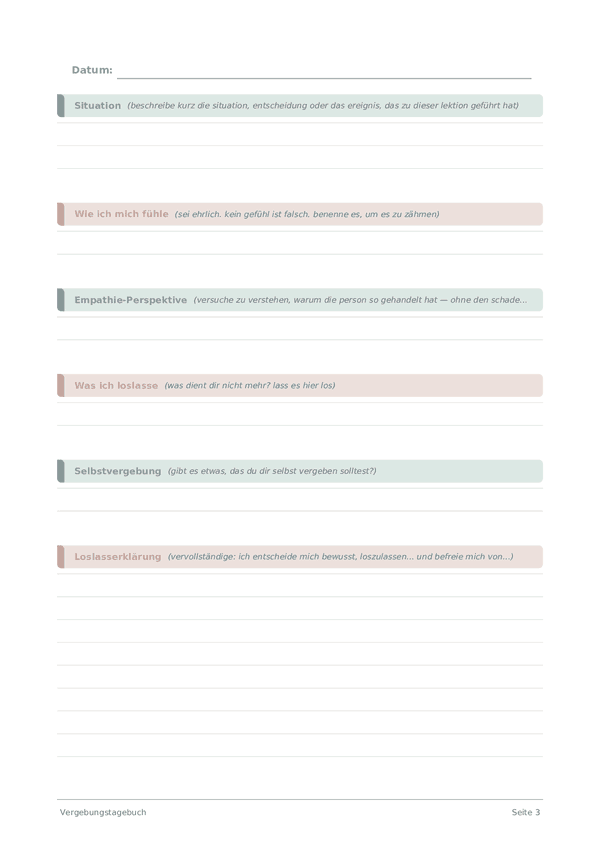
Situation
Beschreiben Sie die Situation oder das Ereignis objektiv, als wären Sie ein neutraler Beobachter. Fakten von Gefühlen zu trennen hilft Ihnen, die Dinge klarer zu sehen.
Wie ich mich fühle
Beschreiben Sie in Ihren eigenen Worten, wie Sie sich gerade fühlen. Es gibt keine falschen Antworten. Allein das Aufschreiben von Gefühlen reduziert ihre emotionale Ladung.
Empathie-Perspektive
Versuche zu verstehen, warum die Person so gehandelt hat — ohne den Schaden zu entschuldigen
Was ich loslasse
Schreiben Sie etwas auf, das Sie loslassen möchten — eine Sorge, einen Groll oder eine Erwartung. Zu benennen, was Sie loslassen, ist der erste Schritt zur Befreiung davon.
Selbstvergebung
Gibt es etwas, das du dir selbst vergeben solltest?
Loslasserklärung
Vervollständige: Ich entscheide mich bewusst, loszulassen... und befreie mich von...
Tipps für den Erfolg
Wann und wie oft schreiben
Write 2-3 times per week, dedicating each entry to one forgiveness topic. This is deep emotional work, and daily entries on the same wound can feel overwhelming. Alternate between forgiving others and forgiving yourself. Spend 15-20 minutes per entry — forgiveness journaling requires more time than typical journals because you need space to process emotions fully. Monthly, re-read your entries to see how your feelings toward specific situations have evolved. Some wounds take months to process; patience with yourself is part of the practice.
Häufig gestellte Fragen
Was ist das REACH-Modell, das dieses Journal nutzt?
REACH ist Everett Worthingtons Vergebungsmodell — Recall the hurt, Empathize, Altruistic gift, Commit, Hold on. Worthington und Scherer (2004, Psychology and Health, 19(3)) und nachfolgende randomisierte Studien dokumentierten seine Effekte auf Feindseligkeit und Wohlbefinden. Die Abschnitte des Journals — Situation, feelings, empathie-Perspektive, was ich loslasse, loslasserklärung — bilden direkt die REACH-Sequenz ab.
Bedeutet Vergebung das Gutheißen des Geschehenen?
Nein. Worthingtons Forschung und APA-Ressourcen zur Vergebung unterscheiden Vergebung ausdrücklich vom Gutheißen, Vergessen oder Versöhnen. Vergebung ist eine innere Freisetzung von Groll; Versöhnung erfordert die andere Partei. Der was ich loslasse-Abschnitt des Journals adressiert Ihre Beziehung zur Verletzung, nicht die Verantwortung des/der Verletzenden. Sie können vergeben ohne Kontakt oder Vertrauen.
Wie schreibe ich 'empathie-Perspektive', ohne Schaden zu minimieren?
Worthingtons Modell nutzt Empathie, um Affekt zu mildern, ohne Verhalten zu rechtfertigen. Zwei Zeilen: schreiben Sie, welche Faktoren die Handlungen der anderen Person erklären könnten — nicht entschuldigen. McCullough, Pargament, Thoresen (2000, 'Forgiveness: Theory, Research, and Practice', Guilford) beschreiben dies als Humanisieren ohne Absolution. Der Schaden bleibt Schaden; Empathie reduziert die Rumination, die Ihr Leiden aufrechterhält.
Warum 'selbstvergebung' einbeziehen?
Selbstvergebung ist ein vom Vergeben anderer unterscheidbares Konstrukt. Hall und Fincham (2005, Journal of Social and Clinical Psychology, 24(5)) und Wohl, DeShea, Wahkinney (2008, Canadian Journal of Behavioural Science, 40(1)) zeigten: Selbstvergebung reduziert Depression und Scham, wenn mit Verantwortung gepaart. Zwei Zeilen erzwingen härtere Arbeit: benennen Sie, was Sie bedauern, und bieten dieselbe Freisetzung, die Sie anderen anbieten würden.
Was soll das 'loslasserklärung' bewirken?
Es funktioniert als verhaltensbezogene Bindung — was Worthington 'Holding on to forgiveness' nennt. Die einzelne Zeile kristallisiert die Wahl. Karremans et al. (2003, JPSP, 84(5)) fanden: explizite Vergebungsaussagen sagten bessere Ergebnisse voraus als vage Intentionen. Schreiben Sie die Aussage im Präsens und übernehmen Sie die Entscheidung: 'Ich lasse das Gewicht davon los' statt 'Ich werde es versuchen'.
Ist Vergebungs-Journaling für Trauma angemessen?
Mit Vorsicht. Worthington und andere (Wade, Hoyt, Kidwell, Worthington, 2014, Journal of Counseling Psychology, 61(2), Meta-Analyse) fanden Vergebungsinterventionen für viele wirksam, aber unter Druck gesetzte Vergebung kann Traumaüberlebenden schaden. Wenn die Verletzung Missbrauch, Übergriff oder anhaltendes Trauma umfasst, konsultieren Sie eine/n lizenzierte/n Psychotherapeuten/in mit Traumaausbildung vor anhaltender Vergebungsarbeit. Verfrühte Vergebung kann Schaden verstärken.
Wie lange dauert diese Arbeit?
Tage bis Monate je nach Schweregrad der Verletzung. Worthington und Scherer (2004, Psychology and Health, 19(3)) und Wade et al. (2014, Journal of Counseling Psychology, 61(2)) fanden: Vergebungsinterventionseffekte skalierten mit Sitzungszahl und Verletzungstiefe. Das Journal kann für dieselbe Situation über Wochen wieder besucht werden; Fortschritt an derselben Wunde ist ein normales Muster, kein Zeichen, dass die Praxis versagte.
Wird die Vergebung einer Person die Beziehung versöhnen?
Nicht notwendigerweise. Vergebung ist innerlich; Versöhnung erfordert die Wiedergutmachungsarbeit der anderen Partei. APA-Vergebungsressourcen und klinische Literatur behandeln diese als trennbare Entscheidungen. Das Journal unterstützt Vergebung — Ihren Frieden — ohne Kontakt oder wiederhergestelltes Vertrauen zu fordern. Manche vergeben ohne Versöhnung; manche versöhnen ohne vollständige Vergebung. Das loslasserklärung gehört Ihnen allein.
Das könnte Ihnen auch gefallen
Scrollen zum Zoomen, ziehen zum Bewegen