Printable Tagebuch für psychische Gesundheit
Ein umfassender täglicher Check-in für Ihren Geist
Track mood, anxiety, energy, and sleep in one place to get a holistic view of your mental health. Reflect on your day to build emotional awareness and resilience.
Felder anpassen
Schalten Sie Felder ein oder aus. Klicken Sie auf den Stift zum Umbenennen oder fügen Sie eigene Felder hinzu.
Vorteile
Anleitung
Was ist dieses Journal?
A mental health journal is a structured daily check-in that combines mood and wellness tracking with reflective writing. By rating key indicators like mood, anxiety, energy, and sleep quality each day, you build a longitudinal picture of your emotional landscape and the factors that influence it.
This journal serves anyone invested in their psychological well-being — whether you are managing a diagnosed condition, working through a difficult period, or simply want to understand yourself better. Therapists and counselors frequently recommend journaling as a complement to professional treatment.
Research published in the Journal of Affective Disorders indicates that consistent self-monitoring of mood and emotional states improves emotional regulation and helps people identify early warning signs before a downturn becomes a crisis. The combination of quantitative tracking and qualitative reflection creates both data and narrative — two powerful tools for self-understanding.
Ausgefülltes Beispiel
So sieht ein typischer Eintrag aus, wenn er ausgefüllt ist:
Wie Sie jedes Feld ausfüllen
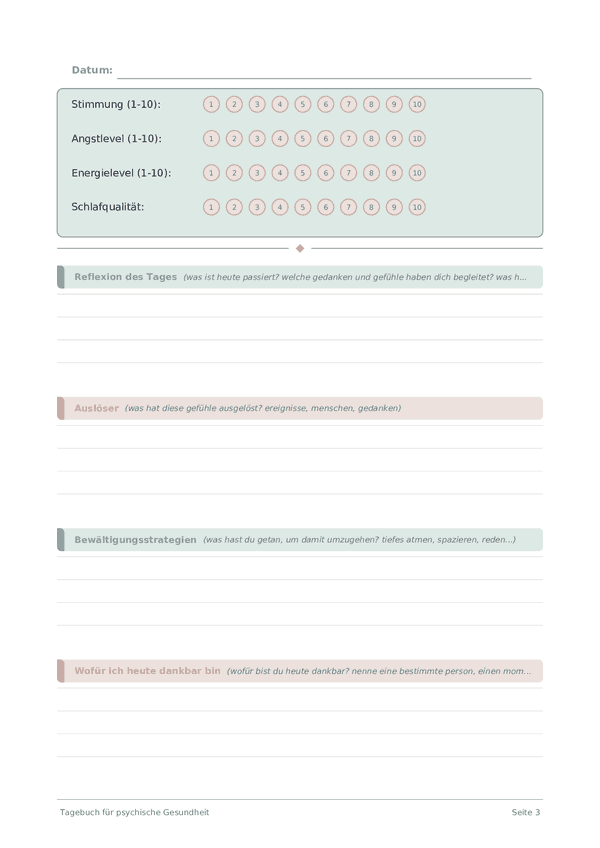
Oben auf jeder Seite befinden sich schnell ausfüllbare Felder (Bewertungen, Kontrollkästchen, Zahlen). Darunter ist ein linierter Bereich zum Schreiben. Hier erfahren Sie, was jedes Feld bedeutet:
Stimmung (1-10)
Bewerten Sie Ihren allgemeinen emotionalen Zustand für den Tag. 1 bedeutet sehr niedergeschlagen oder deprimiert, 10 bedeutet außergewöhnlich glücklich und positiv. Denken Sie nicht zu lange nach — vertrauen Sie Ihrem Bauchgefühl.
Angstlevel (1-10)
Bewerten Sie Ihr Angstniveau heute. Einer Angst eine Zahl zuzuordnen macht das Gefühl handhabbarer und nachverfolgbar.
Energielevel (1-10)
Bewerten Sie Ihr körperliches und geistiges Energieniveau. 1 bedeutet erschöpft und ausgelaugt, 10 bedeutet voller Energie und wach. Dies hilft Ihnen zu erkennen, welche Aktivitäten Ihre Energie steigern oder verbrauchen.
Schlafqualität
Bewerten Sie, wie erholsam Ihr Schlaf war. 1 bedeutet schrecklich und unruhig, 5 bedeutet tief und erfrischend. Qualität ist genauso wichtig wie Quantität.
Reflexion des Tages
Blicken Sie ehrlich auf Ihren Tag zurück. Was lief gut? Was könnte besser sein? Es geht nicht um Urteile — es geht um Lernen und Wachstum.
Auslöser
Identifizieren Sie, was Ihre emotionalen Reaktionen ausgelöst hat — Ereignisse, Menschen, Gedanken, Umgebungen. Auslöser zu erkennen gibt Ihnen die Möglichkeit, sich darauf vorzubereiten oder sie zu vermeiden.
Bewältigungsstrategien
Was hast du getan, um damit umzugehen? Tiefes Atmen, Spazieren, Reden...
Wofür ich heute dankbar bin
Listen Sie 1–3 Dinge auf, für die Sie heute dankbar sind. Es kann Großes oder Kleines sein — eine gute Mahlzeit, ein freundliches Wort, Sonnenschein. Dankbarkeitsjournaling gehört zu den wissenschaftlich am besten belegten Praktiken für das Wohlbefinden.
Was gut gelaufen ist
Auch kleine Erfolge zählen — nenne mindestens einen
Tipps für den Erfolg
Wann und wie oft schreiben
Fill in the tracker daily to build a reliable mental health baseline. The writing section can be brief on good days (2–3 sentences) and longer on hard days (as much as you need). Review weekly to spot trends. If you're in therapy, review your journal before each session — it helps you make the most of your time with your therapist.
Häufig gestellte Fragen
Was erfasst dieses Journal, das ein einzelner Stimmungs-Score nicht erfasst?
Es trennt vier Dimensionen — Stimmung, angstlevel (1-10), Energie, schlafqualität — auf 0–10-Skalen. NIMH-HiTOP und klinische Bewertungsrahmen behandeln diese als unterscheidbare Indikatoren statt als ein Komposit. Ein Tag mit niedriger Energie, aber stabiler Stimmung liest sich anders als niedrige Stimmung bei normaler Energie, und der Reflexionsabschnitt erfasst Kontext, den die Zahlen allein nicht festhalten.
Wie sollte ich das mit meinem/r Therapeuten/in teilen?
Bringen Sie zwei bis vier Wochen ausgefüllter Einträge zu einer Sitzung. APA-Leitlinien zur klinischen Praxis behandeln klientengenerierte Symptomdaten als ergänzend zur Beurteilung. Heben Sie Tage hervor, an denen Bewertungen stark divergierten oder ein einzelner Trigger in mehreren Einträgen auftauchte. Viele Therapeut/innen nutzen dieses Format als Daten zwischen Sitzungen; fragen Sie, ob sie den Tracker, die Reflexion oder beides bevorzugen.
Was kommt in 'triggers' versus 'was gut gelaufen ist'?
Trigger sind Situationen, Gedanken, Menschen oder Umgebungen, die Ihre Bewertungen nach unten verschoben. Was gut gelaufen ist erfasst das Gegenteil — Momente, die die Stimmung hoben oder Energie wiederherstellten. Zusammen kartieren sie Ihre tägliche Affektregulation. Fredricksons Broaden-and-Build-Theorie (2001, American Psychologist, 56(3)) unterstützt das aktive Loggen positiver Ereignisse, um Verhaltensrepertoires zu erweitern. Anhaltende Verfolgung bringt Muster zutage, die in einzelnen Tagen unsichtbar sind.
Wie unterscheidet sich das vom Angst- oder Stimmungsjournal?
Das Mental-Health-Journal ist breiter und niedrigfrequenter: es sampelt vier Kerndimensionen plus offene Reflexion, geeignet für ein tägliches Check-in. Das Angstjournal zentriert auf KVT-Gedankenprotokollen; das Stimmungsjournal betont emotionale Granularität. Wählen Sie nach Bedarf — diagnostizierte Angst zieht zum Angstjournal, breite Selbstbeobachtung zu diesem.
Kann dies helfen, Frühwarnsignale eines Rückgangs zu bemerken?
Ja, das ist eine Kernverwendung. Becks kognitives Modell und Lewinsohns Verhaltensmodell der Depression heben beide langsame Drifts in Schlaf, Energie und Stimmung als prodromale Signale hervor. Wochen 0–10-Bewertungen zu verfolgen macht abwärts gerichtete Trends sichtbar, bevor sie Krisenschwellen erreichen. Bei anhaltendem Rückgang wenden Sie sich umgehend an eine/n lizenzierte/n Psychotherapeuten/in.
Was sollte ich in 'bewältigungsstrategien' schreiben?
Notieren Sie spezifisch, was Sie taten und wie es ankam. Aldao, Nolen-Hoeksema, Schweizer (2010, Clinical Psychology Review, 30(2)) fanden, dass kognitive Reappraisal und Akzeptanz mit besseren Ergebnissen korrelieren; Rumination und Vermeidung mit schlechteren. Ihre Strategien zu kategorisieren — 'ich ging spazieren', 'ich scrollte Social Media' — über Wochen zeigt, was Ihren Bewertungen tatsächlich hilft.
Ist es sicher zu nutzen, wenn ich Gedanken an Selbstverletzung habe?
Journaling ist kein Ersatz für Krisenversorgung. Bei Gedanken an Selbstverletzung oder Suizid kontaktieren Sie sofort Notdienste oder die Telefonseelsorge 0800 111 0 111 (Deutschland, kostenlos, 24/7). Notruf 112. WHO Mental Health und APA-Krisenleitlinien betonen professionelle Intervention als primär. Das Journal kann laufende Behandlung mit einer/m lizenzierten Psychotherapeuten/in ergänzen, sollte aber dringende Hilfe nicht verzögern.
Wie oft sollte ich den Reflexionsabschnitt ausfüllen?
Streben Sie täglich beim Tracker an, drei- bis fünfmal wöchentlich bei der Reflexion. Tägliche Reflexion funktioniert für manche, erzeugt aber Ermüdung bei anderen; Burton und King (2004, Journal of Research in Personality, 38(2)) zeigten, dass auch kurzes expressives Schreiben Effekte erzeugte, während Pennebaker (1997, Psychological Science, 8(3)) demonstrierte, dass drei bis vier Sitzungen wöchentlich oft für Vorteile emotionaler Verarbeitung ausreichen.
Das könnte Ihnen auch gefallen
Scrollen zum Zoomen, ziehen zum Bewegen