Printable Achtsamkeitstagebuch
Verankern Sie sich im gegenwärtigen Moment mit MBSR-inspiriertem täglichem Schreiben
The Mindfulness Journal is built on evidence-based principles from Mindfulness-Based Stress Reduction (MBSR), developed by Jon Kabat-Zinn at the University of Massachusetts. Each daily entry guides you through a structured sequence: setting an intention, scanning your body, sharpening sensory awareness, cultivating gratitude, and practicing self-compassion. By writing without judgment, you train your attention to rest in the present — the foundation of every proven mindfulness program.
Felder anpassen
Schalten Sie Felder ein oder aus. Klicken Sie auf den Stift zum Umbenennen oder fügen Sie eigene Felder hinzu.
Vorteile
Anleitung
Was ist dieses Journal?
A mindfulness journal is a daily writing practice designed to anchor you in the present moment and cultivate non-judgmental awareness. Rooted in Buddhist meditation traditions and adapted by modern psychology, mindfulness journaling combines structured reflection with contemplative exercises to reduce mental chatter and increase inner calm.
Research from Harvard Medical School and the University of Massachusetts shows that regular mindfulness practice reduces cortisol levels, shrinks the brain's stress center (amygdala), and strengthens areas associated with attention and emotional regulation. Writing is a particularly effective mindfulness tool because it forces you to slow down and articulate your inner experience.
This journal guides you through seven focused sections: setting an intention, present-moment awareness, body scan observations, sensory awareness, gratitude, letting go, and self-compassion. Each section takes just 1-2 minutes, making the entire practice achievable in under 15 minutes.
Ausgefülltes Beispiel
So sieht ein typischer Eintrag aus, wenn er ausgefüllt ist:
Wie Sie jedes Feld ausfüllen
Jeden Tag finden Sie mehrere beschriftete Abschnitte mit Zeilen zum Schreiben. Hier erfahren Sie, wofür jeder Abschnitt gedacht ist:
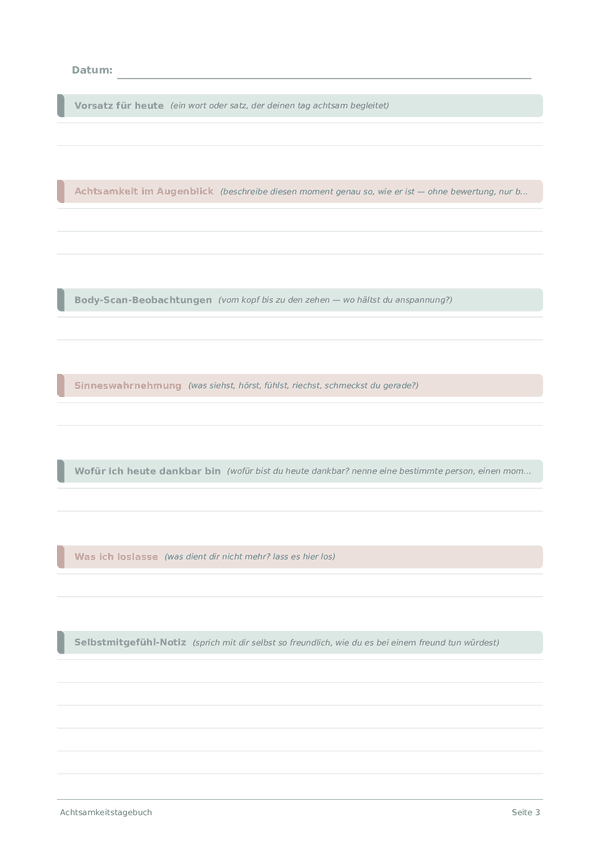
Vorsatz für heute
Ein Wort oder Satz, der deinen Tag achtsam begleitet
Achtsamkeit im Augenblick
Beschreiben Sie, was Sie gerade wahrnehmen — Geräusche, Empfindungen, Gedanken. Das erdet Sie im gegenwärtigen Moment und fördert Ihre Achtsamkeit.
Body-Scan-Beobachtungen
Scanne von Kopf bis Fuß — wo gibt es Spannung, Wärme, Taubheit oder Leichtigkeit? Einfach wahrnehmen, ohne etwas ändern zu wollen
Sinneswahrnehmung
Was siehst, hörst, fühlst, riechst, schmeckst du gerade?
Wofür ich heute dankbar bin
Listen Sie 1–3 Dinge auf, für die Sie heute dankbar sind. Es kann Großes oder Kleines sein — eine gute Mahlzeit, ein freundliches Wort, Sonnenschein. Dankbarkeitsjournaling gehört zu den wissenschaftlich am besten belegten Praktiken für das Wohlbefinden.
Was ich loslasse
Schreiben Sie etwas auf, das Sie loslassen möchten — eine Sorge, einen Groll oder eine Erwartung. Zu benennen, was Sie loslassen, ist der erste Schritt zur Befreiung davon.
Selbstmitgefühl-Notiz
Sprich mit dir selbst so freundlich, wie du es bei einem Freund tun würdest
Tipps für den Erfolg
Wann und wie oft schreiben
Write once a day, ideally right after your meditation or mindfulness practice while awareness is heightened. Morning practice followed by immediate journaling is the most effective pattern — you capture insights while they're vivid. If you don't have a formal practice, use the journal itself as a 5-minute mindfulness exercise: sit, breathe, observe, then write.
Häufig gestellte Fragen
Was ist MBSR und warum basiert dieses Journal darauf?
MBSR (Mindfulness-Based Stress Reduction) wurde 1979 von Jon Kabat-Zinn am University of Massachusetts Medical Center entwickelt und bleibt eine der am meisten untersuchten Achtsamkeitsinterventionen. Khoury et al. (2015, Journal of Psychosomatic Research, 78(6)) meta-analysierten 29 Studien und fanden, dass MBSR moderate Effekte auf Stress und Angst bei gesunden Erwachsenen erzeugte. Die Abschnitte des Journals spiegeln seine Kernpraktiken wider.
Wie mache ich die 'body-Scan-Beobachtungen' richtig?
Der Body Scan ist eine der Ankerpraktiken von MBSR. Bewegen Sie die Aufmerksamkeit langsam von den Füßen zum Kopf und nehmen Sie Empfindung, Temperatur, Anspannung oder Abwesenheit wahr — ohne zu versuchen, etwas zu ändern. Zwei Zeilen reichen für eine Zusammenfassung: wo Sie Anspannung bemerkten, wo Leichtigkeit lebte. Kerr et al. (2013, Frontiers in Human Neuroscience, 7) fanden, dass regelmäßige Body-Scan-Praxis die somatosensorische Kortexregulation veränderte.
Was unterscheidet Achtsamkeit von Entspannung?
Achtsamkeit ist nicht-wertendes Gewahrsein gegenwärtiger Erfahrung, einschließlich unangenehmer Inhalte. Entspannung zielt darauf, Erregung zu reduzieren. Kabat-Zinn unterscheidet sie ausdrücklich: MBSR kultiviert Gleichmut mit dem, was ist, nicht angenehme Gefühle. Goyal et al. (2014, JAMA Internal Medicine, 174(3)) fanden, dass Achtsamkeitsprogramme Angst und Depression verbesserten, wo einfache Entspannung die Effektgröße nicht erreichte.
Was macht 'selbstmitgefühl-Notiz' in einem Achtsamkeitsjournal?
Kristin Neffs Forschung zum Selbstmitgefühl (Neff, 2003, Self and Identity, 2(2)) identifiziert es als Schwesterkonstrukt der Achtsamkeit — drei Säulen: Achtsamkeit, gemeinsame Menschlichkeit, Selbstfreundlichkeit. MBSR-abgeleitete Programme wie Mindful Self-Compassion (MSC) integrieren sie. Die Abschlusszeile trainiert Sie, sich selbst so anzusprechen, wie Sie mit einem/r Freund/in sprechen würden, der/die mit derselben Schwierigkeit kämpft.
Wie hängt 'sinneswahrnehmung' mit Grounding zusammen?
Zu benennen, was Sie sehen, hören, fühlen, riechen und schmecken, ist eine klassische 5-4-3-2-1-Grounding-Technik aus der traumasensiblen Versorgung und DBT-Distresstoleranz (Linehan). Sie verankert die Aufmerksamkeit im sensorischen Jetzt und unterbricht Ruminationsschleifen, die Watkins (2008, Psychological Bulletin, 134(2)) als transdiagnostisch über Depression und Angst hinweg identifizierte. Die zwei Zeilen erzwingen die Auswahl lebendiger Gegenwartsmoment-Daten.
Sollte ich vor oder nach der Meditation journalen?
Nachher. Die Intentionssetzung kann davor erfolgen, aber body scan, sinneswahrnehmung und was ich loslasse sind klarer, wenn Sie zuerst gesessen haben. Killingsworth und Gilbert (2010, Science, 330(6006)) zeigten, dass Gedankenwandern mit geringerem Glück korreliert; ein kurzes Sitzen vor dem Schreiben reduziert das Wandern und produziert ehrlichere Einträge. Selbst fünf Minuten Atembewusstsein schärfen den Output.
Ist Achtsamkeitsjournaling während der Traumaverarbeitung angemessen?
Vorsicht walten lassen. Manche Traumaüberlebende erleben verstärkten Distress bei körperorientierter Achtsamkeit — Treleaven ('Trauma-Sensitive Mindfulness', Norton, 2018) und Forschung von Britton et al. (2021, Clinical Psychological Science, 9(6)) dokumentieren Nebenwirkungen. Bei Traumavorgeschichte konsultieren Sie eine/n lizenzierte/n Psychotherapeuten/in mit Traumaausbildung vor anhaltender Praxis. Modifizieren oder verkürzen Sie body scan nach Bedarf.
Wie lange bis Achtsamkeitsjournaling Ergebnisse zeigt?
MBSR ist ein 8-wöchiges Protokoll, weil dann messbare Veränderungen auftauchen. Tang, Hölzel und Posner (2015, Nature Reviews Neuroscience, 16(4)) prüften neuronale Veränderungen, die innerhalb von Wochen auftraten. Tägliche Einträge — auch zehn Minuten — über 8 Wochen erreichen die Dosisschwelle, die die meisten Studien nutzen. Inkonsistente Praxis erzeugt inkonsistente Ergebnisse; das Journal unterstützt Adhärenz.
Das könnte Ihnen auch gefallen
Scrollen zum Zoomen, ziehen zum Bewegen