Printable Positives-Denken-Tagebuch
Tägliche Praxis für positives Denken und Optimismus
Train your brain to notice and amplify the good. Build an optimistic mindset through daily recognition of positive moments, reframing challenges, acts of kindness, and intentional gratitude.
Felder anpassen
Schalten Sie Felder ein oder aus. Klicken Sie auf den Stift zum Umbenennen oder fügen Sie eigene Felder hinzu.
Was ist dieses Journal?
A positive thinking journal is a daily practice that trains your brain to notice and amplify the good in your life. Each entry guides you through finding silver linings, reframing challenges, and recognizing moments of joy and kindness — gradually shifting your default lens from what is wrong to what is right.
This journal is for anyone who wants to cultivate a more optimistic outlook without ignoring reality. It is especially helpful if you tend toward rumination, pessimism, or simply want to build resilience during uncertain times.
Neuroscience research on neuroplasticity shows that deliberately focusing on positive experiences for even 15-30 seconds strengthens the neural pathways associated with well-being. Over weeks of consistent practice, this journal literally rewires your brain's tendency to scan for threats toward scanning for opportunities and gratitude.
Ausgefülltes Beispiel
So sieht ein typischer Eintrag aus, wenn er ausgefüllt ist:
Wie Sie jedes Feld ausfüllen
Jeden Tag finden Sie mehrere beschriftete Abschnitte mit Zeilen zum Schreiben. Hier erfahren Sie, wofür jeder Abschnitt gedacht ist:
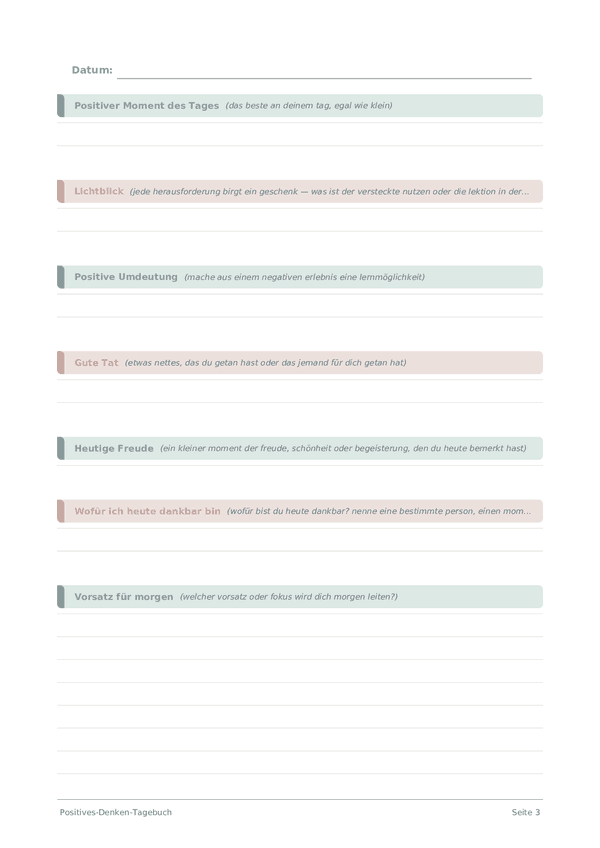
Positiver Moment des Tages
Beschreiben Sie einen positiven Moment des heutigen Tages, egal wie klein. Ihr Gehirn zu trainieren, gute Momente wahrzunehmen, verschiebt Ihre gesamte Sichtweise in Richtung Optimismus.
Lichtblick
Jede Herausforderung birgt ein Geschenk — was ist der versteckte Nutzen oder die Lektion in der heutigen Schwierigkeit?
Positive Umdeutung
Mache aus einem negativen Erlebnis eine Lernmöglichkeit
Gute Tat
Etwas Nettes, das du getan hast oder das jemand für dich getan hat
Heutige Freude
Ein kleiner Moment der Freude, Schönheit oder Begeisterung, den du heute bemerkt hast
Wofür ich heute dankbar bin
Listen Sie 1–3 Dinge auf, für die Sie heute dankbar sind. Es kann Großes oder Kleines sein — eine gute Mahlzeit, ein freundliches Wort, Sonnenschein. Dankbarkeitsjournaling gehört zu den wissenschaftlich am besten belegten Praktiken für das Wohlbefinden.
Vorsatz für morgen
Welcher Vorsatz oder Fokus wird dich morgen leiten?
Tipps für den Erfolg
Wann und wie oft schreiben
Write every evening, taking 5-10 minutes to capture positive moments from your day. Morning entries work too, focused on intentions and what you appreciate right now. The critical habit is consistency — positive thinking patterns take roughly 21 days of daily practice to start feeling automatic. If you miss a day, simply resume without guilt. Weekly, re-read your entries and notice how your perspective is shifting. The journal trains your reticular activating system to filter for good.
Häufig gestellte Fragen
Ist 'positives Denken' durch Forschung gestützt?
Ja, mit Vorbehalten. Positive Psychologie — begründet von Martin Seligman (Seligman et al., 2005, American Psychologist, 60(5)) — operiert nicht als erzwungener Optimismus, sondern als bewusste Aufmerksamkeit auf positiven Inhalt. Die 'Three Good Things'-Übung ist ihre am besten validierte Praxis. Erzwungene Positivität — Negatives leugnend — ist mit schlechteren Ergebnissen assoziiert. Die Struktur dieses Journals folgt der evidenzbasierten Variante.
Wie unterscheidet sich 'lichtblick' von toxischer Positivität?
Lichtblick identifiziert ein Lernen, eine Perspektivverschiebung oder ein unerwartetes Positives innerhalb einer Schwierigkeit — es löscht die Schwierigkeit nicht aus. Folkman (2008, Anxiety, Stress, and Coping, 21(1)) zu sinnfokussiertem Coping zeigte: positiven Sinn während Stress zu finden sagt bessere Anpassung voraus. Toxische Positivität leugnet das Negative gänzlich. Zwei Zeilen sind Raum, das Schwere anzuerkennen und ein echtes Reframing — nicht zu so tun als ob.
Was ist 'positive Umdeutung' konkret?
Kognitive Reappraisal — eine andere Interpretation einer Situation wählen. Gross (2002, Psychophysiology, 39(3)) und Meta-Analysen (Webb, Miles, Sheeran, 2012, Psychological Bulletin, 138(4)) finden konsistent: Reappraisal reduziert negative Emotion ohne die Kosten der Suppression. Zwei Zeilen erzwingen Kompression: schreiben Sie die Situation wie zuerst gesehen und das Reframing, keine Absätze der Rechtfertigung.
Warum 'gute Tat' einbeziehen?
Akte der Freundlichkeit steigern Wohlbefinden zuverlässig. Curry et al. (2018, Journal of Experimental Social Psychology, 76) meta-analysierten 27 Studien und fanden, dass prosoziales Verhalten kleine, aber konsistente Wohlbefindenszuwächse erzeugte. Layous, Nelson, Lyubomirsky und Kolleg/innen zeigten: Der Effekt verstärkt sich, wenn die Akte zwischen Tagen variieren. Den Akt zu loggen baut das Verhaltensmuster auf, nicht nur die Absicht.
Wird dieses Journal funktionieren, wenn ich natürlicher Pessimist bin?
Besonders dann. Seligmans Forschung zum erlernten Optimismus und Becks KVT behandeln beide pessimistischen Erklärungsstil als modifizierbar. Kurze tägliche Aufmerksamkeit auf positive Momente zu erzwingen — drei bis sieben kleine Ereignisse, nach denen die Struktur fragt — gewichtet allmählich den Aufmerksamkeitsbias um, der in Mor und Winquist (2002, Psychological Bulletin, 128(4)) dokumentiert ist. Rechnen Sie früh mit Widerstand; Beharrlichkeit formt das Muster um.
Ist positives Denken bei Depression hilfreich?
Mit Vorsicht nutzen. Depression umfasst mehr als negatives Denken; Major Depression erfordert klinische Versorgung. Wood, Perunovic, Lee (2009, Psychological Science, 20(7)) fanden, dass sich Personen mit geringem Selbstwert mit erzwungenen positiven Affirmationen verschlechterten. Bei diagnostizierter Depression konsultieren Sie eine/n lizenzierte/n Psychotherapeuten/in. Dieses Journal kann Behandlung wie KVT oder Verhaltensaktivierung ergänzen, nicht ersetzen.
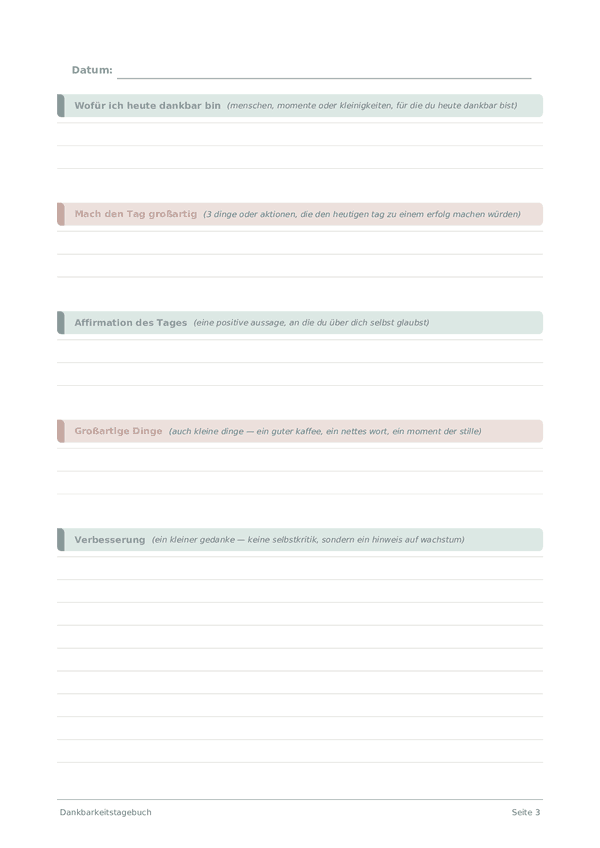
Wie verhält sich das zu einem Dankbarkeitsjournal?
Dankbarkeit fokussiert auf Wertschätzung empfangener Güter; positives Denken ist breiter — Reframing, Freundlichkeit, Freude-Finden, optimistische Intention. Emmons und McCullough (2003, JPSP, 84(2)) etablierten spezifisch Dankbarkeitseffekte. Sin und Lyubomirsky (2009, Journal of Clinical Psychology, 65(5)) meta-analysierten positivpsychologische Interventionen und fanden: Mehrkomponentenansätze (wie dieses Journal) übertrafen oft monokausale.
Was, wenn manche Tage keine 'heutige Freude' haben?
Finden Sie das Kleinste. Fredricksons Broaden-and-Build-Theorie (2001, American Psychologist, 56(3)) zeigte, dass selbst Mikro-positive Emotionen messbare Effekte haben, wenn bemerkt. Eine Zeile erlaubt das Kleine — Sonne durchs Fenster, ein vertrautes Lied. Bryants Savoring-Forschung (2003, Journal of Mental Health, 12(2)) legt nahe, dass Aufmerksamkeitstraining auf Mikro-Freuden deren Häufigkeit über Wochen erhöht.
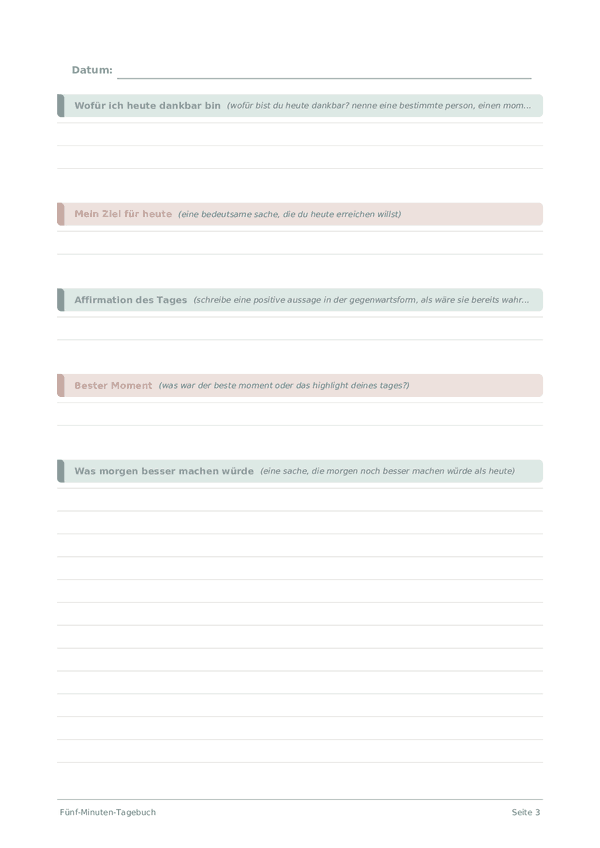
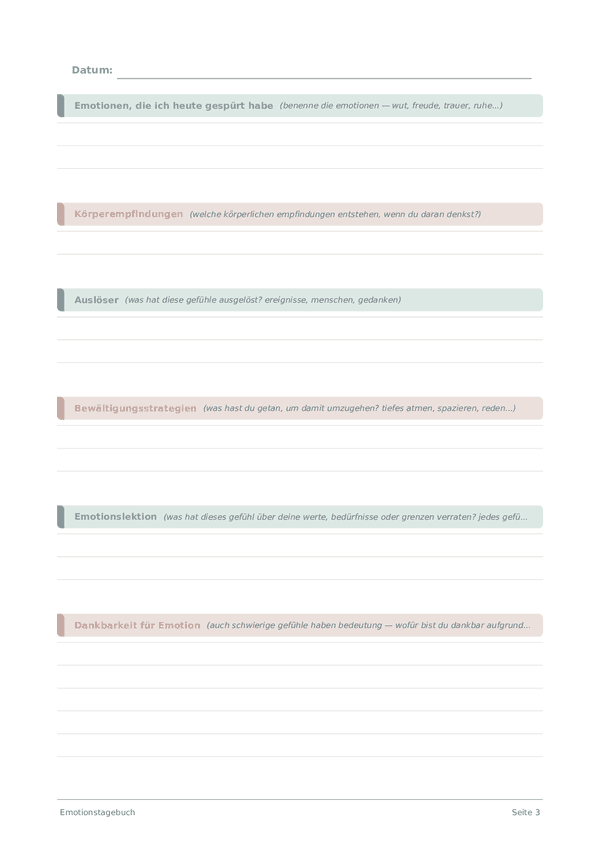
Das könnte Ihnen auch gefallen
Scrollen zum Zoomen, ziehen zum Bewegen