Printable Genesungstagebuch
Tägliche Genesungsunterstützung und Nüchternheits-Tagebuch
Support your recovery journey with daily check-ins, trigger awareness, and coping strategy documentation. Track sobriety milestones, celebrate progress, and maintain connection to your recovery community.
Felder anpassen
Schalten Sie Felder ein oder aus. Klicken Sie auf den Stift zum Umbenennen oder fügen Sie eigene Felder hinzu.
Was ist dieses Journal?
A recovery journal is a deeply personal daily writing practice designed for individuals on the path of addiction recovery or healing from any life-altering challenge. Each entry provides structured prompts that guide you through reflecting on your emotional state, identifying triggers, acknowledging your coping strategies, and celebrating daily accomplishments — no matter how small they may seem.
Recovery is not a straight line, and a journal helps you navigate its inevitable ups and downs with greater awareness. Writing about your feelings and triggers creates emotional distance, allowing you to process difficult experiences rather than react impulsively. Documenting the coping strategies that work reinforces healthy patterns, while noting what you are grateful for shifts your focus toward the positive aspects of your new life.
Many recovery programs, including 12-step and therapeutic approaches, recommend journaling as a core practice. This journal supports that recommendation with a clear daily structure that reduces the intimidation of a blank page. Over time, reading back through your entries becomes a powerful reminder of how far you have come and the strength you carry within you.
Ausgefülltes Beispiel
So sieht ein typischer Eintrag aus, wenn er ausgefüllt ist:
Wie Sie jedes Feld ausfüllen
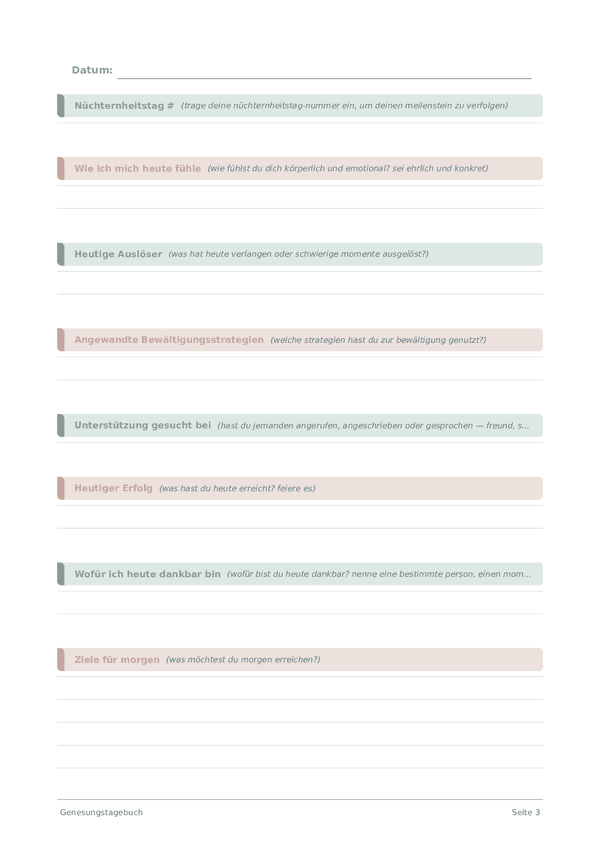
Jeden Tag finden Sie mehrere beschriftete Abschnitte mit Zeilen zum Schreiben. Hier erfahren Sie, wofür jeder Abschnitt gedacht ist:
Nüchternheitstag #
Trage deine Nüchternheitstag-Nummer ein, um deinen Meilenstein zu verfolgen
Wie ich mich heute fühle
Fragen Sie sich selbst: Wie fühlen Sie sich gerade körperlich und emotional? Seien Sie konkret — 'müde, aber hoffnungsvoll' ist nützlicher als 'gut.'
Heutige Auslöser
Was hat heute Verlangen oder schwierige Momente ausgelöst?
Angewandte Bewältigungsstrategien
Welche Strategien hast du zur Bewältigung genutzt?
Unterstützung gesucht bei
Hast du jemanden angerufen, angeschrieben oder gesprochen — Freund, Sponsor, Familie oder Berater?
Heutiger Erfolg
Notieren Sie etwas, das Sie heute erreicht haben, egal wie klein. Das Anerkennen täglicher Erfolge stärkt Selbstvertrauen und Schwung.
Wofür ich heute dankbar bin
Listen Sie 1–3 Dinge auf, für die Sie heute dankbar sind. Es kann Großes oder Kleines sein — eine gute Mahlzeit, ein freundliches Wort, Sonnenschein. Dankbarkeitsjournaling gehört zu den wissenschaftlich am besten belegten Praktiken für das Wohlbefinden.
Ziele für morgen
Was möchtest du morgen erreichen?
Tipps für den Erfolg
Wann und wie oft schreiben
Write every single day, especially in the first 90 days. Evening journaling is ideal — it processes the day and releases emotional pressure that might otherwise build overnight. On hard days, write in the moment if you can. In early recovery, even a 3-sentence entry counts. After 90 days, daily remains ideal, but the habit should feel natural by then. Weekly, re-read your entries to see growth you cannot feel in the moment. Monthly, note how your triggers and coping strategies have evolved.
Häufig gestellte Fragen
Wie unterstützt tägliches Journaling die Genesung von Sucht?
NIH NIAAA (2021, Treating Alcohol Use Disorder) und evidenzbasierte NIDA-Prinzipien identifizieren Selbstmonitoring als Kernkompetenz der Rückfallprävention. APA und SAMHSA berichten, dass tägliche Reflexion — besonders Auslöserbewusstsein und Dankbarkeitspraxis — das Rückfallrisiko reduziert, indem sie die Genesungsidentität und Bewältigungsfähigkeiten stärkt. Die strukturierten Prompts der Vorlage (nüchternheitstag #, Auslöser, Bewältigungsstrategien, Unterstützungskontakte) entsprechen kognitiv-verhaltenstherapeutischen Rückfallpräventions-Modellen. Nutzen Sie sie ergänzend zu professioneller Behandlung, nicht als Ersatz.
Was ist der Wert beim Tracken von Abstinenztagen?
Laut NIAAA und Selbsthilfe-Traditionen von AA/NA stärken Abstinenz-Meilensteine den Identitätswandel. Verhaltensforschung im Journal of Substance Abuse Treatment zeigt, dass sichtbare Tageszähler mit längerer Abstinenz korrelieren. Das nüchternheitstag #-Feld gibt tägliche Bestätigung — laut APA (2021) übertrifft konsistente kleine Verstärkung seltene intensive Markierungen. Feiern Sie Meilensteine (30, 60, 90 Tage; 1 Jahr) mit Ihrem Sponsor oder Unterstützungsnetzwerk.
Wie identifiziere und dokumentiere ich Auslöser?
Laut NIDA (2020, Principles of Drug Addiction Treatment) und Marlatts Rückfallpräventions-Framework fallen Auslöser in emotionale (HALT: hungrig/wütend/einsam/müde), soziale (Personen/Orte), umweltbedingte (visuelle Hinweise) und innere (Gedanken/Verlangen) Kategorien. Nutzen Sie das heutige Auslöser-Prompt zur Erfassung konkreter Ereignisse, Intensität (leicht/moderat/schwer) und Ihrer Reaktion. Muster über 4–8 Wochen offenbaren risikoreiche Situationen zur vorausschauenden Planung.
Was zählt als 'Bewältigungsstrategie', die trackbar ist?
Evidenzbasierte Bewältigungsstrategien von SAMHSA und APA: Urge Surfing, Sponsor anrufen, Meeting besuchen, Sport, Achtsamkeitsübung, sich aus der Triggerumgebung entfernen, Krisenhotline anrufen. Dokumentieren Sie Genutztes in angewandte Bewältigungsstrategien und ob es wirkte. NIH-NIDA-Forschung zeigt, dass das schriftliche Erinnern an effektive Bewältigung 'Selbstwirksamkeit' aufbaut — Vertrauen in zukünftige Bewältigung, der stärkste Prädiktor anhaltender Genesung.
Warum ist das unterstützung gesucht bei-Prompt wichtig?
Laut NIDA und AA/NA-Peer-Support-Forschung ist soziale Isolation der stärkste akute Rückfallprädiktor; tägliche Verbindung — auch kurz — schützt deutlich. Das unterstützung gesucht bei-Feld erfasst Sponsoranrufe, Meeting-Besuche, Freundes-Nachrichten oder Therapiesitzungen. APA (2021)-Daten zeigen, dass Engagement in der Recovery-Community in jeder Form mit längerer Abstinenz korreliert. Keine Kontaktaufnahme für 3+ Tage ist ein klinisches Warnsignal, das mit Ihrem Behandlungsteam zu besprechen ist.
Wie passt Dankbarkeitspraxis in die Genesung?
Laut Journal of Substance Abuse Treatment und APA-Positive-Psychology-Forschung aktiviert Dankbarkeitspraxis Belohnungspfade anders als Substanzgebrauch und reduziert Dysphorie — einen Hauptrückfalltreiber. Das wofür ich heute dankbar bin-Prompt verlangt Spezifik (laut Emmons, 2003, Journal of Personality and Social Psychology, 84(2)): nennen Sie drei konkrete Dinge, keine generischen. Drei Wochen konsequente Praxis zeigen in klinischen Studien messbare Stimmungsverbesserung.
Ist dieses Tagebuch ohne professionelle Behandlung geeignet?
Es unterstützt, ersetzt aber keine klinische Versorgung. SAMHSA und NIDA betonen, dass schwere Substanzkonsumstörungen meist medizinische Entgiftung, medikamentengestützte Behandlung (z.B. Buprenorphin, Naltrexon) und Verhaltenstherapie erfordern. Das Tagebuch ergänzt die Behandlung durch Daten, die Ihr Berater oder Arzt einsehen kann. Entzug von Alkohol, Benzodiazepinen oder Opioiden ohne ärztliche Aufsicht kann lebensbedrohlich sein — konsultieren Sie Suchtmediziner oder rufen Sie die Sucht- und Drogen-Hotline 01806 313031 an.
Wann sollten Tagebuchmuster dringende Hilfe auslösen?
SAMHSA-Krisenkriterien: Gedanken an Selbstverletzung oder Suizid (Telefonseelsorge 0800 111 0 111, kostenlos und 24/7), aktiver Rückfall, schwere Entzugssymptome oder anhaltende Unfähigkeit, Bewältigungsstrategien zu nutzen. Muster im Tagebuch — eskalierende Auslöser, abnehmende Unterstützungskontakte, wiederkehrende Verlangenseinträge — rechtfertigen sofortigen Kontakt zu Sponsor, Therapeut oder Behandlungszentrum. NIDA merkt an, dass frühe Intervention bei 'Lapse'-Momenten den Progress zum vollständigen Rückfall verhindert — Ihr Tagebuch kann diese Bahn Tage im Voraus erkennen.
Das könnte Ihnen auch gefallen
Scrollen zum Zoomen, ziehen zum Bewegen