Printable Reflexionstagebuch
Beenden Sie jeden Tag mit Klarheit, Einsicht und Intention
The Reflection Journal is a structured end-of-day review that takes just 5–10 minutes. Capture the day's highlight, the key lesson you learned, one area to improve, what you're grateful for, and your intention for tomorrow. This five-part ritual turns daily experience into lasting growth — building self-awareness, gratitude, and purposeful momentum one evening at a time.
Felder anpassen
Schalten Sie Felder ein oder aus. Klicken Sie auf den Stift zum Umbenennen oder fügen Sie eigene Felder hinzu.
Vorteile
Anleitung
Was ist dieses Journal?
A reflection journal is your daily space for looking back at the day with honest eyes. Unlike forward-looking planners, this journal is about learning from lived experience — celebrating wins, processing challenges, extracting lessons, and consciously designing better tomorrows based on what today taught you.
Reflective practice is a cornerstone of continuous improvement, used by everyone from military leaders to CEOs to therapists. Studies show that employees who spend 15 minutes reflecting at the end of the day perform 23% better than those who do not. The act of reflection transforms raw experience into usable wisdom.
This journal's five-section structure — highlight, lesson learned, areas for improvement, gratitude, and tomorrow's intention — creates a balanced reflective practice that avoids both toxic positivity and unproductive self-criticism. Each entry becomes a conversation with yourself about what matters most.
Ausgefülltes Beispiel
So sieht ein typischer Eintrag aus, wenn er ausgefüllt ist:
Wie Sie jedes Feld ausfüllen
Jeden Tag finden Sie mehrere beschriftete Abschnitte mit Zeilen zum Schreiben. Hier erfahren Sie, wofür jeder Abschnitt gedacht ist:
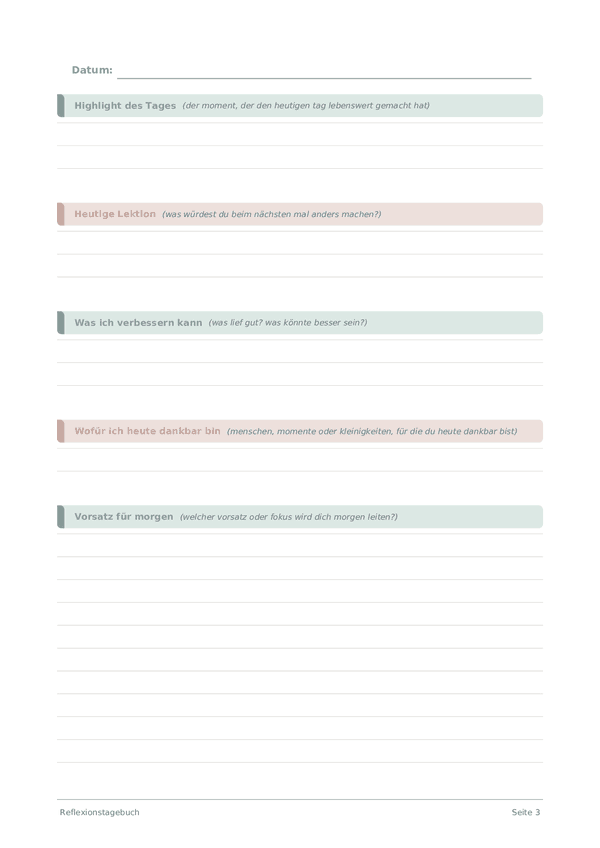
Highlight des Tages
Was war das Beste an Ihrem Tag? Halten Sie den Moment fest, der den heutigen Tag lebenswert gemacht hat. Diese Highlights werden zu einer Sammlung Ihrer schönsten Erinnerungen.
Heutige Lektion
Halten Sie eine Erkenntnis aus den heutigen Erfahrungen fest. Im Laufe der Zeit werden diese Lektionen zu einer persönlichen Weisheitsbibliothek.
Was ich verbessern kann
Identifizieren Sie einen konkreten Bereich, in dem Sie morgen besser sein können. Seien Sie konstruktiv, nicht kritisch — es geht um Wachstum, nicht um Selbstverurteilung.
Wofür ich heute dankbar bin
Listen Sie 1–3 Dinge auf, für die Sie heute dankbar sind. Es kann Großes oder Kleines sein — eine gute Mahlzeit, ein freundliches Wort, Sonnenschein. Dankbarkeitsjournaling gehört zu den wissenschaftlich am besten belegten Praktiken für das Wohlbefinden.
Vorsatz für morgen
Welcher Vorsatz oder Fokus wird dich morgen leiten?
Tipps für den Erfolg
Wann und wie oft schreiben
Write every evening as part of your wind-down routine — 10–15 minutes before bed. Reflection works best when you have the full day to look back on, but you're not yet exhausted. If daily is too much, write at least on Wednesday (mid-week check-in) and Sunday (full-week reflection). Over time, the evening reflection habit becomes a form of self-coaching.
Häufig gestellte Fragen
Was macht diese fünfteilige Struktur wirksam?
Highlight, heutige Lektion, was ich verbessern kann, wofür ich heute dankbar bin, vorsatz für morgen decken zusammen positive Ereignisverstärkung (Bryants Savoring-Forschung, 2003, Journal of Mental Health, 12(2)), Sinnstiftung (Park, 2010, Psychological Bulletin, 136(2)), Dankbarkeit und Umsetzungsintentionen (Gollwitzer, 1999, American Psychologist, 54(7)) ab. Jeder evidenzbasierte Mechanismus erhält einen kurzen Abschnitt und passt in 5–10 Minuten, ohne die Wirkstoffe zu verdünnen.
Wie schreibe ich eine nützliche 'heutige Lektion'?
Wandeln Sie Erfahrung in ein übertragbares Prinzip um, nicht in Selbstkritik. Park (2010, Psychological Bulletin, 136(2)) zur Sinnstiftung und Kolbs Erfahrungslernzyklus behandeln Reflexion beide als Schritt, der Ereignisse in Lernen verwandelt. Eine nützliche Lektion ist ein Satz, der angibt, was Sie nun wissen und morgen anwenden können — nicht 'ich hätte X nicht tun sollen', sondern 'Meetings um 8 Uhr morgens entleeren meinen morgendlichen Fokus'.
Warum gibt es eine 'vorsatz für morgen' Zeile?
Umsetzungsintentionen — Wenn-Dann-Pläne — schließen die Lücke zwischen Wissen und Tun. Gollwitzer (1999, American Psychologist, 54(7)) und Gollwitzer und Sheeran (2006, Advances in Experimental Social Psychology, 38) meta-analysierten 94 Studien, die zeigten, dass mit Situationshinweisen spezifizierte Intentionen Handlungsraten verdoppelten. Zwei Zeilen reichen für eine klare Wenn-Dann-Aussage, keine lange To-do-Liste.
Ist 'was ich verbessern kann' dasselbe wie Selbstkritik?
Nein, und die Unterscheidung ist wichtig. Neff (2011, 'Self-Compassion', William Morrow) zeigte: Selbstmitgefühl korreliert mit Wachstum und Motivation; harte Selbstkritik sagt das Gegenteil voraus. Formulieren Sie die Zeile als konstruktiven nächsten Schritt — was Sie anders machen würden — nicht als moralisches Urteil. Drei Zeilen sollten eine konkrete, umsetzbare Änderung ergeben, keine Liste von Misserfolgen.
Wann sollte ich das machen — wirklich abends?
Tagesende ist konventionell, aber die Forschung ist gemischt. Schlaf konsolidiert emotionale Erinnerungen (Walker, 2009, Annals of the New York Academy of Sciences, 1156); Reflexion vor dem Schlaf kann die Verarbeitung anstoßen. Manche finden Spätabend-Reflexion ruminativ — Trapnell und Campbell (1999, JPSP, 76(2)) unterschieden gesunde Reflexion von Rumination. Wenn Reflexion Sie wachhält, verschieben Sie sie auf den frühen Abend.
Was, wenn mein Tag kein echtes 'highlight' hatte?
Finden Sie ehrlich den kleinsten positiven Moment. Fredricksons Broaden-and-Build-Theorie (2001, American Psychologist, 56(3)) zeigte, dass selbst kleine positive Ereignisse messbare Effekte haben, wenn bemerkt. Bryants Savoring-Forschung legt nahe, dass bewusste Aufmerksamkeit auf Mikropositiva — ein guter Kaffee, ein freundlicher Austausch — die Erkennung positiven Affekts trainiert. Drei Zeilen sind für das Kleine; Sie brauchen kein Spitzenerlebnis.
Wie unterscheidet sich das von einem Dankbarkeitsjournal?
Ein Dankbarkeitsjournal fokussiert auf einen Mechanismus. Das Reflexionsjournal fügt Sinnstiftung, konstruktive Überprüfung und Vorwärtsintention hinzu — einen vollständigeren Tagesendzyklus. Emmons und McCullough (2003, JPSP, 84(2)) etablierten Dankbarkeitseffekte; reflexionsfokussierte Interventionen wie Seligman et al.s 'Best Possible Self' (2005, American Psychologist, 60(5)) wirken über andere, komplementäre Mechanismen.
Wie schnell sollte ich Ergebnisse erwarten?
Seligman et al. (2005, American Psychologist, 60(5)) fanden, dass eine strukturierte positivpsychologische Übung Wohlbefindensänderungen erzeugte, die innerhalb einer Woche erkennbar waren und sechs Monate anhielten. Für Mustererkennung über Tage rechnen Sie mit 2–4 Wochen. Die fünfteilige Struktur ist dicht beladen — tägliche Ausführung über einen Monat ist die Mindestdosis, um zu sehen, ob sie zu Ihnen passt.
Das könnte Ihnen auch gefallen
Scrollen zum Zoomen, ziehen zum Bewegen