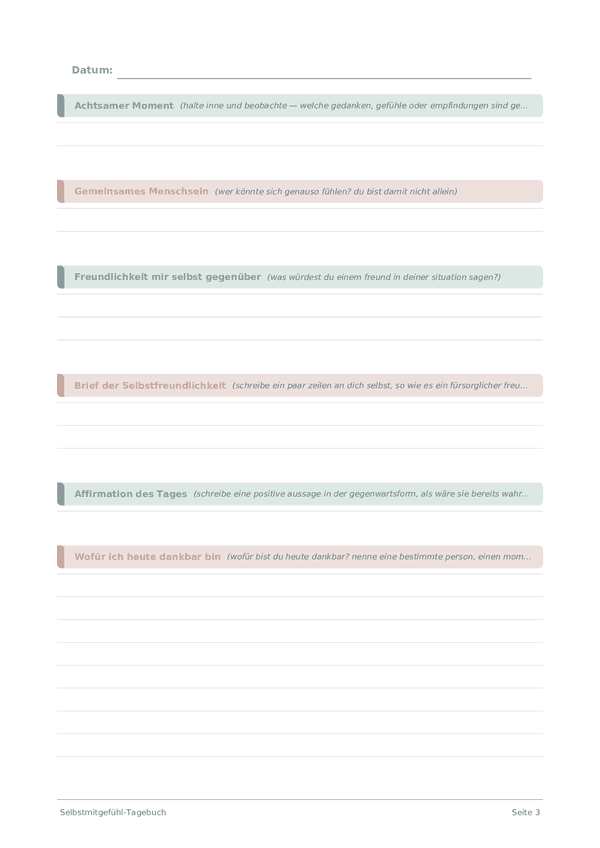
Printable Selbstmitgefühl-Tagebuch
Tägliche Praxis für Selbstmitgefühl und innere Güte
Cultivate genuine self-compassion through Kristin Neff three-pillar practice: mindfulness, common humanity, and self-kindness. Treat yourself with the same warmth and understanding you would offer a dear friend.
Felder anpassen
Schalten Sie Felder ein oder aus. Klicken Sie auf den Stift zum Umbenennen oder fügen Sie eigene Felder hinzu.
Was ist dieses Journal?
A self-compassion journal is a daily practice built on Dr. Kristin Neff's three pillars of self-compassion: mindfulness, common humanity, and self-kindness. Each entry guides you through recognizing suffering without over-identifying with it, remembering that struggle is universally human, and treating yourself with the same warmth you would offer a friend.
This journal is for anyone who tends to be their own harshest critic — perfectionists, overachievers, people-pleasers, and anyone who finds it easier to be compassionate to others than to themselves. It is particularly powerful during periods of failure, loss, or transition.
Research shows that self-compassion is a stronger predictor of mental health than self-esteem. While self-esteem depends on achievement and comparison, self-compassion provides a stable foundation of self-worth regardless of outcomes. Regular self-compassion practice has been shown to reduce cortisol, increase emotional resilience, and decrease symptoms of anxiety and depression.
Ausgefülltes Beispiel
So sieht ein typischer Eintrag aus, wenn er ausgefüllt ist:
Wie Sie jedes Feld ausfüllen
Jeden Tag finden Sie mehrere beschriftete Abschnitte mit Zeilen zum Schreiben. Hier erfahren Sie, wofür jeder Abschnitt gedacht ist:
Achtsamer Moment
Halte inne und beobachte — welche Gedanken, Gefühle oder Empfindungen sind gerade da, ohne zu urteilen?
Gemeinsames Menschsein
Wer könnte sich genauso fühlen? Du bist damit nicht allein
Freundlichkeit mir selbst gegenüber
Schreiben Sie etwas Freundliches an sich selbst, so wie Sie es einem guten Freund sagen würden, der dasselbe durchmacht. Selbstmitgefühl ist eine Fähigkeit, die mit Übung wächst.
Brief der Selbstfreundlichkeit
Schreibe ein paar Zeilen an dich selbst, so wie es ein fürsorglicher Freund tun würde — mit Wärme, Verständnis und Ermutigung
Affirmation des Tages
Schreiben Sie eine positive Aussage über sich selbst in der Gegenwartsform, als wäre sie bereits wahr. Zum Beispiel: 'Ich bin fähig und belastbar.' Das Wiederholen von Affirmationen formt mit der Zeit Ihre Denkmuster um.
Wofür ich heute dankbar bin
Listen Sie 1–3 Dinge auf, für die Sie heute dankbar sind. Es kann Großes oder Kleines sein — eine gute Mahlzeit, ein freundliches Wort, Sonnenschein. Dankbarkeitsjournaling gehört zu den wissenschaftlich am besten belegten Praktiken für das Wohlbefinden.
Tipps für den Erfolg
Wann und wie oft schreiben
Write daily, ideally in the evening when you can reflect on moments of self-criticism from the day. Each entry takes 10 minutes. Focus on one moment of difficulty and walk through the three pillars: mindfulness (acknowledging pain without exaggerating), common humanity (recognizing others share this), and self-kindness (treating yourself gently). After three weeks of daily practice, self-compassion begins to feel less forced and more natural. Review weekly to notice which self-critical patterns are losing their grip.
Häufig gestellte Fragen
Was sind Kristin Neffs drei Säulen des Selbstmitgefühls?
Achtsamkeit, gemeinsame Menschlichkeit und Selbstfreundlichkeit — definiert in Neff (2003, Self and Identity, 2(2)) und entwickelt durch ihre späteren peer-reviewten Arbeiten. Die Abschnitte achtsamer Moment, gemeinsames Menschsein und freundlichkeit mir selbst gegenüber des Journals bilden direkt ab. Neff und Germers Mindful-Self-Compassion-Programm (Neff und Germer, 2013, Journal of Clinical Psychology, 69(1)) zeigte messbare Verbesserungen des Wohlbefindens über ein 8-wöchiges Protokoll mit dieser Struktur.
Was kommt in 'gemeinsames Menschsein'?
Erkenntnis, dass der Kampf, dem Sie gegenüberstehen, Sie mit anderen verbindet, statt zu isolieren. Neff (2003, Self and Identity, 2(2)) identifizierte Isolation als zentrales Hindernis in Selbstkritik — 'nur ich kämpfe damit'. Zwei Zeilen: benennen Sie die Schwierigkeit und geben Sie an, wie sie Teil geteilter menschlicher Erfahrung ist. Dies rahmt Selbstverurteilung als universelles Muster, keinen persönlichen Defekt.
Wie unterscheidet sich 'freundlichkeit mir selbst gegenüber' von Selbstnachsicht?
Neff und Vonk (2009, Journal of Personality, 77(1)) unterschieden Selbstmitgefühl ausdrücklich von Selbstnachsicht — Selbstmitgefühl beinhaltet, sich selbst mit Sorge zu behandeln und gleichzeitig Wachstum zu unterstützen, nicht Schwieriges zu vermeiden. Drei Zeilen sind Raum für Freundlichkeit, die Sie in der Verantwortung hält, keine Erlaubnis zum Disengagement. 'Ich werde heute Abend ausruhen' unterscheidet sich von 'ich überspringe die Frist'.
Was soll der 'brief der Selbstfreundlichkeit' bewirken?
Es ist eine bildbasierte Intervention, adaptiert aus Neff und Germers MSC-Programm (Neff und Germer, 2013, Journal of Clinical Psychology, 69(1)). Drei Zeilen, um an sich selbst zu schreiben, wie Sie an eine/n Freund/in in derselben Situation schreiben würden. Neffs Forschung und Gilberts Compassion-Focused Therapy (Gilbert, 2009, 'The Compassionate Mind', Constable) zeigen beide, dass diese Briefübung selbstkritische Stimme mildert.
Senkt Selbstmitgefühl die Motivation?
Nein — das Gegenteil. Breines und Chen (2012, Personality and Social Psychology Bulletin, 38(9)) fanden: Selbstmitgefühl nach Misserfolg erhöhte die Motivation zur Verbesserung im Vergleich zu Selbstkritik. Selbstmitgefühl bietet die Sicherheit, Fehler anzuerkennen; harte Selbstkritik löst oft Vermeidung aus. Die Struktur des Journals unterstützt wachstumsorientierte Selbstbehandlung, keine Selbstzufriedenheit. Tägliche Einträge über acht Wochen nähern die Dosis aus MSC-Forschung.
Ist das während Depression angemessen?
Oft vorteilhaft, aber nicht heilend. MacBeth und Gumley (2012, Clinical Psychology Review, 32(6)) meta-analysierten Selbstmitgefühl und fanden es konsistent mit geringerer Psychopathologie assoziiert. Neff und Germers MSC-Forschung zeigt Vorteile in subklinischen und klinischen Stichproben. Bei diagnostizierter Depression konsultieren Sie eine/n lizenzierte/n Psychotherapeuten/in — Selbstmitgefühlspraxis ergänzt evidenzbasierte Behandlung, ersetzt sie nicht.
Wie unterscheidet sich das von positivem Denken oder Affirmationen?
Selbstmitgefühl erkennt Schwierigkeit an, statt sie zu übergehen. Neff und Vonk (2009, Journal of Personality, 77(1)) zeigten: Selbstmitgefühl erzeugte stabileres Wohlbefinden als Selbstwert, weil es nicht von positiven Bewertungen abhängt. Der achtsamer Moment-Abschnitt lädt ausdrücklich zum Kontakt mit Schmerz ein; Affirmationspraktiken überspringen ihn oft. Verschiedene Mechanismen, komplementäre Werkzeuge.
Wie lange bis ich Effekte sehe?
Neff und Germer (2013, Journal of Clinical Psychology, 69(1)) nutzten ein 8-wöchiges MSC-Protokoll mit messbaren Wohlbefindensverbesserungen. Tägliche Einträge über diese Spanne nähern sich der Dosis. Selbstkritik ist oft über Jahre gut eingeübt; rechnen Sie früh mit Widerstand und merklichen Verschiebungen nach 4–8 Wochen konsistenter Einträge. Das kompakte sechsteilige Format hält tägliche Ausführung realistisch.
Das könnte Ihnen auch gefallen
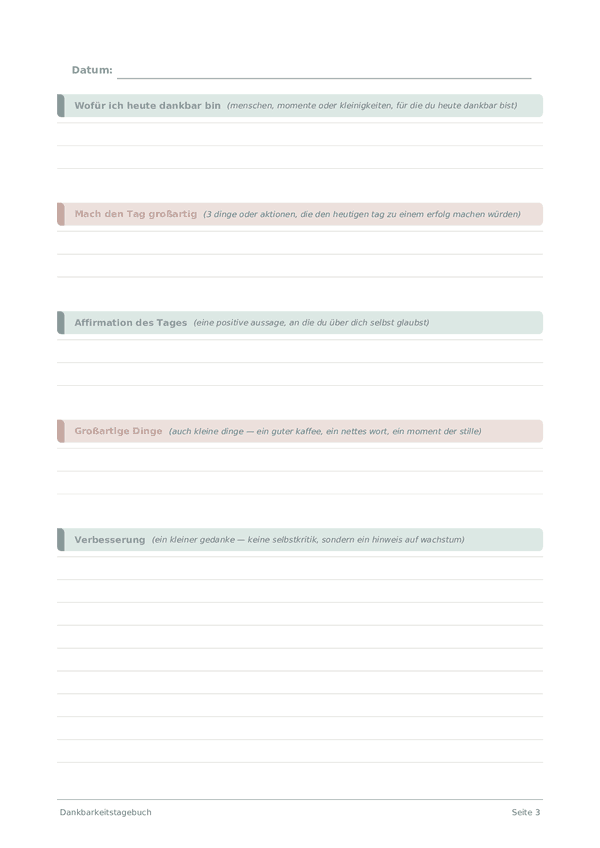
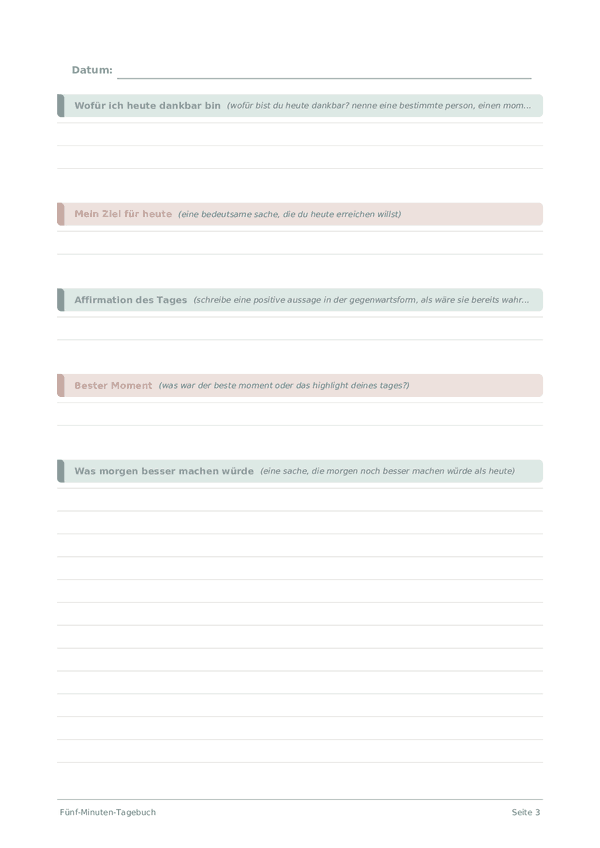
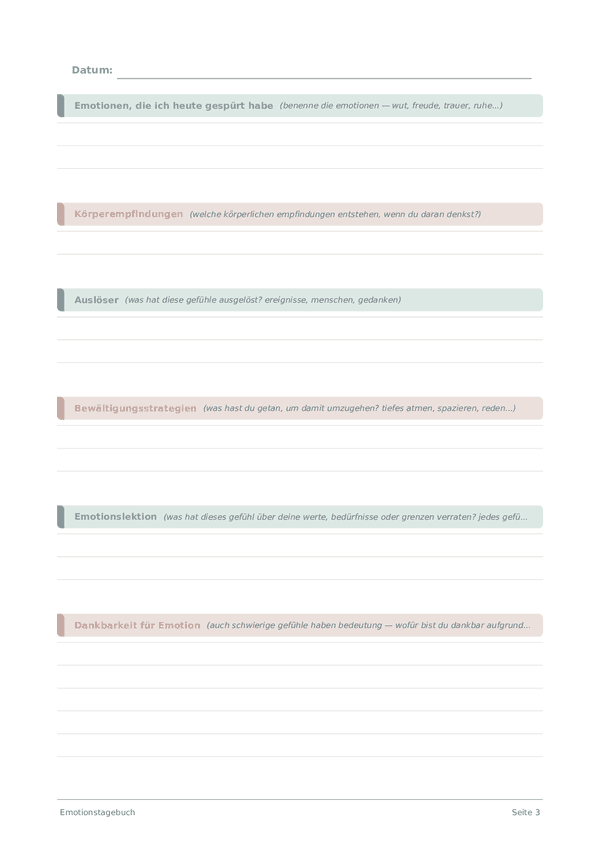
Scrollen zum Zoomen, ziehen zum Bewegen