Printable Therapietagebuch
Maximieren Sie den Nutzen Ihrer Therapiesitzungen
Capture key takeaways from therapy sessions, track homework assignments, and reflect on progress between appointments. A valuable bridge between sessions.
Felder anpassen
Schalten Sie Felder ein oder aus. Klicken Sie auf den Stift zum Umbenennen oder fügen Sie eigene Felder hinzu.
Vorteile
Anleitung
Was ist dieses Journal?
A therapy journal is a guided writing practice designed to complement your therapeutic work. By tracking your mood and anxiety alongside structured reflections on situations, automatic thoughts, and cognitive reframes, you practice the core skills of cognitive behavioral therapy between sessions.
This journal is ideal for anyone currently in therapy or practicing self-guided CBT techniques. It provides a framework for examining the connection between situations, thoughts, and emotional responses — the foundation of most evidence-based therapeutic approaches.
Clinical research consistently shows that clients who journal between therapy sessions make faster progress and retain therapeutic gains longer. Writing down automatic thoughts and practicing reframes strengthens neural pathways for healthier thinking patterns, turning therapeutic insights into lasting cognitive habits.
Ausgefülltes Beispiel
So sieht ein typischer Eintrag aus, wenn er ausgefüllt ist:
Wie Sie jedes Feld ausfüllen
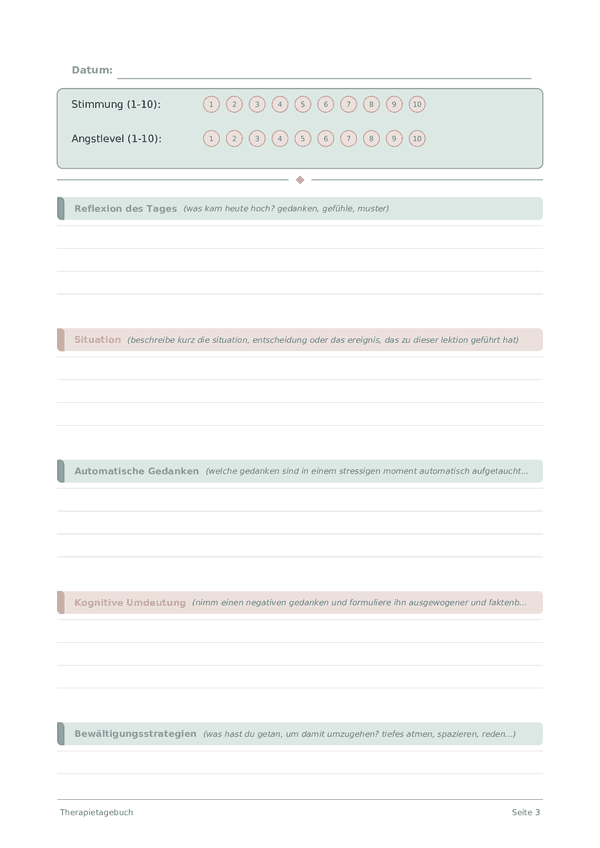
Oben auf jeder Seite befinden sich schnell ausfüllbare Felder (Bewertungen, Kontrollkästchen, Zahlen). Darunter ist ein linierter Bereich zum Schreiben. Hier erfahren Sie, was jedes Feld bedeutet:
Stimmung (1-10)
Bewerten Sie Ihren allgemeinen emotionalen Zustand für den Tag. 1 bedeutet sehr niedergeschlagen oder deprimiert, 10 bedeutet außergewöhnlich glücklich und positiv. Denken Sie nicht zu lange nach — vertrauen Sie Ihrem Bauchgefühl.
Angstlevel (1-10)
Bewerten Sie Ihr Angstniveau heute. Einer Angst eine Zahl zuzuordnen macht das Gefühl handhabbarer und nachverfolgbar.
Reflexion des Tages
Blicken Sie ehrlich auf Ihren Tag zurück. Was lief gut? Was könnte besser sein? Es geht nicht um Urteile — es geht um Lernen und Wachstum.
Situation
Beschreiben Sie die Situation oder das Ereignis objektiv, als wären Sie ein neutraler Beobachter. Fakten von Gefühlen zu trennen hilft Ihnen, die Dinge klarer zu sehen.
Automatische Gedanken
Welche Gedanken sind in einem stressigen Moment automatisch aufgetaucht? Schreibe sie genau so auf, wie sie kamen — auch wenn sie irrational erscheinen
Kognitive Umdeutung
Nimm einen negativen Gedanken und formuliere ihn ausgewogener und faktenbasierter um. Was würde ein weiser Freund sagen?
Bewältigungsstrategien
Was hast du getan, um damit umzugehen? Tiefes Atmen, Spazieren, Reden...
Wofür ich heute dankbar bin
Listen Sie 1–3 Dinge auf, für die Sie heute dankbar sind. Es kann Großes oder Kleines sein — eine gute Mahlzeit, ein freundliches Wort, Sonnenschein. Dankbarkeitsjournaling gehört zu den wissenschaftlich am besten belegten Praktiken für das Wohlbefinden.
Tipps für den Erfolg
Wann und wie oft schreiben
Write after every therapy session while insights are fresh — ideally within 1 hour. Between sessions, use the journal when you notice automatic thoughts or cognitive distortions in daily life. Before your next session, spend 5 minutes reviewing your entries to identify what you want to explore further. This between-session work is what transforms weekly therapy into continuous growth.
Häufig gestellte Fragen
Wie unterstützt dieses Journal Psychotherapie?
Es funktioniert als Hausaufgabe zwischen Sitzungen, eine Praxis, die in KVT, ACT und Schematherapie unterstützt wird. Kazantzis, Whittington und Dattilio (2010, Clinical Psychology: Science and Practice, 17(2)) meta-analysierten Therapie-Hausaufgaben und fanden, dass abgeschlossene Hausaufgaben Ergebnisse verbesserten. Die strukturierten Felder (Situation, automatische Gedanken, kognitive Umdeutung, bewältigungsstrategien) spiegeln Becks tägliches Gedankenprotokoll wider, das in der kognitiven Verhaltenstherapie verwendet wird.
Was kommt in 'automatische Gedanken' versus 'kognitive Umdeutung'?
Automatische Gedanken erfasst die wortgetreuen Gedanken, die in der Situation auftauchten — genau wie sie erschienen. Kognitive Umdeutung ist die umstrukturierte, evidenzausgewogene Alternative. Dies ist die klassische Zwei-Spalten-Technik nach Beck ('Cognitive Therapy and the Emotional Disorders', 1976). Der 10-zeilige Abschnitt gibt Raum für beides. Überspringen Sie den ursprünglichen Gedanken nicht — das Reframing wirkt nur im Kontrast.
Wie bringe ich das produktiv zu meinem/r Therapeuten/in?
Bringen Sie zwei bis vier Wochen Einträge und heben Sie Muster hervor. APA-Leitlinien zur klinischen Praxis und Kazantzis et al. (2010, Clinical Psychology: Science and Practice, 17(2)) empfehlen, dass klientengenerierte Daten die Sitzungsarbeit verankern. Markieren Sie Einträge, in denen das Reframing schwer fiel — dort konzentriert sich wahrscheinlich die Therapiearbeit. Erwarten Sie nicht, dass Therapeut/innen jeden Eintrag lesen; bieten Sie Zusammenfassung plus ausgewählte Details.
Warum sind 'mood' und 'angstlevel (1-10)' die einzigen Tracker-Felder?
Diese zwei Indikatoren decken die häufigsten Therapieziele ab — Depressions- und Angstsymptome — und stimmen konzeptuell mit kurzen klinischen Screenern überein (PHQ-9 für Depression, GAD-7 für Angst). Den Tracker minimal zu halten bewahrt die Hauptfunktion des Journals als sitzungsüberbrückende Reflexion. Fügen Sie bei Bedarf weitere Dimensionen über das Mental-Health-Journal hinzu.
Ist dieses Journal ein Ersatz für Therapie?
Nein. Es ergänzt, ersetzt aber keine Psychotherapie. APA-, NIMH- und WHO-Mental-Health-Leitlinien behandeln Psychotherapie als klinische Intervention, die ausgebildete Anbieter erfordert. Das Journal ist ein Werkzeug, um Therapieeffekte zwischen Sitzungen zu verlängern — Aufgetauchtes zu erfassen, Techniken wie kognitives Reframing zu üben — unter Anleitung einer/s lizenzierten Psychotherapeuten/in — dieses Journal ersetzt keine Psychotherapie.
Was, wenn ich derzeit nicht in Therapie bin?
Das Journal hat dennoch Selbsthilfewert, aber seien Sie sich seiner Grenzen bewusst. Cuijpers et al. (2010, Clinical Psychology Review, 30(1)) überprüften Selbsthilfe-KVT und fanden kleinere, aber reale Effekte im Vergleich zu therapeutengeführter KVT. Die kognitive Umstrukturierungssequenz ist allein nutzbar. Wenn Sie sich an demselben Inhalt festfahren oder Distress sich verschlechtert, konsultieren Sie eine/n lizenzierte/n Kliniker/in.
Wie ehrlich sollte ich im Journal sein?
So ehrlich wie möglich — selektive Einträge reduzieren seinen therapeutischen Wert. Pennebaker (1997, Psychological Science, 8(3)) zum expressiven Schreiben zeigte, dass Vorteile mit emotionalem Engagement skalierten. Wenn Sie befürchten, dass jemand es liest, lagern Sie es sicher oder verwenden Sie einen privaten Code. Für andere bearbeitetes Journaling vereitelt die kognitive Verarbeitung, die Nutzen erzeugt.
Wie oft sollte ich zwischen Sitzungen schreiben?
Streben Sie zwei bis vier Einträge zwischen wöchentlichen Sitzungen an. Täglich kann ermüden; weniger als wöchentlich verliert Schwung. Kazantzis et al. (2016, Cognitive Therapy and Research, 40(6)) fanden moderates Hausaufgabenengagement (mehrere Einträge wöchentlich) optimal — zu wenig und Effekte verschwinden, zu viel und Qualität sinkt. Fragen Sie Ihre/n Therapeuten/in nach einer Zielkadenz.
Das könnte Ihnen auch gefallen
Scrollen zum Zoomen, ziehen zum Bewegen