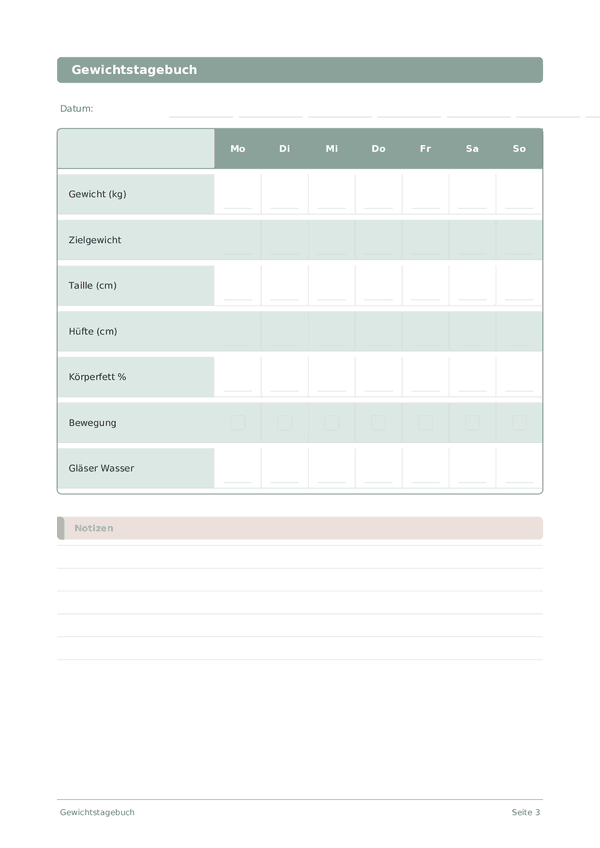
Printable Gewichtstagebuch
Körpermaße verfolgen und Gewichtsziele erreichen
Monitor weight, waist measurements, exercise, and water intake in a weekly grid. See trends that help you stay on course toward your body composition goals.
Felder anpassen
Schalten Sie Felder ein oder aus. Klicken Sie auf den Stift zum Umbenennen oder fügen Sie eigene Felder hinzu.
Vorteile
Anleitung
Was ist dieses Journal?
A weight journal is a weekly tracker where you record your body weight alongside related measurements — body fat percentage, waist and hip circumference — as well as daily habits like exercise and water intake. By capturing these numbers consistently over time, you build a clear, objective picture of your body composition changes that goes far beyond what the scale alone can tell you.
This journal is for anyone with a body composition goal: people looking to lose weight, gain muscle, or maintain their current physique. It is equally useful for those who have struggled with inconsistent tracking or who feel discouraged by day-to-day weight fluctuations and want a more balanced, data-driven perspective on their progress.
Daily weight can swing by a kilogram or more due to water retention, meal timing, and other factors that have nothing to do with actual fat loss or gain. A weight journal helps you see through this noise by showing weekly trends and correlations. When you notice that your waist measurement is decreasing even though the scale hasn't moved, you know your body composition is improving. Tracking exercise and water intake alongside your measurements reveals which habits most strongly correlate with the results you want.
Ausgefülltes Beispiel
So sieht ein typischer Eintrag aus, wenn er ausgefüllt ist:
| Mon | Tue | Wed | Thu | Fri | Sat | Sun | |
|---|---|---|---|---|---|---|---|
| Gewicht (kg) | 82.4 | 82.1 | 82.6 | 82 | 81.8 | 82.2 | 81.5 |
| Zielgewicht | 79 | 79 | 79 | 79 | 79 | 79 | 79 |
| Taille (cm) | 88 | 88 | 87.5 | ||||
| Hüfte (cm) | 101 | 101 | 100.5 | ||||
| Körperfett % | 22.1 | 22 | 21.8 | ||||
| Bewegung | ✓ | ✓ | ✓ | ✓ | |||
| Gläser Wasser | 8 | 6 | 9 | 8 | 7 | 10 | 8 |
Wie Sie jedes Feld ausfüllen
Jede Seite ist ein Wochenraster. Die Zeilen sind Ihre Tracking-Elemente, die Spalten sind die Wochentage. Hier erfahren Sie, was jedes Element bedeutet:
Gewicht (kg)
Notieren Sie Ihr Gewicht, wenn Sie es verfolgen. Wiegen Sie sich jeden Tag zur gleichen Zeit für konsistente Daten. Konzentrieren Sie sich auf wöchentliche Trends, nicht auf tägliche Schwankungen.
Zielgewicht
Taille (cm)
Messen Sie Ihren Taillenumfang. Zuverlässiger als das Gewicht allein spiegelt der Taillenumfang tatsächliche Veränderungen der Körperzusammensetzung wider.
Hüfte (cm)
Körperfett %
Bewegung
Haken Sie ab, ob Sie heute Sport gemacht haben. Selbst ein 10-minütiger Spaziergang zählt. Das Ziel ist es, ein Bewusstsein für Ihre Aktivitätsmuster zu entwickeln.
Gläser Wasser
Verfolgen Sie Ihre tägliche Wasseraufnahme. Die meisten Menschen benötigen 6–8 Gläser. Das Abhaken der Gläser im Laufe des Tages hilft Ihnen, ausreichend hydriert zu bleiben.
Tipps für den Erfolg
Wann und wie oft schreiben
Step on the scale every morning under the same conditions for the most reliable trend data. Record the number without judgment — it is just data. At the end of each week, calculate and log your 7-day average weight. Compare weekly averages, not daily readings, to determine real progress. Monthly, take body measurements (waist, hips, chest) to capture changes the scale misses. A rate of 0.5–1% body weight change per week is sustainable in either direction.
Häufig gestellte Fragen
Warum erfasst das Tagebuch Taille und Hüfte neben dem Gewicht?
Die American Heart Association (2022, Circulation, 146(5)) und WHO sehen den Taillenumfang als stärkeren Prädiktor kardiometabolischen Risikos als Gewicht allein — viszerales Fett zählt mehr als Gesamtmasse. NIH NIDDK stuft Taille >102 cm (Männer) oder >88 cm (Frauen) als erhöhtes Risiko ein. Taille und Hüfte zeigen zudem Veränderungen der Körperzusammensetzung bei stabilem Gewicht, hilfreich in Rekompositionsphasen, wenn Muskel Fett ersetzt.
Wie oft sollte ich mich tatsächlich wiegen?
Täglich, zur gleichen Zeit nach dem Toilettengang und vor dem Essen, laut Mayo Clinic und Forschung in Obesity (2015, 23(11)), die zeigt, dass tägliches Wiegen die langfristige Gewichtshaltung verbessert. Daten der Obesity-Zeitschrift belegen, dass der Fokus auf den 7-Tage-gleitenden Mittelwert — nicht auf einzelne Tage — Enttäuschung über normale 1–2-kg-Schwankungen durch Hydration, Natrium und Glykogen verhindert.
Welche Gewichtsverlustrate ist sicher anzustreben?
CDC und USPSTF (2022, JAMA, 328(11)) empfehlen 0,5–1 kg pro Woche — ein Defizit von etwa 250–500 kcal/Tag. Schnellerer Verlust erhöht Muskelverlust und Rückprallrisiko. ADA Standards of Care (2024, Diabetes Care, 47 Suppl 1) merken an, dass bereits 5–10% Körpergewichtsreduktion Blutdruck, Blutzuckerkontrolle und Lipide bedeutsam verbessern. Wöchentliche Trends in der Gewichtsspalte sind die richtige Kennzahl, nicht Einzelmessungen.
Warum den Körperfettanteil messen und wie genau ist die Heim-Schätzung?
Der Körperfettanteil spiegelt die Zusammensetzung besser wider als der BMI. NIH NHLBI stuft >25% Körperfett (Männer) bzw. >32% (Frauen) als erhöhtes Risiko ein. Bioimpedanz-Waagen haben laut NEJM-Geräte-Evaluierungen einen Fehler von ±3–8% und hängen stark vom Hydrationszustand ab. Nutzen Sie die körperfett %-Spalte für monatliche Trends, nicht für tägliche Präzision. DEXA ist der klinische Referenzstandard, aber für Tracking unnötig — Konsistenz der Methode zählt am meisten.
Ist tägliches Wiegen sicher bei Essstörungsrisiko?
Oft nicht. APA und Academy for Eating Disorders raten von täglichem Wiegen bei Personen mit Anorexie, Bulimie, Binge-Eating-Störung oder Orthorexie ab. Gewichtsschwankungen können restriktives Verhalten auslösen. Bei entsprechender Vorgeschichte konsultieren Sie eine Fachperson und konzentrieren Sie sich auf die Trainings-Checkbox und Wasser-Spalte. Gewicht ist ein Datenpunkt, kein Maß des Selbstwerts.
Wie hängen Hydrations- und Trainings-Tracking mit Gewichtsänderungen zusammen?
Hydration beeinflusst das Waagengewicht täglich um 1–2 kg — nicht getrunkenes Wasser bläht das scheinbare Gewicht auf und gleicht sich später aus. American Journal of Clinical Nutrition (2010, 91(3)) zeigt, dass Wasser vor Mahlzeiten die Kalorienaufnahme reduziert. Bewegung erhält Muskelmasse im Kaloriendefizit, laut ACSM. Wasser- und Trainings-Spalten erklären zusammen ~30% des täglichen Gewichtsrauschens und helfen, echten Fortschritt von temporären Schwankungen zu trennen.
Wann sollte ich wegen Gewichtsveränderungen zum Arzt?
Red-Flag-Hinweise von Mayo Clinic und NIH NIDDK: unbeabsichtigter Verlust von 5% Körpergewicht in 6–12 Monaten, rasche Zunahme von 2+ kg pro Woche oder Gewichtsveränderungen begleitet von Müdigkeit, Appetitveränderungen oder anderen Symptomen erfordern ärztliche Abklärung. Schilddrüse, Diabetes und Herz-Kreislauf-Erkrankungen manifestieren sich über Gewichtsänderungen. Bringen Sie 4+ Wochen an Tagebuchdaten zum Termin für ein klareres klinisches Bild.
Wie lange bis ich aussagekräftige Trends sehe?
Etwa 3–4 Wochen. Obesity-Forschung zeigt, dass tägliche Varianz von ±1–2 kg normal ist; statistisch belastbare Trends benötigen mindestens drei volle Wochenzyklen, um Natrium-, hormonelles und darmbedingtes Rauschen herauszufiltern. Das Wochenraster der Vorlage ist genau dafür konzipiert — berechnen Sie Montag-bis-Sonntag-Durchschnitte, statt sich auf einzelne Tage zu fixieren. Muster im Taillenumfang zeigen sich oft vor Gewichtsänderungen.
Das könnte Ihnen auch gefallen
Scrollen zum Zoomen, ziehen zum Bewegen