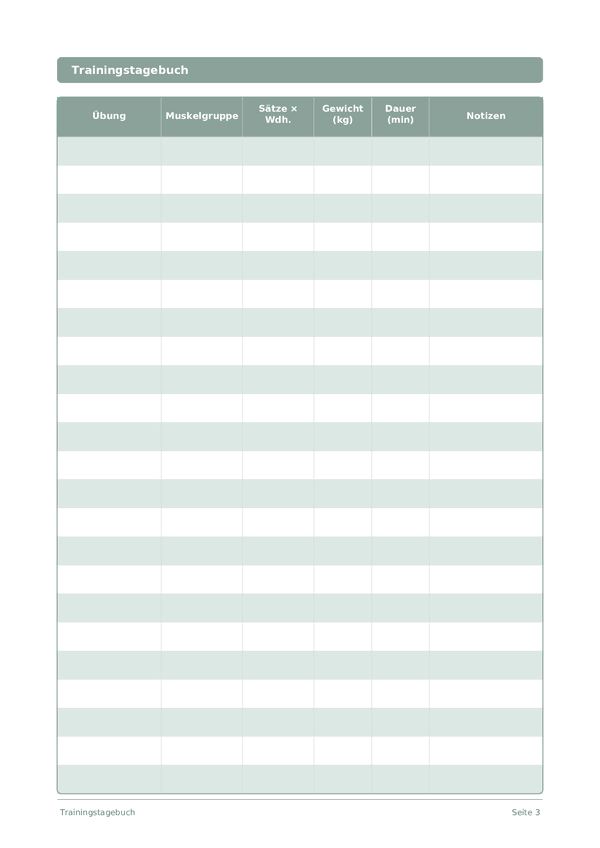
Printable Trainingstagebuch
Jeden Satz, jede Wiederholung und jedes Gewicht erfassen — Ihren Kraftzuwachs sehen
A structured workout log that helps you record exercises, sets, reps, weights, and duration for each training session. Built for gym-goers and home athletes alike, this journal keeps your progress visible and your motivation high.
Felder anpassen
Schalten Sie Felder ein oder aus. Klicken Sie auf den Stift zum Umbenennen oder fügen Sie eigene Felder hinzu.
Vorteile
Anleitung
Was ist dieses Journal?
A workout journal is a structured training log where you record every exercise you perform — the type, target muscle group, sets, reps, weights, and duration. It serves as both a detailed record of what you did and a planning tool for progressive overload, helping you ensure that your training is moving forward rather than staying stagnant.
This journal is designed for anyone who exercises regularly and wants to train with intention, from gym beginners learning proper programming to experienced lifters tracking periodization cycles. It is equally valuable for people doing bodyweight training, group fitness classes, or rehabilitation exercises — any physical activity where tracking progress leads to better outcomes.
The difference between people who make consistent progress in the gym and those who plateau often comes down to one thing: tracking. When you write down that you bench pressed 60 kg for 3 sets of 8 reps, you know that next session you should aim for 3 sets of 9 or increase the weight. Without a journal, most people repeat the same weights and reps for months without realizing it. Your workout journal transforms each session from an isolated event into part of a coherent, progressive plan.
Ausgefülltes Beispiel
So sieht ein typischer Eintrag aus, wenn er ausgefüllt ist:
| Übung | Muskelgruppe | Sätze × Wdh. | Gewicht (kg) | Dauer (min) | Notizen |
|---|---|---|---|---|---|
| Barbell Back Squat | Legs / Glutes | 4 x 8 | 80 | 12 | Warm-up: 2x10 at 40kg. Depth was good on all sets. |
| Romanian Deadlift | Hamstrings / Lower Back | 3 x 10 | 60 | 10 | Focused on slow eccentric. Felt stretch in hamstrings. |
| Leg Press | Quads | 3 x 12 | 140 | 8 | Feet placed high and wide |
| Walking Lunges | Legs / Glutes | 3 x 12 each leg | 16 | 8 | Dumbbells, 8kg each hand |
| Leg Curl Machine | Hamstrings | 3 x 12 | 35 | 6 | Last 2 reps were tough |
| Calf Raises (Standing) | Calves | 4 x 15 | 50 | 6 | Full range of motion, 2-sec pause at top |
| Plank | Core | 3 x 60 sec | 0 | 5 | Finished with 3 sets of planks for core stability |
Wie Sie jedes Feld ausfüllen
Jede Seite ist eine Tabelle mit Spalten. Füllen Sie pro Eintrag eine Zeile aus. Hier erfahren Sie, wofür jede Spalte gedacht ist:
Übung
Schreiben Sie auf, welche Art von Training Sie gemacht haben (z. B. Laufen, Yoga, Krafttraining). Abwechslung ist wichtig — das Verfolgen hilft, ein ausgewogenes Programm sicherzustellen.
Muskelgruppe
Brust, Rücken, Beine, Schultern, Arme, Core...
Sätze × Wdh.
Notieren Sie Sätze und Wiederholungen (z. B. 3×12). Dies ist Ihr Krafttrainingsprotokoll — progressive Überlastung wird im Laufe der Zeit sichtbar.
Gewicht (kg)
Notieren Sie Ihr Gewicht, wenn Sie es verfolgen. Wiegen Sie sich jeden Tag zur gleichen Zeit für konsistente Daten. Konzentrieren Sie sich auf wöchentliche Trends, nicht auf tägliche Schwankungen.
Dauer (min)
Notieren Sie, wie lange Sie in Minuten trainiert oder geübt haben. Die Dauer zu verfolgen hilft Ihnen, Ihr Engagement wachsen zu sehen und Ihre optimale Sitzungslänge zu finden.
Notizen
Fügen Sie zusätzlichen Kontext oder Gedanken hinzu. Diese Auffangspalte ist für alles, was nirgendwo anders hinpasst, aber später nützlich sein könnte.
Tipps für den Erfolg
Wann und wie oft schreiben
Log every workout in the table format immediately during or after your session: exercise name, sets, reps, weight, and rest periods. On rest days, note recovery activities (stretching, foam rolling, walking) and how your body feels. Weekly, review your training log to ensure progressive overload is happening and no muscle group is neglected. Every 4-6 weeks, compare your current numbers to your starting point — this is where real motivation lives. Deload weeks should also be logged to track how recovery affects subsequent performance.
Häufig gestellte Fragen
Was ist progressive Überlastung und wie tracke ich sie hier?
Progressive Überlastung — das schrittweise Erhöhen des Trainingsreizes — ist laut ACSM und British Journal of Sports Medicine (2022, 56(13)) der fundamentale Treiber für Kraft und Hypertrophie. Verfolgen Sie sie über die Spalten weight und sätze × Wdh.: streben Sie 1–2,5 kg oder eine Wiederholung mehr pro Einheit bei derselben Übung an. Überprüfen Sie monatliche Trends pro Bewegung. Plateaus signalisieren nötige Entlastungswochen oder Programmwechsel.
Wie viele Sätze und Wiederholungen pro Übung?
ACSM (2009, Medicine & Science in Sports & Exercise, 41(3)) und der ISSN-Konsens empfehlen: 3–5 Sätze à 5–8 Wiederholungen bei 75–85% 1RM für Kraft; 3–4 Sätze à 8–12 Wiederholungen bei 65–75% für Hypertrophie; 2–3 Sätze à 12–20 Wiederholungen für Ausdauer. Loggen Sie alle Sätze in der sätze × Wdh.-Spalte (z.B. '4x8'). Das wöchentliche Gesamtvolumen pro Muskelgruppe — Sätze mal Wiederholungen mal Gewicht — treibt die Anpassung mehr als jede einzelne Einheit.
Warum das Körpergewicht oben auf jeder Seite eintragen?
Das Körpergewicht als Kontext interpretiert Kraftveränderungen — Kraftzuwachs bei Gewichtsverlust deutet auf echte Leistungsverbesserung hin, während Kraftzuwächse bei Gewichtszunahme teils die Masse spiegeln können. ACSM und Sports-Medicine-Reviews betonen das Tracken beider. Das körpergewicht (kg)-Feld in der Seitenkopfzeile liefert eine wöchentliche Momentaufnahme ohne tägliche Wiegungen, nützlich in Definitions-, Aufbau- oder Erhaltungsphasen.
Wie tracke ich Übungen wie Klimmzüge oder Liegestütze ohne Zusatzgewicht?
Tragen Sie 0 in die Gewichtsspalte ein und nutzen Sie das Körpergewicht aus der Seitenkopfzeile als Kontext. ACSM akzeptiert Körpergewichtsprogression durch erhöhte Wiederholungen, Sätze oder Tempo. Bei gewichteten Varianten (z.B. Klimmzüge mit Zusatzgewicht) tragen Sie nur das zusätzliche Gewicht ein. Die Notizspalte kann Annahmen zur Körpergewichtsbelastung präzisieren. Verfolgen Sie den Fortschritt über Wiederholungen und Gesamtvolumen, nicht nur über Gewicht.
Wie unterscheidet sich das von Apps wie Strong, Jefit oder Hevy?
Apps automatisieren Berechnungen und Pausen-Timer; Papiertagebücher fördern Reflexion und bewusste Planung. NIH NCCIH (2022) zeigt: handschriftliche Programmierung verbessert Adhärenz und Selbstwahrnehmung. Die Notizspalte erfasst qualitative Daten — Ermüdungsgrad, Technik-Cues, Gelenkfeedback —, die Apps oft verwerfen. Viele Kraftsportler nutzen beides: App für In-Session-Logging, Tagebuch für Wochenplanung und Programm-Review.
Wie oft sollte ich Übungen rotieren oder mein Programm ändern?
ACSM empfiehlt Programmwechsel alle 4–8 Wochen zur Stagnationsvermeidung. Die Notizspalte ist der richtige Ort, um Übungen zu markieren, bei denen die Progression 2–3 Einheiten in Folge stagniert. Sports Medicine (2018, 48(4)) schlägt Entlastungswochen (50–70% Volumen) alle 4–8 Wochen vor zur Ermüdungssteuerung. Verfolgen Sie die Sitzungsdauer neben dem Gewicht, um steigende Ermüdungskosten pro Workout zu erkennen.
Wie sollten Anfänger dieses Tagebuch nutzen?
Laut ACSM-Anfängerleitlinien konzentrieren Sie sich auf 2–3 Ganzkörper-Einheiten pro Woche mit 6–8 Verbundübungen. Loggen Sie in den ersten 8–12 Wochen jeden Satz, um Technikbewusstsein und Progressions-Baseline aufzubauen. NIH NIA merkt an, dass Krafttraining das Gesamtmortalitätsrisiko senkt; Konsistenz zählt anfangs mehr als Intensität. Nutzen Sie die Notizspalte für Technik-Cues von Trainer oder Video.
Welche Anzeichen deuten auf Übertraining hin?
Red Flags des British Journal of Sports Medicine (2013, 47(8)) und ACSM: Leistungsabfall über 2+ Wochen, anhaltender Muskelkater über 72 Stunden, Schlafstörungen, erhöhter Ruhepuls in der Frühphase, Stimmungsabfall, häufige leichte Erkrankungen und nachlassende Trainingsmotivation. Verfolgen Sie diese in der Notizspalte und vergleichen Sie mit den letzten 4 Wochen. Erholung erfordert typischerweise 1–2 Wochen bei 50–70% Volumen, nicht völlige Ruhe. Konsultieren Sie eine Sportmedizinerin bei anhaltenden Symptomen oder Auftreten von Brustschmerzen.
Das könnte Ihnen auch gefallen
Scrollen zum Zoomen, ziehen zum Bewegen