Printable Bullet Journal
Structured daily log for rapid logging
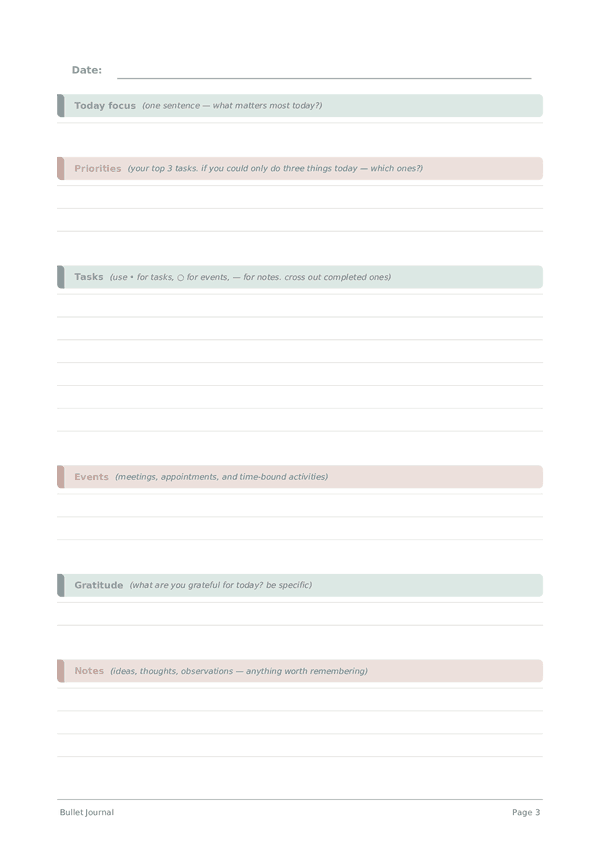
A structured daily spread based on the Bullet Journal method. Each page includes sections for focus, priorities, tasks, events, gratitude, and notes — everything you need for productive rapid logging.
Customize fields
Toggle fields on or off. Click the pencil to rename, or add your own fields.
Benefits
How to Use
What is this journal?
A bullet journal is a rapid-logging system that combines task management, event tracking, and personal reflection in one streamlined daily entry. Using short, focused bullet points, you capture priorities, tasks, events, and thoughts without the pressure of writing full paragraphs.
This journal is for people who think in lists and bullet points — organizers, planners, and anyone who wants the benefits of journaling with the efficiency of a to-do list. Inspired by Ryder Carroll's Bullet Journal method, this digital adaptation preserves the core principles of rapid logging and intentional organization.
The bullet journal method has gained millions of practitioners because it bridges the gap between planning and reflecting. Research on task management shows that writing down tasks increases completion rates by 33%, while the gratitude and notes sections add the reflective depth that transforms a planner into a genuine journal. It is productivity and mindfulness in one practice.
Filled example
Here's what a typical entry looks like when filled in:
How to fill in each field
Each day you'll find several labeled sections with lines for writing. Here's what each section is for:
Today focus
One sentence — what matters most today?
Priorities
Your top 3 tasks. If you could only do three things today — which ones?
Tasks
Use • for tasks, ○ for events, — for notes. Cross out completed ones
Events
Meetings, appointments, and time-bound activities
Gratitude
What are you grateful for today? Name one specific person, moment, or thing
Notes
Add any additional context or thoughts. This catch-all column is for anything that doesn't fit elsewhere but might be useful later.
Tips for success
When and how often to write
Set up your daily spread each morning in 2\u20133 minutes: write the date, list your priorities and tasks, and note any scheduled events. Throughout the day, log tasks, events, and notes as they happen using rapid logging. Each evening, spend 3 minutes reviewing: migrate unfinished tasks, check off completions, and add a line of gratitude or reflection. Weekly, review your week and set up the next. This morning-evening-weekly rhythm is the heartbeat of the bullet journal method.
Frequently Asked Questions
What is rapid logging and how does this daily spread support it?
Rapid logging is the core Bullet Journal technique: short, bulleted entries using simple notation — bullets for tasks, circles for events, dashes for notes. This spread provides six dedicated sections (focus, priorities, tasks, events, gratitude, notes) so you capture information quickly without losing structure. The result is a single page that works as task list, calendar, and notebook at once.
How is this layout different from a blank Bullet Journal notebook?
Original BuJo requires drawing your own daily spread, which takes 5-10 minutes per page. This template pre-prints the six core sections — today's focus (1 line), priorities (3 lines), tasks (7 lines), events (3 lines), gratitude (2 lines), notes (5 lines) — so you keep the method's clarity without the setup overhead. Useful when consistency matters more than aesthetic customization.
Why limit priorities to three and tasks to seven lines?
The three-priority constraint forces ruthless selection of high-leverage work — a principle in Greg McKeown's Essentialism (Crown Business, 2014) and Stephen Covey's 7 Habits of Highly Effective People (Free Press, 1989). Seven task lines hold the day's smaller items without inviting bloat. Together they reproduce the Eisenhower Matrix sort: important-and-urgent at the top, the rest below.
How does task migration work with this template?
Cross out completed tasks. For unfinished ones, draw an arrow (>) and rewrite them on the next day's spread — this is the BuJo migration technique. Reviewing what keeps getting migrated reveals tasks that aren't truly urgent or important. David Allen's Getting Things Done (Penguin, 2001; revised 2015) uses a similar weekly review principle: unfinished items either get done, dropped, or deferred consciously.
Is the gratitude section necessary, or can I skip it?
It's optional, but worth keeping. Two-line gratitude is one of the most replicated positive-psychology interventions, and pairing it with a productivity spread balances output-focus with meaning-focus. Skipping it occasionally is fine; abandoning it entirely turns the page into a pure to-do list, which loses the original BuJo intention of mindful self-tracking alongside task management.
How long does daily rapid logging take with this template?
Filling all six sections typically takes 5-10 minutes in the morning and 3-5 minutes for evening review. The pre-printed structure removes setup time entirely. BJ Fogg's Tiny Habits (2019) suggests anchoring the practice to an existing routine — coffee, commute, bedtime — for sustainability. Skipping the daily review is the most common failure point; the spread loses value when entries pile up unprocessed.
Who is this Bullet Journal template best suited for?
People who like the BuJo method but find drawing daily spreads tedious, plus those new to the system who want structure before customization. Heavy customizers who treat their journal as an art project may prefer blank dotted notebooks. The pre-printed sections suit task-heavy days, freelance work, and anyone moving from digital task apps back to paper for focus reasons.
Can I combine this with a separate weekly or monthly planner?
Yes — that's actually how the original Bullet Journal method works. The daily spread captures execution; weekly and monthly logs capture planning and review. David Allen's Getting Things Done (Penguin, 2001; revised 2015) uses similar nested horizons: daily action items roll up into projects and goals. Use this daily template for the next 24 hours, a separate review tool for longer horizons.
You Might Also Like
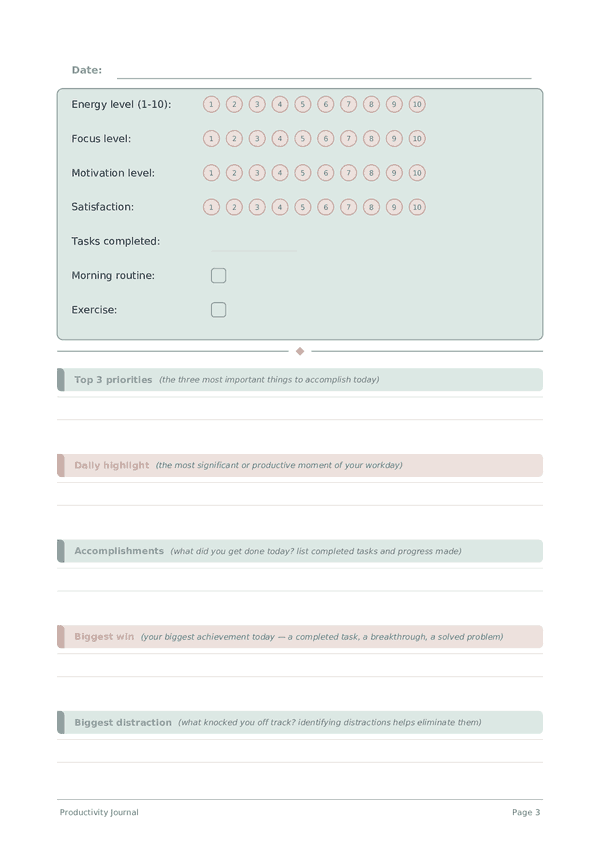
Productivity Journal
Track energy, focus, and daily output to build peak performance habits
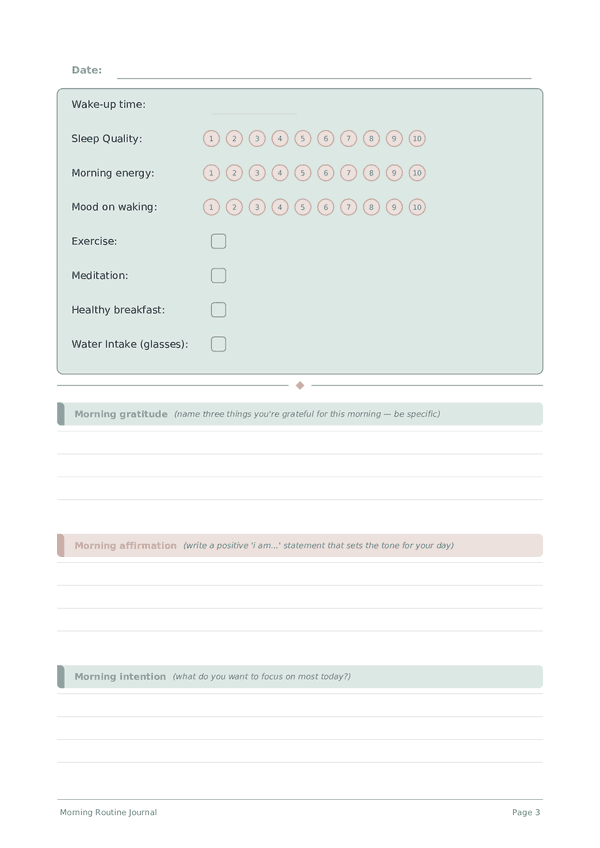
Morning Routine Journal
Start every day with clarity, gratitude, and intention
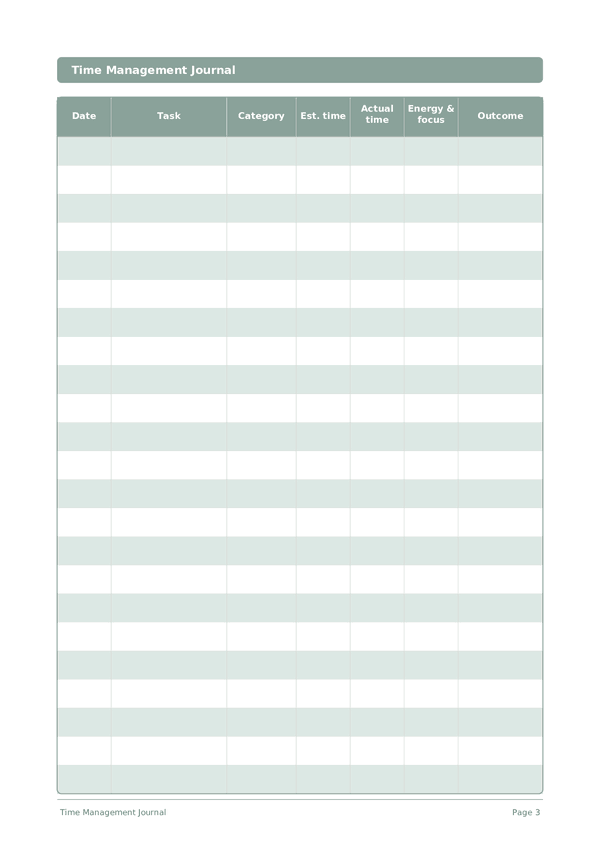
Time Management Journal
Track tasks, time, and energy to reclaim your day
Decision Journal
Think clearly, decide confidently, learn from every choice
Scroll to zoom, drag to move